
XMAN-F1
In stock
- 상표:
- KEENON
- ORIGIN:
- 중국
- AVAILABILITY:
- SUBJECT TO AVAILABILITY
- SKU:
- KEENON-XMAN-F1
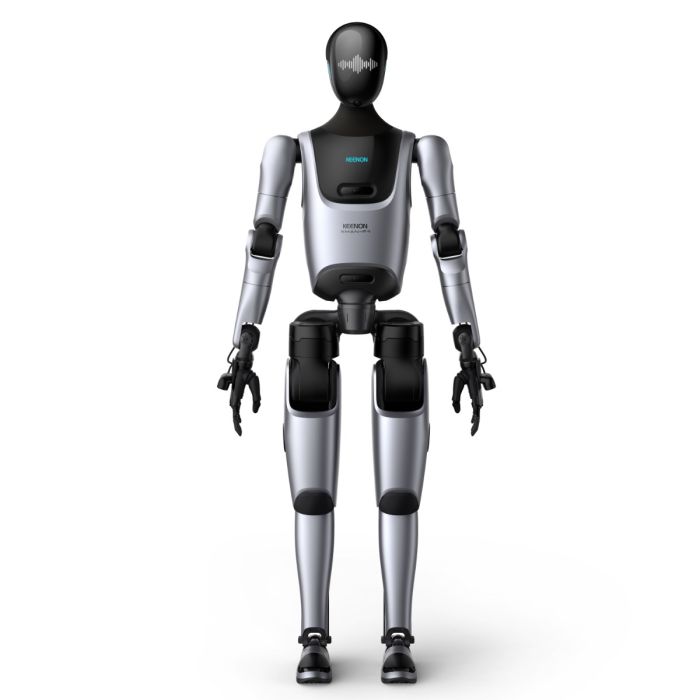
XMAN-F1: Keenon Humanoid's Role-Based Embodied Intelligence Platform
The XMAN-F1's commercial context is shaped by its parent company's established position. KEENON Robotics holds 22.7 percent of global commercial service robot shipments and 40.4 percent of the food delivery robot market, according to IDC's latest data reported at WAIC 2025. The XMAN-F1 enters a market where KEENON already has more than 100,000 commercial robots deployed across more than 60 countries, customer relationships across restaurants, hotels, hospitals, and aged care facilities, and the accumulated operational data that only sustained commercial deployment provides.
The "General-Purpose Plus Special-Purpose" Architecture
A Commercial Innovation, Not Just a Technical One
The most commercially significant aspect of the XMAN-F1 is not its specifications but its deployment architecture. KEENON describes its approach as "General-Purpose + Special-Purpose" robot collaboration, a framework that was explicitly validated with a specific flagship deployment: the Shangri-La Traders Hotel at Shanghai Hongqiao Airport.
The October 31, 2025 PRNewswire announcement of this deployment describes it in direct terms: "The hotel has not only become one staffed by humanoid robot servers but also establishes the world's first smart scenario model demonstrating collaborative operations between 'General-Purpose + Special-Purpose' robots." The announcement characterizes this model as "the concentration of Keenon's years of commercial scenario data accumulation and technological development."
The architecture works as follows: general-purpose humanoid robots (the XMAN-R1 and XMAN-F1) handle the humanoid interaction and dexterous manipulation tasks that require a human-proportioned body and human-interface physical capabilities. Special-purpose robots (the T10, M104, S100, and other platform-specific KEENON robots) handle the logistics, transport, delivery, and specialized process tasks that purpose-built robots execute more efficiently and reliably than a general-purpose humanoid.
This is not a compromise or a workaround for a humanoid that cannot perform all tasks. It is a deliberate commercial design philosophy: allocate each task category to the platform most efficient and reliable for that specific task, and coordinate the platforms through KEENON's fleet management system.
Why This Architecture Matters for Commercial Buyers
For commercial buyers evaluating humanoid robots, the General-Purpose + Special-Purpose architecture resolves the most common objection to humanoid investment: the concern that a single humanoid robot cannot reliably execute the full range of tasks that justify its cost.
A hotel that already operates DINERBOT T10 delivery robots, KLEENBOT C30 or C40 cleaning robots, and potentially a BUTLERBOT W3 hotel service robot already has KEENON's fleet management infrastructure installed. Adding an XMAN-F1 to this existing fleet is an incremental augmentation of a known system rather than a wholesale replacement requiring new infrastructure investment. The XMAN-F1's fleet management integration connects with the existing robots' operational coordination, with each platform receiving appropriate task assignments from the central management system.
The Keenon Humanoid Brand and Wang Yongtang's Vision
A Dedicated Humanoid Division
The Keenon Humanoid brand represents KEENON's recognition that humanoid robots require a distinct commercial and product development identity from the company's established wheeled service robot business. Wang Yongtang as CEO of Keenon Humanoid provides the brand with dedicated leadership focused specifically on the humanoid product roadmap rather than dividing executive attention across the full KEENON product portfolio.
The brand's stated mission, "Embodied Intelligence, Changing Life," frames humanoid robots not as industrial automation tools but as life-changing technologies integrated into human social and service environments. The phrase "Changing Life" rather than "Improving Efficiency" reflects a commercial positioning that prioritizes the quality and naturalness of human-robot integration over measurable productivity metrics alone. Wang's emphasis on "role-based and scenario-specific approaches to integrate robots into human society" is a direct rejection of the general-purpose-first philosophy that characterizes much of the humanoid robot industry's promotional framing.
The XMAN-F1 and the XMAN-R1: Understanding Both Platforms
The Two-Platform XMAN Family
The XMAN family currently comprises the XMAN-R1 and XMAN-F1, introduced approximately four months apart in 2025.
The XMAN-R1 (introduced March 31, 2025) was deployed at the Shangri-La Traders Hotel in October 2025, where it was described as working "alongside other KEENON robots, such as the DINERBOT T10, KLEENBOT C30, and KEENON S100." This deployment was the validation event for the General-Purpose + Special-Purpose model at a globally recognized luxury hotel brand.
The XMAN-F1 (world premiered July 26, 2025 at WAIC 2025) was presented specifically as the role-specific embodied AI demonstration platform, showcasing the F1's capabilities across three distinct service scenarios. The F1 had been deployed in commercial catering, retail, and medical settings prior to the WAIC public premiere.
The relationship between R1 and F1 within the XMAN family is not fully specified in KEENON's public materials as of mid-2026, but their sequential introduction suggests they may address different form factor, capability, or price tier requirements within KEENON Humanoid's product roadmap.
Role-Specific AI: The Design Philosophy in Detail
What "Role-Specific" Actually Means
KEENON's title for the WAIC 2025 XMAN-F1 press release was explicit: "KEENON Debuts First Bipedal Humanoid Service Robot at WAIC, Showcasing Role-Specific Embodied AI Solutions." The emphasis on role-specific is a design philosophy with direct commercial implications.
A role-specific humanoid robot is trained and optimized for the full capability requirements of defined service roles, such as a lounge bar beverage specialist, a medical supply runner, or a retail product demonstration host, rather than trained to perform any task at a mediocre level. This approach accepts a narrower task scope in exchange for higher reliability and performance within that scope.
The lounge bar demonstration at WAIC 2025 illustrated this specifically. Mixing beverages with adjustable ice levels, understanding customer preferences through natural language, and executing the physical task sequence of pouring and serving is a complete service role. The XMAN-F1 was not demonstrating that it can sometimes, under ideal conditions, mix a drink. It was demonstrating operational role proficiency: the ability to execute this service role reliably in a real-world environment with real visitors.
Futunn's documentation of the F1's capabilities extends this: "robust human-robot interaction capabilities, allowing it to understand human language and body gestures, thereby facilitating natural and smooth dialogue and collaboration." Understanding body gestures in addition to language is a multimodal interaction capability that goes beyond voice-command interfaces, enabling the robot to respond to natural human communication including pointing, gesturing, and non-verbal cues that service interactions routinely involve.
The WAIC 2025 Demonstration: Three Roles, Not Three Features
The choice to present the XMAN-F1 in three complete scenario environments rather than as a single demonstration is itself a statement of the role-specific philosophy. KEENON did not demonstrate the F1 performing multiple tasks sequentially in a single generic environment. They created three distinct, immersive role environments: a medical station, a lounge bar, and a performance space, each representing a different deployment vertical.
This presentation format communicates that the XMAN-F1 is not a general-purpose robot that happens to work in these scenarios. It is a platform designed to adopt specific roles comprehensively, including the environmental context, the task sequence, the interaction style, and the coordination with supporting systems that each role requires.
Commercial Context and Current Deployment Status
Already Deployed Before the Public Premiere
Futunn's coverage of the Keenon Humanoid brand launch event confirmed a commercially significant detail: "Currently, the XMAN-F1 has been deployed in multiple scenarios, including catering, retail, and medical settings, providing users with efficient services."
This pre-premiere deployment status means the XMAN-F1's WAIC appearance was not the introduction of an experimental prototype to potential customers. It was the public announcement of a robot already operating in commercial environments. This distinction matters for buyers evaluating humanoid robots: the XMAN-F1's demonstration at WAIC was not the robot's first encounter with real-world service conditions.
The Shangri-La Hotel Validation
The Shangri-La Traders Hotel deployment, confirmed by KEENON's October 31, 2025 PRNewswire announcement, provided the most visible validation of KEENON's humanoid strategy in a globally recognized luxury hospitality context. The deployment of the XMAN-R1 at this property, working alongside the T10, KLEENBOT C30, and S100, "signifies that embodied intelligence is now practically enhancing hotel operational quality and guest stay experience," per the official announcement.
For international hospitality buyers, the Shangri-La brand carries procurement-grade credibility. A technology deployment at a Shangri-La property in an international airport hotel environment signals that the technology met Shangri-La's operational standards, which include some of the most demanding guest experience and reliability requirements in the global hospitality industry.
Advantages and Benefits
Role-based optimization delivering real service task proficiency: The XMAN-F1's role-specific design means its performance within defined service roles, such as beverage service and medical supply logistics, is optimized rather than generalized, enabling commercial buyers to specify the exact scenarios the robot will handle and evaluate performance against those specific requirements.
Pre-deployment commercial validation in catering, retail, and medical settings: The robot was operating in commercial settings before its WAIC public premiere, providing buyers with evidence of deployment-grade readiness rather than prototype-grade demonstration capability.
General-Purpose + Special-Purpose ecosystem architecture leveraging existing KEENON fleet installations: For operators already running KEENON robots, the XMAN-F1 augments a known and tested system with humanoid capability rather than requiring fresh infrastructure investment.
Wang Yongtang's dedicated leadership of Keenon Humanoid: The dedicated brand and CEO structure provides the XMAN product line with focused strategic leadership and a clear brand identity distinct from KEENON's wheeled service robot portfolio.
Understanding of human language and body gestures: The multimodal interaction capability enabling response to non-verbal as well as verbal human communication supports genuinely natural service interactions beyond voice-command interfaces.
Summary
The KEENON XMAN-F1 represents the embodiment of Wang Yongtang's "Embodied Intelligence, Changing Life" vision and the "General-Purpose + Special-Purpose" collaboration framework that the Shangri-La Traders Hotel deployment validated commercially in October 2025. As a role-specific embodied AI platform deployed in catering, retail, and medical settings before its WAIC 2025 public premiere, the XMAN-F1 demonstrates KEENON Humanoid's commitment to commercial task performance over demonstrational novelty. For buyers evaluating humanoid service robots, the XMAN-F1 is the platform built by the company with more commercial service robot deployment experience than any competitor, designed for the specific service roles where KEENON's operational data gives it the clearest understanding of what genuine performance in real environments requires.
Frequently Asked Questions (FAQ)
Who is Wang Yongtang and what is his role in the XMAN-F1?
Wang Yongtang is the CEO of Keenon Humanoid, the dedicated humanoid robot brand that KEENON Robotics established in 2025 to develop and commercialize the XMAN product family. At the Keenon Humanoid brand launch event in Shanghai, Wang articulated the brand's founding philosophy: "Embodied Intelligence, Changing Life," describing a commitment to "role-based and scenario-specific approaches to integrate robots into human society." His leadership of the dedicated humanoid brand provides focused strategic direction for the XMAN-F1 and subsequent XMAN products, separate from KEENON's broader wheeled service robot portfolio management.
What is the General-Purpose + Special-Purpose robot collaboration model?
The General-Purpose + Special-Purpose model is KEENON's deployment architecture for humanoid service robots, formalized through the Shangri-La Traders Hotel deployment in October 2025, which KEENON described as "the world's first smart scenario model demonstrating collaborative operations between 'General-Purpose + Special-Purpose' robots." General-purpose robots (XMAN humanoids) perform the dexterous manipulation and human-facing interaction tasks that require a humanoid form. Special-purpose robots (T10, M104, S100, KLEENBOT, BUTLERBOT) perform the logistics, delivery, cleaning, and specialized process tasks they are optimized for. KEENON's fleet management system coordinates both types within a unified operational framework.
How does the XMAN-F1 understand human communication?
The XMAN-F1 understands both human language and body gestures, according to Futunn's documentation of the Keenon Humanoid brand launch. This multimodal interaction capability allows the robot to respond to natural human communication including verbal requests, pointing, gesturing, and non-verbal cues, rather than being limited to specific voice commands or structured inputs. This capability was demonstrated at WAIC 2025 when visitors specified beverage preferences, including drink type (Sprite or Coke) and ice level, in natural conversational interactions with the robot.
What is the difference between the XMAN-R1 and XMAN-F1?
Both the XMAN-R1 (introduced March 31, 2025) and XMAN-F1 (world premiered July 26, 2025) are bipedal humanoid service robots in KEENON's XMAN family. The XMAN-R1 was the first to be commercially deployed, with the Shangri-La Traders Hotel deployment in October 2025 documented as the flagship reference case for the General-Purpose + Special-Purpose collaboration model. The XMAN-F1 was premiered at WAIC 2025 with demonstrations across three service scenarios (medical station, lounge bar, performance space) and was confirmed to have been deployed in catering, retail, and medical settings prior to the public premiere. The specific technical differentiation between the R1 and F1 had not been fully detailed in publicly available English-language documentation as of mid-2026.