
DINERBOT T8
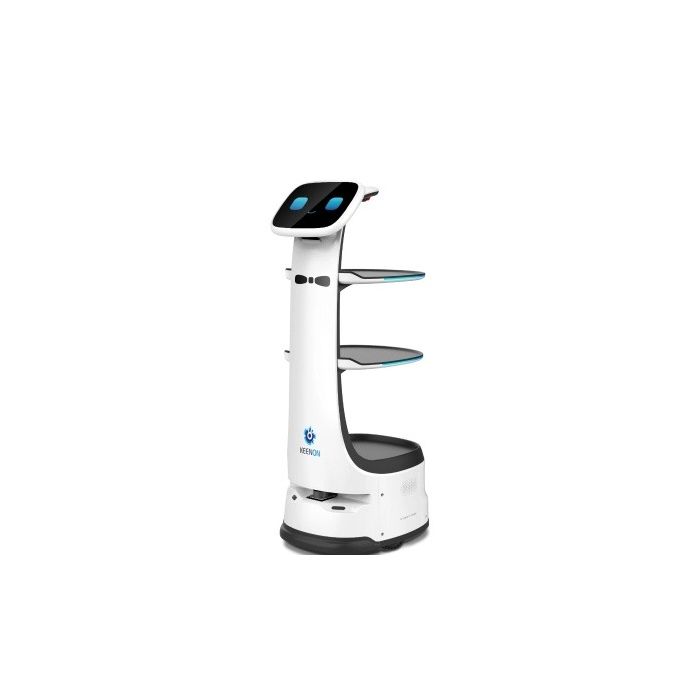
In stock
- TATAK:
- KEENON
- ORIGIN:
- China
- AVAILABILITY:
- SUBJECT TO AVAILABILITY
- SKU:
- KEENON-T8
DINERBOT T8: Design Award, Ten Expressions, and the Case for Charm in Service Automation
Commercially, the T8 sits at the intersection of two specific requirements that no other current DINERBOT model satisfies simultaneously: 55-centimeter minimum passage capability for venues where wider robots cannot operate, and award-validated design quality appropriate for venues where visual and interpersonal charm are part of the value proposition. FOODtech Japan 2022 was the T8's Japanese market debut, where KEENON introduced it to the Japanese market alongside distributor partner SGST Co., Ltd. The T8 won the Japan Good Design Award the following year in 2023. In May 2024, it was exhibited at the National Restaurant Association Show in Chicago alongside the T9, T9 Pro, T10, T3, and BUTLERBOT W3, confirming its place in KEENON's complete US market lineup.
The Emotional Design Philosophy: Ten Expressions and a Charming Voice
What the Good Design Award Actually Recognized
The Japan Good Design Award, managed by the Japan Institute of Design Promotion, has evaluated products since 1957. Its evaluation criteria extend beyond visual aesthetics to functional design quality, usability, safety, environmental consideration, and the product's contribution to users and society. Products that earn the G Mark have been determined by an expert judging committee to represent genuine design excellence in their category.
The committee's commentary on the T8, translated and published in KEENON's official award announcement, is specific about what earned the recognition: "In an era witnessing evolving needs and a shortage of service industry workers, the DINERBOT T8 achieves a delicate balance, exuding charm and emitting a pleasant voice while dutifully fulfilling its tasks. Its approach is delightful and inviting. This exceptional fusion of functionality and charm holds paramount significance, catering to the diverse needs of a broad audience and underscoring its pivotal role."
This language is unusual for industrial design award commentary on a service robot. "Exuding charm," "delightful and inviting," and "fusion of functionality and charm" describe a product that succeeded specifically on the emotional dimension of design, not only the functional one. The committee recognized that a delivery robot operating in a dining room is not merely a machine executing a task but a presence interacting with diners, and that the quality of that interaction matters to the dining experience.
The T8's ten unique expressions displayed on its screen are the specific design feature that enables this emotional quality. Rather than a static face or a simple status indicator, the T8 can display ten distinct emotional expressions that change contextually during operation: a greeting expression when approaching a table, a delivery completion expression when a customer collects their food, an expression of concern when navigating around an obstacle, and others calibrated to the specific moments of a restaurant service interaction.
The Voice System
The T8's voice system is described in KEENON's official documentation and award materials as "emitting a pleasant voice," with language support for English, Japanese, Korean, Thai, German, Arabic, and other languages. The voice quality is described specifically as pleasant rather than merely functional, reflecting the same design philosophy as the expression system: in a dining room environment where the robot's audible presence affects the ambiance, the tone and warmth of the voice matter beyond simple intelligibility.
For restaurant operators in Japan, where customer service interaction quality standards are among the highest in the global hospitality industry, the T8's pleasant voice and expressive face address the cultural expectation that service interactions, even from a robot, should be warm and engaging rather than mechanically transactional.
The Japanese Market Context: FOODtech Japan to G Mark
FOODtech Japan 2022: The T8's Japanese Debut
The DINERBOT T8 was introduced to the Japanese market at FOODtech Japan 2022, held in Tokyo in December 2022, at which KEENON exhibited alongside new Japanese distribution partner SGST Co., Ltd. FOODtech Japan is a leading B2B trade show specifically focused on food factory automation, smart restaurant, and kitchen technologies, attended by food manufacturers and restaurant operators from across Japan.
The timing and venue of the T8's Japanese introduction were commercially deliberate. Japan faces one of the world's most severe service industry labor shortages among advanced economies, with the restaurant and hospitality sector particularly affected by demographic aging that is reducing the available workforce faster than immigration or productivity improvements can compensate. FOODtech Japan 2022 was described by its organizers as "committed to providing solutions to the growing challenges facing the industry, such as labor shortages," and the T8's narrow-body design for the tight spaces of Japanese restaurant floor plans was precisely the product profile that Japanese restaurant operators were evaluating at this event.
The Japan Good Design Award followed in 2023, one year after the FOODtech Japan debut, confirming that the Japanese design and engineering community recognized the T8's design quality as genuinely excellent rather than merely commercially promoted.
The Dual Award Year: T8 and T9 Pro in 2023
An important context for understanding the T8's Japan Good Design Award is that the same year's award cycle also honored the DINERBOT T9 Pro with a GOOD DESIGN® award from The Chicago Athenaeum: Museum of Architecture and Design, a separate American design award. KEENON's NRA Show 2024 press release describes this: "DINERBOT T9 Pro, which has been crowned with 2023 GOOD DESIGN® by The Chicago Athenaeum: Museum of Architecture and Design."
This dual recognition, with the T9 Pro winning the American GOOD DESIGN award and the T8 winning the Japanese Good Design Award in the same year, demonstrates that KEENON was simultaneously investing in design quality across its product lineup rather than concentrating on a single flagship product. It also suggests that the design criteria emphasized by each awards program may reflect cultural differences in what constitutes excellent design: the Japanese G Mark committee's emphasis on charm, emotional presence, and appropriateness to everyday life scenarios aligns with Japanese hospitality culture; the American GOOD DESIGN evaluation may have weighted different design qualities in the T9 Pro.
The Labor Shortage Context: Why the T8's Deployment Timing Matters
The Global Restaurant Staffing Crisis
The timing of the T8's major market entries, FOODtech Japan 2022, Japan Good Design Award 2023, NRA Show 2024 US debut, and Restaurant Asia 2024, corresponds precisely with the period of most acute global restaurant staffing shortages since the post-COVID workforce restructuring of 2021 and 2022 removed millions of hospitality workers from the sector permanently.
US Bureau of Labor Statistics data for 2023 and 2024 showed restaurant employment failing to fully recover to pre-pandemic levels in many regions despite higher wage offers. Japan's demographic trajectory projects a 40 percent decline in the working-age population over the coming decades. European markets in Germany, France, and the UK reported unprecedented difficulty filling food service positions at competitive wages.
This context is why KEENON's Good Design Award committee commentary specifically mentioned "an era witnessing evolving needs and a shortage of service industry workers" as the design challenge the T8 responds to. The T8 is not positioned as a cost reduction tool primarily but as a workforce augmentation solution that enables restaurants to maintain service coverage without expanding headcount, or to redeploy existing staff from transport tasks to customer interaction tasks.
The ROI Case for Boutique Venues
The T8's specific economic value proposition for boutique restaurants differs from the T9's case for high-volume restaurants. A 40-cover boutique café or bistro with 55-centimeter aisle widths may have two or three service staff covering the full floor during peak periods. Adding a T8 or two T8 units to the service team allows those staff to focus on table-side interaction, wine service, and upselling while the robots handle the physical transport of dishes from kitchen to table.
The boutique venue ROI case is more about service quality enhancement and staff redeployment than pure labor cost substitution. When a server is not walking to and from the kitchen 15 to 20 times per hour for dish delivery, they are available for the customer interaction that drives higher check averages, better review scores, and repeat visits. The T8's charm and expressiveness contribute to this redeployment value: a robot that diners find pleasant to interact with becomes a positive conversation point in the dining experience rather than an intrusive industrial object.
Product Design and Technical Specifications
Physical Characteristics
Body width: 38.4 centimeters. Dimensions: 38.4 by 46.8 by 111.1 centimeters. Weight: 34 kilograms. Minimum passage width: 55 centimeters. Speed: 0.1 to 1.2 meters per second, adjustable. Load capacity: 20 kilograms. Battery: 13 to 16 hours depending on operating conditions, with some specifications confirming up to 15 hours. Minimum turning diameter: 65 centimeters. Service life: 20,000 hours.
The 2+1 Binocular Vision and Glass Detection System
The T8's obstacle avoidance uses a 2+1 binocular vision system providing 204-degree dynamic real-time obstacle detection. The "2+1" designation refers to two forward stereo cameras providing depth perception in the primary travel direction plus one additional sensor covering an offset zone, together achieving 204 degrees of continuous 3D coverage. The system detects obstacles under 5 centimeters in height, including the glass partition bases, wine wall glass, and decorative glass elements common in boutique dining rooms that standard LiDAR scanning at higher elevation misses.
Multi-Sensor SLAM Navigation
The T8's navigation fuses data from LiDAR, encoders, gyroscopes (IMU), image modules, UWB, and lidarodom into a unified SLAM positioning system. This multi-sensor fusion provides positioning robustness in the varied optical and spatial environments of narrow dining rooms, where glass surfaces, mirrors, and variable lighting challenge simpler single-sensor navigation systems.
Multi-Robot Fleet Coordination
Up to 10 T8 units can operate simultaneously in coordinated fleet mode under KEENON's multi-robot dispatching system. For larger venues that have adopted the T8 despite narrow aisles, such as a large izakaya with multiple narrow service corridors, coordinating five to ten T8 units through the dispatching system provides the throughput of a substantially larger single-robot operation.
Advantages and Benefits
The only DINERBOT with ten interactive facial expressions: No other model in the DINERBOT lineup matches the T8's emotional expressiveness, making it the appropriate choice for venues where the robot's interpersonal presence in the dining room is part of the customer experience design.
Japan Good Design Award 2023: Independent expert recognition from a 67-year-old design evaluation institution that evaluated the T8's combination of functionality and emotional charm as meeting the G Mark standard.
55-centimeter passage for venues excluding wider competitors: Opens the T8 to the full population of restaurants in buildings designed for human-scale narrow spaces, without requiring any floor plan modification.
15-hour battery for coverage from breakfast through late service: The full-day endurance eliminates the recharging interruption that would otherwise require manual staff involvement.
Pleasant multi-language voice for global deployment: English, Japanese, Korean, Thai, German, Arabic, and additional language support enables direct deployment across KEENON's international distribution network without language-specific hardware variations.
Summary
The DINERBOT T8 is the robot waiter that the Japanese Good Design Award committee specifically recognized for the quality that differentiates it from purely functional automation: a combination of charm, emotional expressiveness through ten facial expressions, pleasant voice, and visually inviting design that integrates into the dining experience rather than merely interrupting it with logistical efficiency. For boutique restaurants, intimate dining venues, and service-sensitive hospitality environments where the robot shares the floor with diners who are paying for an experience as much as a meal, the T8's design-award validation answers the adoption question that purely technical specifications leave open: does this robot belong here? According to Japan's oldest and most respected design recognition institution, it does.
Frequently Asked Questions (FAQ)
What is the DINERBOT T8's Japan Good Design Award?
The Japan Good Design Award (G Mark) is one of the world's most respected industrial design recognition programs, operated by the Japan Institute of Design Promotion since 1957. The DINERBOT T8 received the 2023 G Mark specifically for its combination of functional design excellence and emotional quality in the service robot category. The judging committee recognized the T8 for "exuding charm and emitting a pleasant voice while dutifully fulfilling its tasks" and described its approach as "delightful and inviting." This recognition distinguishes the T8 from purely functional robots in the delivery category, validating its design quality for operators considering it for premium or intimate dining environments.
How many expressions does the DINERBOT T8 display?
The DINERBOT T8 displays ten unique expressions on its screen during service interactions. These expressions change contextually throughout the robot's operation, providing diners with visual emotional cues appropriate to different moments of the service interaction such as approaching a table, completing a delivery, or responding to a customer. This ten-expression system is unique within the DINERBOT lineup and is one of the features specifically recognized by the 2023 Japan Good Design Award committee, which described the T8's "fusion of functionality and charm" as a key design achievement.
When was the DINERBOT T8 introduced to major markets?
The DINERBOT T8 was introduced to the Japanese market at FOODtech Japan 2022 in Tokyo in December 2022, alongside Keenon's Japanese distribution partner SGST Co., Ltd. It won the Japan Good Design Award in 2023. In May 2024, it was exhibited at the National Restaurant Association Show in Chicago, confirming its active US market presence. In June 2024, it was highlighted at Restaurant Asia 2024 as "the award-winning, compact T8 recognized at the 2023 Japan Good Design Awards." This three-year exhibition track record across Japanese, American, and Asian food service industry events establishes the T8 as a consistent and globally distributed product rather than a niche platform.
How does the DINERBOT T8 compare to the T11 for narrow-aisle restaurants?
Both the T8 and T11 serve narrow-aisle venues, but with different strengths. The T11 navigates to 49 centimeters (versus the T8's 55 cm) and adds a 18.5-inch advertising screen and five-sensor VSLAM navigation. The T8's advantages are its ten facial expressions and 2023 Japan Good Design Award-validated aesthetic quality, creating a warmer emotional presence in intimate dining environments; its three-year deployment track record since FOODtech Japan 2022; and potentially lower acquisition cost. For venues with aisles of 55 centimeters or wider where charm and visual quality matter more than advertising capability, the T8 is the more appropriate choice. For venues with aisles under 55 centimeters, only the T11 can operate.
What language support does the DINERBOT T8 provide?
The DINERBOT T8 supports multiple languages for voice interaction including English, Japanese, Korean, Thai, German, Arabic, and additional languages. This multi-language support enables the T8 to be deployed across KEENON's international distribution network in North America, Europe, Japan, Korea, Southeast Asia, and the Middle East without language-specific hardware variants. For venues serving international guests, the T8 can interact with diners in their preferred language, which is particularly relevant in international hotel restaurants, tourist-area cafes, and venues near major airports and transit hubs.
Specifications
- Dimensions(WxDxH): 38.4x46.8x111.1cm (15.12"x18.43"x43.74")
- Weight: 34kg (74.96lbs)
- Max. Moving Speed: 1.0m/s (3.28ft/s)
- Battery Life*: Up to 15h
- Charging Time**: 4h
- Slope Angle: 5°
- Total Load Capacity: 20 kg (44 lbs)
- Minimum Passage Width: 55 cm (21.65")