
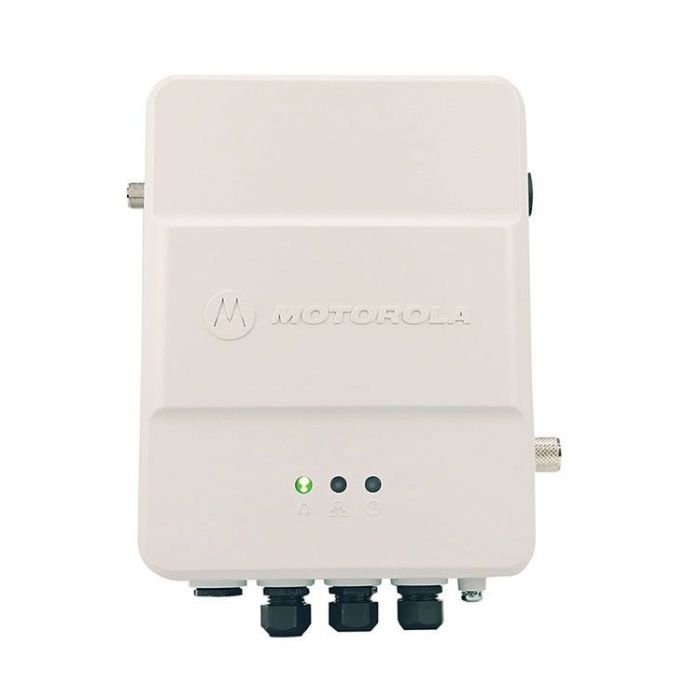
MOTOROLA MOTOTRBO SLR1000 Repeater (SLR1000)
In stock
- PHẦN #:
- SLR1000
- AVAILABILITY:
- SUBJECT TO AVAILABILITY
- SKU:
- MOTOROLA-SLR1000
MOTOROLA MOTOTRBO SLR1000 Repeater (SLR1000)
MOTOTRBO SLR1000 Repeater (SLR1000)
At the platform level, Motorola’s official specification sheets list the SLR 1000 in both VHF 136–174 MHz and UHF 400–527 MHz versions, with 64-channel capacity, 1–10 watts RF output power, and support for both digital and analog operation. The repeater is intended for organizations that want professional-grade MOTOTRBO infrastructure in places where a larger repeater may be harder to install or unnecessary.
What makes the SLR 1000 especially distinctive within the MOTOTRBO repeater family is its combination of compact size, IP65 protection, fanless low-power design, and support for multiple MOTOTRBO architectures. Motorola describes it as a repeater that can be deployed on campuses, in parking structures, and in other indoor or outdoor locations where environmental exposure and installation flexibility matter.
Design and Features
Compact Form Factor
Motorola’s official data sheet lists the SLR 1000 at approximately 279 x 229 x 102 mm and 4.54 kg (10 lb), making it dramatically smaller than many conventional infrastructure repeaters. That compact enclosure is one of the product’s central selling points, because it allows deployment in wall-mounted, pole-mounted, and other constrained installation scenarios where a large telecom rack is not ideal.
Indoor and Outdoor Deployment
A defining feature of the SLR 1000 is its IP65 rating for dust and water protection. Motorola’s brochure explicitly contrasts it with traditional repeaters and says the unit can be deployed in outdoor settings such as campuses and parking garages as well as indoor environments. The quick start guide likewise describes the repeater as rugged and suitable for locations where moisture and dust may be common.
Low-Power, Fanless Design
Motorola emphasizes the SLR 1000’s low-power, fanless design as a practical advantage. This matters for several reasons: it reduces noise, minimizes moving parts, lowers energy use, and can simplify installation in smaller or more exposed locations. Motorola specifically says the design uses less space and energy, which supports its role as a flexible coverage-extension product rather than a heavy central-site repeater.
System Expansion Without Complexity
The SLR 1000 is designed not just as a standalone signal booster but as a repeater that can expand with a customer’s wider MOTOTRBO system. Dealer and Motorola materials indicate support from analog operation through digital systems and on up to more advanced network architectures. In practical terms, that means the SLR 1000 can serve smaller installations today and still remain useful as the broader radio system evolves.
Technology and Specifications
Frequency Bands and Power
Motorola’s official specifications list the SLR 1000 in these main ranges:
- VHF: 136–174 MHz
- UHF: 400–527 MHz
- RF output power: 1–10 W
- Channel capacity: 64
- Frequency stability: 0.5 ppm
This places the SLR 1000 in a different category from high-power 50W or 100W repeaters such as the SLR 5000 and SLR 8000 lines. Its goal is not maximum site power, but practical, space-efficient coverage improvement in targeted areas. That is an inference based on Motorola’s published specifications and product positioning.
Electrical and Physical Specifications
Motorola lists the repeater as operating on 12 V DC (11.0–15.5 V), with current figures of about 0.7 A standby and 3 A typical when transmitting at 10W. These modest power requirements reinforce the SLR 1000’s role as a low-power infrastructure option that can be easier to deploy in nontraditional locations.
Supported System Types
Motorola’s documentation and mirrored spec sheets indicate support for a broad set of MOTOTRBO architectures, including Digital Conventional, IP Site Connect, Capacity Plus (single-site and multi-site), Capacity Max, Analogue Conventional, and MPT 1327. This makes the SLR 1000 much more than a basic repeater; it can participate in scalable digital radio systems rather than remaining isolated as a one-off extension device.
Receiver and Operating Performance
The detailed spec information surfaced in the official-style data sheets includes 0.22 µV sensitivity figures for both 12 dB SINAD and 5% BER, along with performance metrics for selectivity, intermodulation rejection, and spurious rejection. Those are professional repeater-grade figures and help explain why Motorola positions the SLR 1000 as a serious infrastructure product despite its small size.
Environmental Capability
The product’s installation materials indicate an operating environment designed for challenging sites, and the broader SLR 1000 documentation places it in the same professional category as other Motorola infrastructure products. Its rugged compact housing and IP65 protection are particularly important because they let the repeater be installed closer to the actual coverage problem area rather than only in protected equipment rooms.
Applications and Use Cases
The Motorola SLR 1000 is especially well suited to coverage extension in places where radio signals struggle. Motorola directly references dead zones and remote locations, which makes the repeater relevant for campuses, parking garages, warehouses, stairwells, temporary sites, and remote building edges where handheld radios may otherwise lose connectivity.
It is also useful for outdoor or semi-exposed installations where a traditional indoor-only repeater would be inconvenient. Because the unit is IP65-rated and compact, it can be deployed in more varied positions, including on walls or poles. That flexibility can help organizations solve very specific coverage problems without redesigning an entire radio network.
Another strong use case is the incremental modernization of existing radio systems. Since Motorola supports both analog and digital operation, the SLR 1000 can be deployed in legacy analog environments and remain relevant as the organization migrates toward MOTOTRBO digital workflows. That staged migration path is especially valuable for schools, facilities teams, logistics operators, hospitality sites, and commercial campuses that need reliability but may not upgrade all subscriber radios at once.
The repeater is also a good fit for temporary events or moving operational footprints, according to dealer descriptions. Because it is small and less infrastructure-heavy than rack-mounted repeaters, it can be practical where teams need portable or semi-permanent coverage support. That use case is supported more directly by dealer descriptions than by Motorola’s official marketing copy, so it should be treated as a common market application rather than a formal Motorola headline claim.
Advantages / Benefits
One of the clearest benefits of the SLR 1000 is coverage without complexity. Motorola’s own product wording emphasizes that idea: the repeater is meant to extend reach through dead zones and remote locations while remaining easy to deploy. For many customers, that is more valuable than headline transmit power.
A second major benefit is installation flexibility. The repeater’s compact dimensions, fanless design, and IP65 environmental rating allow it to be placed in more diverse locations than traditional repeaters. That can reduce infrastructure cost and help solve coverage issues more precisely.
A third advantage is system compatibility. The SLR 1000 is not a dead-end product: it supports analog and digital operation plus a broad set of MOTOTRBO architectures. That means buyers can deploy it for a near-term coverage issue without sacrificing long-term system integration.
Finally, the SLR 1000 offers lower operational burden than larger repeaters. Its modest DC power requirement and low-power design can simplify deployment planning in constrained sites. This is an inference from Motorola’s published electrical specifications and low-power positioning, rather than a direct quoted claim about installation cost.
FAQ Section
What is the Motorola MOTOTRBO SLR 1000 Repeater?
The Motorola MOTOTRBO SLR 1000 is a compact professional repeater designed to extend radio coverage in dead zones and remote locations. It supports analog and digital operation and is available in VHF and UHF versions.
How does the Motorola SLR 1000 work?
It receives radio traffic on one frequency and retransmits it on another to improve range and coverage. Motorola also supports multiple MOTOTRBO system types, so it can function as part of a broader digital radio network, not just as a standalone repeater.
Why is the Motorola SLR 1000 important?
It is important because it offers professional radio coverage extension in a small, rugged, IP65-rated package. That makes it especially useful where traditional large repeaters are harder to install.
What are the benefits of the Motorola SLR 1000?
Its main benefits are compact size, IP65 dust and water protection, fanless low-power operation, analog and digital compatibility, and support for scalable MOTOTRBO system architectures.
Is the Motorola SLR 1000 for indoor or outdoor use?
Both. Motorola explicitly says the SLR 1000 can be deployed indoors or outdoors, supported by its IP65 environmental rating.
What frequency bands does the SLR 1000 support?
Motorola lists the SLR 1000 in VHF 136–174 MHz and UHF 400–527 MHz versions.
Summary
The Motorola MOTOTRBO SLR 1000 Repeater is a compact, rugged coverage-extension repeater built for organizations that need reliable radio communications in places where traditional infrastructure is too large, too exposed, or too inconvenient. Based on Motorola’s official materials, it combines IP65 protection, fanless low-power design, 1–10W output, 64-channel capacity, and support for both analog and digital MOTOTRBO systems. For buyers searching for a compact Motorola repeater, outdoor MOTOTRBO repeater, or SLR 1000 coverage solution, it stands out as a purpose-built answer for targeted indoor and outdoor coverage improvement.
Specifications
| PHẦN # | SLR1000 |
|---|