Apptronik APOLLO Humanoid Robot
In stock
- نام تجاری:
- APPTRONIK
- مدل:
- APOLLO
- AVAILABILITY:
- SUBJECT TO AVAILABILITY
- SKU:
- Apptronik-APOLLO
Apptronik APOLLO Humanoid Robot
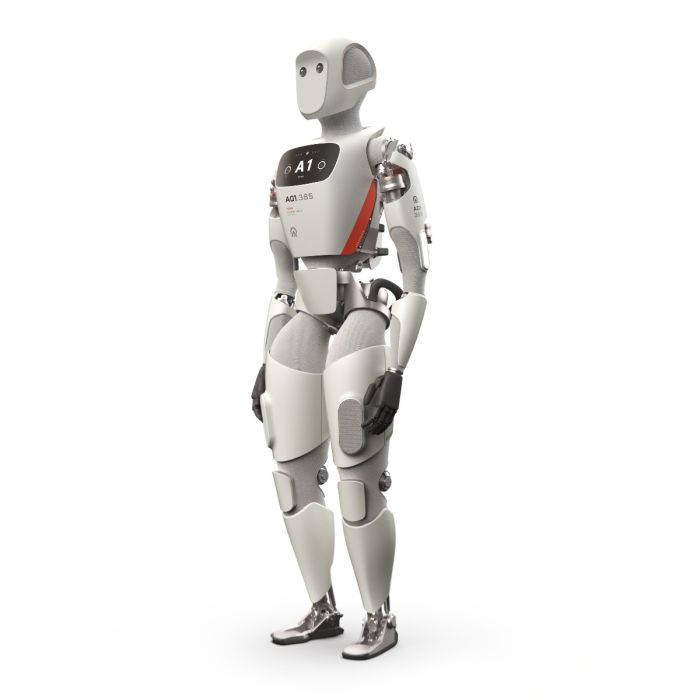
Apptronik APOLLO Humanoid Robot is a general-purpose robotics platform developed for material-handling work in logistics and manufacturing. Its human-scale design addresses environments organized around people, including warehouses, production lines, and workcells. Apptronik identifies trailer unloading, case picking, palletization, machine tending, and workcell delivery as target applications, with an initial emphasis on moving cases and totes.
APOLLO combines electric actuation, a force-control architecture, interchangeable battery packs, and software intended to support industrial integration. These features describe the platform, not a guarantee that every application is ready to run. Practical capability depends on configuration, tooling, task programming, facility conditions, and commissioning. Buyers should evaluate a specific workflow rather than assume that a general-purpose humanoid can immediately perform every job associated with its shape.
Background
Company and robotics lineage
Apptronik was founded in 2016 from the Human Centered Robotics Lab at the University of Texas at Austin. Its development background includes work on more than ten robots and experience connected to NASA’s Valkyrie humanoid. That history brings research in actuation, controls, and human-centered robotics into the company’s commercial platform development.
APOLLO was publicly unveiled in August 2023 with a focus on industrial work. The connection to earlier robotics research explains its technical lineage; it does not establish space qualification, industrial certification, or suitability for hazardous locations. Those requirements must be assessed separately for the proposed deployment.
Product positioning
APOLLO is positioned around human-scale manipulation rather than a single permanently fixed operation. Manufacturer materials describe stationary, mobility-platform-mounted, and legged configurations. This modular approach allows a purchasing discussion to begin with the task: whether the robot needs to remain beside a machine, move between workstations, or operate with legs.
A humanoid platform is not automatically preferable to a conventional robot arm or mobile robot. Its relevance increases where reach, object handling, and compatibility with existing human-oriented infrastructure matter together. Configuration selection should follow the workflow, not simply the appeal of a human-shaped machine.
Technical Specifications
| Parameter | Manufacturer-published information |
|---|---|
| Robot platform | General-purpose humanoid |
| Height | 5 feet 8 inches |
| Weight | 160 lb |
| Payload | 55 lb |
| Battery runtime | Four hours per battery pack |
| Battery arrangement | Hot-swappable battery packs |
| Other power options | Plug-in charging or tethered operation |
| Configuration options | Stationary, mobility-platform-mounted, or legged |
| Status communication | LED indicators in head, mouth, and chest |
| Software | Point-and-click suite for industrial integration |
| Initial application focus | Logistics and manufacturing case/tote handling |
Confirm current specifications, supplied configuration, payload conditions, and task-dependent runtime against the project datasheet and quotation. Public platform information does not define the complete equipment package.
What makes APOLLO relevant to warehouses and factories?
Warehouses and factories contain containers, benches, carts, shelves, and equipment arranged for human workers. APOLLO’s proportions are intended to help it interact with that infrastructure. The potential advantage is compatibility with selected existing workflows, although grippers, handoff stations, protective measures, or process adjustments may still be necessary.
The published payload provides a starting point for screening handling tasks. It should not be treated as an assurance that every object of that weight can be manipulated in every posture. Shape, center of gravity, surface condition, grasp stability, and reach all affect whether a particular transfer is suitable.
Apptronik also describes a point-and-click software suite for deploying and integrating solutions. Buyers should establish which task functions and interfaces are included, who performs commissioning, and how exceptions are handled. Accessible controls do not remove the need for engineering validation or integration with warehouse and production systems.
The head, mouth, and chest LEDs provide visible status communication. During commissioning, operators should learn what those indications mean and how they relate to task progress, interruptions, and intervention procedures. Clear status information can help people understand a robot’s activity, but it must sit alongside documented training and supervisory arrangements. The purchasing review should therefore cover the operator interface as well as mechanical specifications and software functionality.
How does APOLLO support longer operating periods?
Apptronik publishes four hours of runtime per battery pack and describes hot-swappable packs that can be exchanged instead of stopping for an entire plug-in charging cycle. Plug-in charging and tethered operation are also described as options.
Battery exchange can support shift planning, but continuous productivity still depends on spare packs, charging arrangements, exchange procedures, maintenance, and task-related energy consumption. A tethered configuration introduces its own cable-routing and movement constraints. Buyers should request runtime assumptions for their application rather than interpret the published figure as guaranteed performance under every load.
Who is Apptronik APOLLO for?
APOLLO is relevant to warehouse operators, logistics providers, manufacturers, systems integrators, and enterprise automation teams evaluating humanoid material handling. A suitable evaluation starts with a bounded task, representative objects, an agreed operating area, and measurable acceptance criteria.
Useful criteria include completed transfers, placement accuracy, operator interventions, recovery from failed grasps, and compatibility with surrounding equipment. A controlled pilot can establish whether the selected configuration offers practical value before broader deployment.
Worker proximity also requires careful assessment. Apptronik’s force-control architecture is intended to support operation around people, but that intention is not a blanket safety guarantee. Risk assessment must consider carried objects, pinch points, operating speed, emergency response, and the surrounding process, not only the robot itself.
What is Apptronik APOLLO used for?
- Trailer unloading. A manufacturer-identified target application involving package transfer from trailers. Suitability depends on floor conditions, package variation, available space, and the downstream handoff arrangement.
- Case picking. Handling selected cases within a warehouse workflow. Implementation depends on container dimensions, grasp surfaces, shelf access, identification requirements, and the treatment of damaged or irregular packages.
- Palletization. Placing cases into planned pallet arrangements. Stack stability, reach, package weight, placement accuracy, and coordination with conveyors or staging positions require project-specific validation.
- Machine tending. Transferring material at a production machine. Feasibility depends on part presentation, fixtures, machine access, interlocks, timing, and integration with the machine’s control system.
- Workcell delivery. Bringing materials to designated production locations. Route design, handoff positions, pedestrian interaction, and traffic coordination determine the appropriate mobility configuration and operating procedures.
- Case and tote transfer. Moving containers between defined pickup and delivery positions. Container geometry, load distribution, transfer height, and gripping requirements shape the tooling and commissioning plan.
Pricing and Availability
Request a quotation for Apptronik APOLLO based on the intended task and configuration. This page does not establish a fixed price, immediate stock, delivery commitment, or universal package of software and integration services.
Review the purchase details on this page and include the facility location, payload examples, operating hours, preferred configuration, and throughput objectives in the enquiry. Ask the quotation to separate robot hardware, tooling, batteries, software, commissioning, training, and support where applicable. Regional supply, documentation, service coverage, and deployment requirements should be confirmed before ordering.
Frequently Asked Questions
Is Apptronik APOLLO a humanoid robot?
Yes. Apptronik presents APOLLO as a general-purpose humanoid platform. Its human-scale proportions are intended for environments designed around people, while stationary, mobility-platform-mounted, and legged configurations support different deployment approaches.
How much can APOLLO carry?
Apptronik publishes a payload of 55 lb. Confirm the applicable configuration and handling conditions before specifying a task. Object geometry, grip, reach, and movement requirements can affect practical suitability.
How long does an APOLLO battery last?
The published runtime is four hours per battery pack. Apptronik describes hot-swappable packs, with plug-in charging or tethered operation also possible. Actual duty-cycle performance should be confirmed for the intended application.
Can APOLLO operate autonomously without integration?
The public platform description does not establish universal out-of-the-box autonomy. Buyers should confirm supported tasks, perception requirements, system interfaces, supervision, and exception handling. A defined workflow still requires commissioning and acceptance testing.
Is APOLLO safe to work alongside people?
Its force-control architecture is intended to support operation around people. That does not establish risk-free use or a particular certification. A deployment-specific assessment must address the robot, payload, tooling, nearby equipment, and operating procedures.
Does every APOLLO configuration include legs?
No. Apptronik describes a modular platform with stationary, mobility-platform-mounted, and legged options. Confirm which form is proposed and what mobility equipment, power arrangements, and software are included in the quotation.
Where can I buy Apptronik APOLLO and what does it cost?
Use the enquiry options on this page to request a quotation. Cost and supply arrangements depend on the confirmed configuration and project scope. Ask for written purchasing terms, included equipment, integration responsibilities, and regional support details.
Summary
Apptronik APOLLO combines human-scale manipulation, modular configuration options, interchangeable batteries, and an industrial software concept for logistics and manufacturing. Its value should be assessed against verified task performance, integration requirements, and a documented safety plan. For comparing the platform and preparing a project-specific quotation request, this page is the starting point.