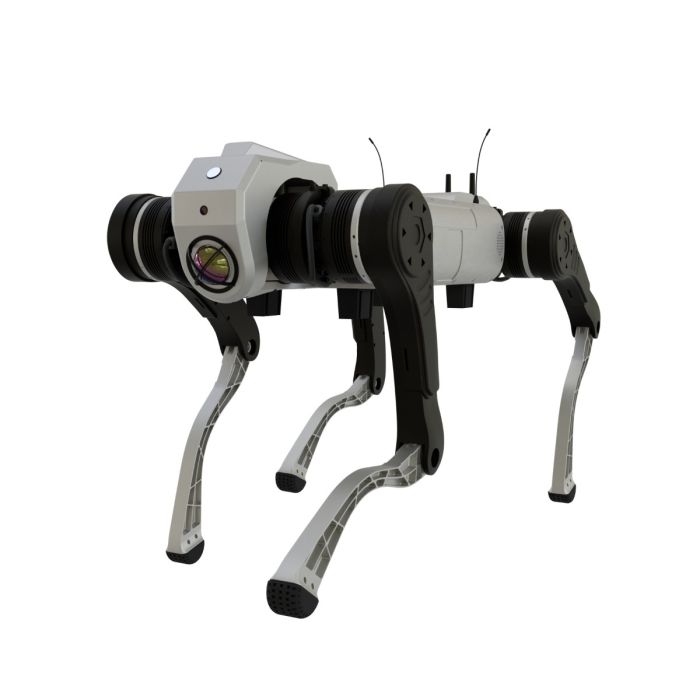
AgiBot D1 MaxPro Quadruped Robot Dog
In stock
- MEREK:
- AGIBOT
- BAGIAN #:
- D1 MaxPro
- ORIGIN:
- Tiongkok
- AVAILABILITY:
- SUBJECT TO AVAILABILITY
- SKU:
- AgiBot-D1-MaxPro
AgiBot D1 MaxPro Quadruped Robot Dog
AgiBot D1 MaxPro is an industrial-oriented quadruped robot designed for heavy-duty field work such as plant inspection, emergency response, and outdoor logistics. Within AgiBot’s D1 lineup (Edu → Pro → Ultra → Max/MaxPro), the MaxPro variant emphasizes higher payload capacity, longer endurance, and rugged operation compared with lighter models. Public materials highlight reinforcement-learning (RL)–based gait control, runtime up to ~2.5 hours, and a top speed around 3.5 m/s, positioning the platform for extended missions in complex terrain.
The D1 MaxPro's defining characteristics are its payload capacity of up to 100 kilograms, its extended operational endurance of up to 5.5 hours per charge, and its reinforcement learning-based gait control system that adapts locomotion in real time to varied terrain conditions without operator intervention. These three attributes combined — heavy payload, long endurance, and autonomous terrain adaptation — make the MaxPro relevant to industrial deployment contexts that the lighter D1 Pro (approximately 15 kilograms body weight, one to two hours of endurance) and the D1 Ultra (IP54-rated, approximately 15 kilograms, designed for inspection-class payloads) cannot address.
The D1 Series as a whole received the Netzwelt Innovation Award 2026 at CES in January 2026, recognizing the platform's significance as a quadruped robot that navigates challenging terrain within AgiBot's broader ecosystem of humanoid and inspection robots.
Design and Physical Features
Overall Architecture
The D1 MaxPro uses a four-legged quadruped architecture designed to navigate terrain that wheeled platforms cannot reliably traverse: stairs, slopes, uneven outdoor ground, construction debris, muddy surfaces, gravel, and gratings. The legged design distributes the robot's weight across four contact points that can independently adapt to surface height variations, providing inherent stability advantages over wheeled systems on irregular terrain.
The robot's structure uses advanced, high-strength lightweight materials — engineering alloys and structural composites — to minimize the chassis mass relative to the total payload the system must carry. This material optimization is particularly important for a platform designed to carry up to 100 kilograms, as every kilogram saved in structural weight translates directly to additional payload or battery capacity within the total system mass budget.
Payload Capacity
The D1 MaxPro's maximum payload capacity of 100 kilograms is the specification that most clearly distinguishes it from the rest of the D1 family and from most commercially available quadruped platforms. At this capacity, the MaxPro can carry substantially heavier multi-sensor inspection rigs than the compact D1 Ultra, enabling the integration of more capable and heavier sensing hardware including industrial-grade LiDAR systems, thermal imaging cameras, gas and chemical detection instruments, and communications gear simultaneously on a single platform.
The 100-kilogram payload figure represents the theoretical maximum under favorable conditions. Real-world effective payload for sustained dynamic operation varies based on terrain, gait speed, and environmental conditions. Despite this typical gap between maximum rated and sustained practical payload in field conditions, even a fraction of the 100-kilogram ceiling represents a substantial advantage over competing platforms in the sub-15-kilogram payload class.
Operating Temperature Range
The D1 MaxPro operates across a temperature range from -20°C to 55°C — a substantially broader thermal envelope than the D1 Pro/Edu's 0°C to 40°C operating range. This extended range enables year-round deployment in climates and facilities where the ambient temperature exceeds the more constrained range of lighter D1 variants: outdoor winter inspection in sub-zero temperatures, inspection inside steel mills, foundries, or other high-temperature industrial environments, and operations in desert or tropical climates where ambient temperatures regularly exceed 40°C.
Technology and Specifications
Core Specifications at a Glance
| Specification | Value |
|---|---|
| Maximum Payload | Up to 100 kg |
| Operating Endurance | Up to 5.5 hours |
| Maximum Running Speed | Approximately 3.5 m/s |
| Operating Temperature | -20°C to 55°C |
| Gait Control | Embedded RL-based motion algorithm |
| Autonomy Modules | Autonomous patrol, environmental perception |
| Sensor Compatibility | 3D LiDAR, depth cameras, RGB cameras, RTK, 4G/5G |
Reinforcement Learning Gait Control
The defining technology of the entire D1 Series — and a critical differentiator for the MaxPro in particular — is its embedded reinforcement learning (RL) motion algorithm. Rather than operating from a fixed library of pre-programmed gaits for specific surface types, the MaxPro's locomotion controller was trained through reinforcement learning to adapt its step timing, foot placement, stance width, and body posture in real time based on sensory feedback from joint torque sensors, inertial measurement units, and foot contact sensors.
The result is gait control that generalizes across surface types without requiring the operator to manually switch between mode settings: loose gravel, slick concrete, muddy ground, stair edges, and sloped surfaces are all handled through the same underlying controller that adjusts its behavior based on what the robot's sensors report about the current terrain. The RL training specifically emphasizes self-balancing, anti-tipping, and disturbance rejection behaviors — the ability to recover stability after unexpected pushes, surface changes, or misstep events without falling.
For the MaxPro specifically, the RL controller must manage the substantially greater dynamic loads generated by the 100-kilogram payload capacity. A heavily loaded quadruped faces significantly more challenging stability requirements than an unloaded one, as the payload shifts the robot's center of mass upward and creates larger destabilizing moments during the stance and swing phases of the gait cycle. The MaxPro's RL training addresses these challenges by learning to dynamically adjust leg stiffness, swing height, and stance duration under varying load conditions.
Autonomous Patrol and Environmental Perception
Beyond raw locomotion, the D1 MaxPro incorporates built-in modules for autonomous patrol and environmental perception. These modules enable the robot to execute pre-defined patrol routes without continuous operator supervision, recognizing and documenting environmental anomalies, obstacles, and changes along its programmed path. Autonomous patrol is particularly important for industrial inspection use cases where the mission profile involves repeating the same route across a facility on a schedule — a task well suited to automation once the route is established.
The environmental perception module processes data from the robot's sensor payload to build situational awareness of the environment. In inspection contexts, this includes identifying potential hazards, flagging unusual readings from sensors such as thermal cameras or gas detectors, and creating maps of the facility that support navigation and documentation.
Multi-Sensor Payload Integration
The D1 MaxPro is designed to accept a range of mission-specific sensor and communications payloads via standardized mechanical and electrical interfaces. Compatible payloads include 3D LiDAR for spatial mapping and obstacle detection, depth cameras for visual inspection, RGB cameras for documentation and live monitoring, RTK (Real-Time Kinematic) positioning modules for precise location tracking, and 4G and 5G communication modules for connectivity in facilities where direct wireless links to operators are required.
This modular payload architecture allows the same MaxPro base platform to be configured differently for different inspection missions: a patrol deployment might carry cameras and communications hardware; a gas facility inspection might add chemical sensors; a construction site survey might combine LiDAR mapping with thermal imaging. The shared platform reduces the cost of maintaining multiple specialized inspection systems.
Applications and Use Cases
Industrial Plant Inspection
The D1 MaxPro's combination of all-terrain mobility, extended endurance, heavy payload capacity, and wide operating temperature range positions it for inspection of industrial plants across the energy, petrochemical, metals, and manufacturing sectors. These facilities share several common inspection challenges: large areas requiring extended patrol endurance, complex terrain including stairs, catwalks, gratings, and outdoor ground, harsh environmental conditions, and inspection requirements that involve carrying substantial sensing equipment.
With higher payload headroom and an extended thermal range, the MaxPro is suited to routine patrol rounds in power generation, oil and gas, metals, and chemical facilities — carrying thermal imagers, acoustic sensors, or gas detectors while navigating stairs, catwalks, and debris-prone floors. The RL-based gait control maintains stability when surfaces vary between smooth concrete, gratings, and outdoor gravel typical of these mixed-surface industrial environments.
Emergency Response and Reconnaissance
Emergency response scenarios — fire investigation, search and rescue support, hazardous material assessment, and post-incident reconnaissance — frequently involve terrain that is physically dangerous for human entry and operationally challenging for wheeled robots. The D1 MaxPro's quadruped architecture enables it to navigate the debris, rubble, and uneven surfaces of emergency sites, while its wide operating temperature range supports deployment in environments affected by fire, extreme cold, or industrial heat.
The combination of rugged locomotion and multi-sensor payloads allows autonomous or tele-supervised site sweeps, perimeter patrols, and post-incident reconnaissance, especially in environments where human exposure is undesirable due to smoke, heat, contaminants, or structural instability.
Outdoor Logistics and Equipment Transport
Demonstrations of the D1 MaxPro have highlighted its capacity for moving equipment or supply kits between points in outdoor yards, large campuses, and industrial sites. The long endurance and RL-based locomotion make the platform viable for repetitive transport loops or ad hoc delivery tasks when paired with fleet management tools. In large facility contexts — airports, ports, mining operations, military bases — the ability to carry significant payloads across mixed outdoor terrain extends the robot's logistical utility beyond what smaller quadrupeds or wheeled alternatives can provide.
Energy Sector Monitoring
Pipeline monitoring, inspection of remote solar and wind installations, and safety checks within power generation facilities represent application contexts where the MaxPro's extended endurance and all-terrain mobility are directly beneficial. Renewable energy installations in particular are often located in outdoor environments with challenging terrain — wind turbine bases on hillsides, solar farms on uneven ground — where the MaxPro's slope-handling and payload capacity enable it to carry inspection sensors to locations that are time-consuming or difficult for human inspectors to reach on the same schedule.
Advantages and Benefits
Industry-Leading Payload for a Commercial Quadruped: The 100-kilogram payload capacity at the top-end figure substantially exceeds the payload envelope of compact industrial quadrupeds in the D1 Pro/Ultra class (typically 3 to 8 kilograms effective payload), enabling the MaxPro to carry multi-sensor inspection rigs that require combining LiDAR, thermal imaging, gas detection, and communications hardware on a single platform.
Extended 5.5-Hour Endurance for Full-Shift Missions: At up to 5.5 hours of operational endurance, the MaxPro can sustain inspection patrols and logistics transport missions across a full industrial half-shift without requiring battery charging intervention, substantially reducing mission planning complexity compared to platforms requiring more frequent returns to base.
Wide -20°C to 55°C Operating Range for Year-Round Deployment: The expanded temperature tolerance of the MaxPro compared to the D1 Pro/Edu's 0°C to 40°C range enables deployment in climatic and industrial conditions that would prevent the lighter models from operating, making the MaxPro suitable for facilities in cold climates, hot industrial environments, and year-round outdoor patrol programs.
RL-Based Terrain Adaptation Without Manual Gait Switching: The reinforcement learning locomotion controller adapts autonomously to terrain variation without requiring operators to manually switch gait modes or issue frequent corrections, reducing operator cognitive load and enabling more effective deployment in environments with unpredictable surface conditions.
Autonomous Patrol Modules Reduce Staffing Requirements: Built-in autonomous patrol capability allows the MaxPro to execute programmed inspection routes without continuous operator supervision, providing staffing efficiency benefits for facilities that need frequent rounds of large areas.
Modular Sensor Integration for Mission Flexibility: The standardized payload interface system allows the same MaxPro platform to be reconfigured for different inspection requirements by swapping sensor modules, reducing total system cost compared to maintaining separate dedicated inspection platforms for each sensor type.
Comparison with Related Platforms
AgiBot D1 MaxPro vs. AgiBot D1 Ultra: The D1 Ultra is the IP54-rated inspection quadruped in the D1 family, weighing approximately 15 kilograms with a top speed of 3.7 m/s and an endurance of approximately one hour. The MaxPro trades the Ultra's compact portability for substantially higher payload capacity (up to 100 kg versus approximately 3 to 5 kg effective payload for the Ultra), approximately five times longer endurance (5.5 hours versus one hour), and a wider operating temperature range. The Ultra is better suited to compact inspection deployments where portability and developer flexibility are the primary requirements; the MaxPro is designed for sustained field missions requiring heavier sensing hardware and extended operational time.
AgiBot D1 MaxPro vs. Boston Dynamics Spot: Boston Dynamics Spot is the market-leading commercial inspection quadruped, priced at approximately $75,000, with a payload capacity of approximately 14 kilograms and endurance of approximately 90 minutes per battery. The MaxPro's payload capacity substantially exceeds Spot's 14-kilogram limit, and its 5.5-hour endurance is approximately three times longer. Spot has a significantly more mature global enterprise support infrastructure and a larger track record of verified industrial deployments. The MaxPro addresses a different segment of the industrial quadruped market: buyers who need payload capacity and endurance substantially beyond Spot's specifications and who operate in or near AgiBot's distribution network.
AgiBot D1 MaxPro vs. ANYbotics ANYmal: ANYmal by ANYbotics is a Swiss-engineered inspection quadruped with an approximately 10-kilogram payload capacity, deployed at offshore oil platforms, chemical plants, and power generation facilities. ANYmal has the most extensive documented track record in regulated industrial inspection environments among commercial quadrupeds. The MaxPro targets a similar primary use case — industrial plant inspection — at a lower price point with higher payload capacity, but without ANYmal's lengthy deployment history in safety-critical regulated environments.
Frequently Asked Questions (FAQ)
What is the AgiBot D1 MaxPro? The AgiBot D1 MaxPro is the highest-capacity quadruped robot in AgiBot's D1 Series, designed for industrial-grade heavy-duty field work including plant inspection, emergency response, outdoor logistics, and extended multi-sensor survey missions. Its defining specifications are a maximum payload of up to 100 kilograms, operational endurance of up to 5.5 hours, and reinforcement learning-based gait control for autonomous all-terrain locomotion. It operates across a temperature range of -20°C to 55°C, making it suitable for year-round deployment in harsh industrial environments.
How does the AgiBot D1 MaxPro work? The D1 MaxPro navigates complex terrain using four motorized legs controlled by an embedded reinforcement learning motion algorithm that adapts step timing, foot placement, body posture, and leg stiffness in real time based on sensory feedback from joint torque sensors and inertial measurement units. Built-in autonomous patrol modules enable it to execute pre-defined inspection routes without continuous operator supervision. Its payload interface system accepts standardized sensor and communications modules — 3D LiDAR, depth cameras, gas detectors, RTK, 4G/5G — enabling mission-specific configuration without platform redesign.
What makes the AgiBot D1 MaxPro different from the D1 Ultra? The D1 Ultra is a compact, IP54-rated inspection quadruped weighing approximately 15 kilograms with an effective sensor payload of approximately 3 to 5 kilograms and approximately one hour of operational endurance. The MaxPro trades the Ultra's compact portability for a substantially higher maximum payload (up to 100 kg), approximately five times longer endurance (up to 5.5 hours), and a wider operating temperature range (-20°C to 55°C versus 0°C to 40°C for the D1 Pro/Edu). The MaxPro is designed for heavy-duty industrial missions; the Ultra for compact inspection and developer integration use cases.
What are the main applications of the AgiBot D1 MaxPro? The primary applications are industrial plant inspection (power generation, oil and gas, chemical and petrochemical facilities), emergency response and post-incident reconnaissance, outdoor logistics and equipment transport across large sites, energy sector monitoring (solar farms, wind installations, pipelines), and extended multi-sensor field surveys. The MaxPro's combination of high payload capacity, 5.5-hour endurance, and wide temperature range makes it particularly relevant for facilities that need to carry heavy inspection hardware across large areas in harsh environmental conditions.
How does the AgiBot D1 MaxPro compare to Boston Dynamics Spot? Boston Dynamics Spot has a payload capacity of approximately 14 kilograms, endurance of approximately 90 minutes per battery, and a price of approximately $75,000 USD. It has the most established global enterprise support infrastructure and the most extensively documented track record in industrial inspection among commercial quadrupeds. The AgiBot D1 MaxPro offers substantially higher payload capacity (up to 100 kg) and approximately three to four times longer endurance (up to 5.5 hours), addressing inspection missions requiring heavier sensor payloads and longer operating times that exceed Spot's capabilities. Spot's advantage remains its mature global support network and extensive verified industrial deployment history. Buyers should select between them based on payload requirements, endurance needs, required support infrastructure, and regional availability.
Summary
The AgiBot D1 MaxPro Quadruped Robot Dog occupies a distinct and commercially important position in the industrial inspection robotics market: the gap between the lighter compact quadrupeds suitable for short-duration patrol and research tasks, and the high-cost specialized inspection systems deployed in regulated industrial facilities. With its 100-kilogram maximum payload, 5.5-hour endurance, -20°C to 55°C operating range, reinforcement learning gait control, and autonomous patrol modules, the MaxPro addresses the practical requirements of industrial inspection teams who need to carry substantial sensor rigs across complex terrain for extended mission durations a combination that smaller D1 variants and most other commercially available quadruped platforms cannot match. Supported by AgiBot's CES 2026 Netzwelt Innovation Award recognition for the D1 Series and the company's production-scale manufacturing infrastructure, the D1 MaxPro represents a credible and commercially accessible entry point into heavy-duty quadruped inspection robotics for buyers in the energy, petrochemical, manufacturing, and emergency response sectors.