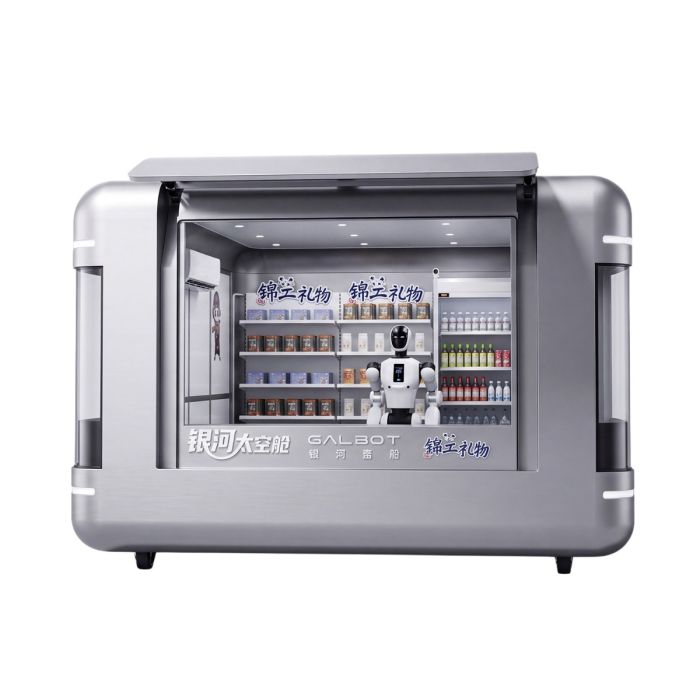
Galbot Galaxy Space Capsule
In stock
- MEREK:
- GALBOT
- MODEL:
- CAPSULE
- ORIGIN:
- Tiongkok
- AVAILABILITY:
- SUBJECT TO AVAILABILITY
- SKU:
- Galbot-Capsule
Galbot Galaxy Space Capsule
Galbot Capsule (Galaxy Space Capsule): Complete Guide to the World's First Humanoid-Staffed Retail Store
The concept debuted at the Zhongguancun ART PARK plaza in Beijing in mid-2025, attracting significant public and media attention as the first large-scale public demonstration of a fully humanoid-operated retail environment in a live commercial setting. Customers interact with the store by placing orders on a tablet, after which the G1 robot retrieves the requested items drinks, snacks, coffee, pharmaceuticals from shelves and delivers them. The robots are capable of voice conversation during service, responding to questions and initiating greetings in natural language
Background and Development
Galbot was founded in May 2023 by Professor He Wang, a Stanford-trained robotics scientist at Peking University, and co-founder Zhang Zhizheng. The company's core thesis was that enabling general-purpose robot manipulation at commercial scale required training AI systems on massive synthetic simulation datasets — Galbot's Sim2Real methodology — rather than the prohibitively expensive real-world teleoperation data that had blocked previous manipulation robot commercialization attempts.
The Galaxy Space Capsule emerged as the consumer retail application of Galbot's embodied AI platform. Rather than deploying the G1 as a back-office or factory-floor system invisible to consumers, Galbot chose to place humanoid robots directly in public-facing retail positions where their capabilities and limitations would be tested continuously in live commercial environments. This decision reflected a deliberate strategy: Galbot co-founder Zhang Zhizheng told China Daily that the company views large-scale retail deployment as both a commercial operation and a continuous real-world data collection and robot performance validation system.
The first pilot locations opened with approximately ten stores in Beijing, and the company set a target of 100 stores nationwide within the year. By March 2026, that target had been exceeded, with the Galaxy Space Capsule operating in over 100 locations across more than 20 cities, including not only commercial plazas but also culturally significant sites such as Beijing's Summer Palace — a deployment Galbot described as blending technology with cultural heritage.
Design and Physical Format
Store Format and Layout
The Galaxy Space Capsule takes its name from the visual design of the store unit — a compact, capsule-shaped retail pod designed for rapid deployment in high-traffic commercial areas. The physical store footprint is compact enough to operate within plaza spaces, shopping centers, cultural sites, and commercial landmarks without requiring full retail unit construction. A single Galbot G1 robot can manage a 50-square-meter store, serving all customer-facing and inventory management functions autonomously.
Each store is equipped with product shelving organized to match the reach envelope of the G1 robot — shelves at heights accessible to the robot's 240-centimeter maximum reach while offering the full product range of a standard convenience store: chilled and room-temperature beverages, packaged snacks, coffee, and pharmaceuticals. Some locations also offer cold and frozen product categories under chilled storage conditions.
Customer Interface
Customer interaction at the Galaxy Space Capsule is designed to be accessible to consumers with no prior experience with robotic retail. The primary ordering interface is a tablet mounted at accessible height, where customers browse the product catalog, select items, and place their order. The G1 robot receives the order autonomously, navigates to the appropriate shelf location, retrieves the item, and delivers it to the customer — the complete service cycle without any human staff intervention.
Beyond the tablet ordering interface, the G1 robot supports voice interaction throughout the service cycle. Robots at Galbot Capsule locations can conduct natural-language voice conversation with customers — responding to questions about products, initiating welcome greetings, and providing order status updates. At the initial Zhongguancun flagship location, a visitor quoted by Global Times noted: "The robots can talk, and can also serve coffee and soft drinks — it's really convenient."
24/7 Autonomous Operation
The Galaxy Space Capsule operates 24 hours a day, seven days a week, fully autonomously. The G1 robot's 10-hour battery runtime supports full commercial shift operation without mid-shift charging interruptions, and autonomous battery management enables uninterrupted overnight operation in high-demand locations. The store format is explicitly designed to address the labor cost and availability challenges of 24-hour retail — eliminating the need for night-shift human staffing while maintaining full service availability for customers at any hour.
A single store can serve over one thousand customers per day at high-traffic locations, demonstrating the throughput capacity of humanoid-operated retail at commercial scale.
Technology and AI Systems
GroceryVLA: The Retail Intelligence Foundation
The Galbot Capsule's operational capability rests directly on GroceryVLA, Galbot's retail-specific embodied AI foundation model. GroceryVLA is built on top of GraspVLA — Galbot's general manipulation foundation model — and adds retail-specific intelligence for product recognition, dense shelf navigation, and multi-category product handling.
The key operational capability GroceryVLA provides is the ability to handle the full product diversity of a convenience store — hundreds of different SKUs spanning soft packaging (snack bags, pouches), rigid containers (bottles, cans), glass containers, pharmaceutical packaging, and coffee cups — without requiring engineers to program handling routines for each individual product. Galbot describes GroceryVLA as solving two specific challenges: intelligent grasping across a large and varied product catalog without per-product parameter adjustment, and navigation through densely stacked shelving where imprecise retrieval could knock adjacent products off the shelf.
GraspVLA: Zero-Shot Grasping Across Object Categories
GraspVLA, the underlying manipulation foundation model, was released in January 2025 and is described by Galbot as the world's first end-to-end embodied grasping model trained on simulated synthetic data. The model provides zero-shot generalization — the ability to handle object types not seen during training — using pre-training on billions of synthetic physical interactions generated through NVIDIA Isaac Sim.
In practice at Galbot Capsule locations, GraspVLA enables the G1 robot to retrieve newly stocked products without requiring additional training for each new item. A convenience store's product catalog changes continuously through seasonal items, new product introductions, and supplier substitutions; GraspVLA's generalization capability means the robot can handle these changes without costly and time-consuming retraining cycles.
TrackVLA and NavFoM: Autonomous Navigation
Customer-following, order retrieval routing, and store navigation are governed by TrackVLA — Galbot's navigation foundation model — and NavFoM, the navigation foundation model that handles spatial environment mapping and path planning. These systems allow the G1 to navigate between customer service zones, product shelves, and storage areas without floor-embedded guidance tracks or QR code markers, using pure visual perception of the environment.
TrackVLA's ability to follow a human target through crowded spaces and resume tracking after temporary visual occlusion is particularly relevant in high-traffic retail locations where multiple customers may be present simultaneously and the robot must maintain situational awareness of service targets across visual obstructions.
AstraBrain: Full System Integration
All navigation, manipulation, voice interaction, and customer service functions at the Galaxy Space Capsule are coordinated by AstraBrain, Galbot's integrated AI architecture. AstraBrain manages the real-time sequencing of task components — understanding a customer's order, planning the retrieval route, executing the grasp, navigating back to the customer, and conducting voice interaction throughout — in a continuously running autonomous loop without teleoperation or human supervision.
Galbot explicitly distinguishes the Galaxy Space Capsule from robot retail concepts that use remote human operators to guide the robot through customer interactions: the G1 at Capsule locations operates with full autonomy, and the company describes this as a direct commercial validation of the AstraBrain system's readiness for unsupervised deployment in live consumer environments.
Applications and Use Cases
Convenience Store Retail
The primary and most developed application of the Galbot Capsule is convenience store retail — beverages, snacks, packaged goods, and coffee at locations serving high-traffic commercial and public space visitors. The format serves the on-premise purchase need common to office districts, technology parks, cultural attractions, and transit-adjacent locations.
Pharmaceutical Dispensing and Pharmacy Integration
Several Galaxy Space Capsule locations incorporate pharmaceutical products alongside standard convenience goods, extending the format into the pharmacy retail segment. This aligns with Galbot's parallel deployment of G1 robots in more than 10 dedicated Beijing pharmacies — the same underlying AI capabilities serve both formats, and the pharmaceutical sorting gold medal at the World Humanoid Robot Games provides independent validation of the G1's accuracy in medication handling.
Cultural Tourism and Landmark Sites
The Summer Palace deployment represents a distinct application context — serving tourists at a UNESCO World Heritage Site where the novelty and interactive experience of a humanoid-operated retail format contributes directly to the attraction experience. Galbot has described these landmark deployments explicitly as combining retail functionality with public experience of embodied AI at a cultural heritage context.
Smart City Service Model
Galbot describes the Galaxy Space Capsule explicitly as part of a "smart city service" vision in which humanoid robot retail nodes provide reliable, 24-hour commercial services at the neighborhood and district scale, reducing dependence on shift labor for overnight and peak-period service coverage. The company has articulated ambitions for robot convenience stores at landmark areas across China's major cities as part of this vision.
Advantages and Benefits
24/7 Staffless Operation: The Galaxy Space Capsule eliminates the labor cost and availability constraints of overnight and peak-period staffing by deploying autonomous robots that operate continuously without shift management.
One-Day Deployment per Location: The G1 robot's one-day store deployment capability means new Galbot Capsule locations can be made operational within 24 hours of hardware arrival, substantially reducing the time-to-revenue for each new location and enabling rapid network expansion.
No Teleoperation Required: Unlike robot retail systems that rely on remote human operators to guide robot actions during customer interactions, the Galbot Capsule operates with full autonomy — the G1 handles all customer service tasks independently, enabling true staffless operation rather than remotely supervised service.
Zero-Shot Product Handling for Evolving Catalogs: GraspVLA's zero-shot generalization means the Galbot Capsule can add new products to its catalog without retraining the robot, unlike conventional automation systems that require mechanical or software reconfiguration for each new item.
Continuous AI Improvement Through Deployment Data: Each Galaxy Space Capsule location generates real-world manipulation data that feeds Galbot's training pipeline, progressively improving the G1's capabilities across the full store network as cumulative operational experience grows.
Comparison with Conventional Unmanned Retail
Galbot Capsule vs. Automated Vending Machines: Traditional vending machines dispense a limited fixed catalog of pre-slotted items through mechanical ejection. The Galbot Capsule offers an open-shelf format where the robot retrieves any product from any location on standard shelving, supporting a full convenience store range without pre-slotting constraints and allowing shelf layouts to be modified freely.
Galbot Capsule vs. Unmanned Convenience Stores (Camera + AI): Japan and China have both deployed camera-equipped unmanned convenience stores (such as Amazon Go and its Chinese equivalents) that track customer product selection and charge automatically. These systems automate payment and entry/exit but still require human restocking, cleaning, and customer assistance. The Galbot Capsule goes further by using a humanoid robot to handle both customer service and inventory management, eliminating human operational requirements more completely.
Frequently Asked Questions (FAQ)
What is the Galbot Capsule? The Galbot Capsule (also called the Galaxy Space Capsule) is a fully autonomous retail convenience store concept operated entirely by Galbot G1 humanoid robots without human staff or remote teleoperation. Customers place orders via a tablet interface, and the G1 robot retrieves products from open shelving and delivers them. Locations operate 24/7 and stock beverages, snacks, coffee, and pharmaceuticals. By early 2026, the format had expanded to over 100 locations across more than 20 Chinese cities, including Beijing, Hangzhou, and Suzhou.
How does the Galbot Capsule work? Customers place orders on a tablet display at the store entrance. The Galbot G1 robot receives the order wirelessly through its AstraBrain autonomous AI system, navigates to the appropriate product shelf using visual navigation (no floor tracks or QR codes), retrieves the item using its dexterous dual-arm manipulation system guided by GraspVLA and GroceryVLA AI models, and delivers the product to the customer. The robot can simultaneously conduct voice conversation — answering questions, greeting customers, and providing order updates. All operations are fully autonomous, running continuously without human supervision.
Where can I visit a Galbot Capsule store? Galaxy Space Capsule locations are operational across major Chinese cities including Beijing, Hangzhou, Suzhou, and others. The flagship location opened at the Zhongguancun ART PARK plaza in Beijing. A notable location at Beijing's Summer Palace has been widely reported. Galbot is in talks with management at prominent commercial areas including Qianmen and Wangfujing in Beijing and West Lake in Hangzhou. As of early 2026, over 100 locations are operational across 20+ cities. Check galbot.com for current location information.
Is the Galbot Capsule operated by a human remotely? No. Galbot explicitly distinguishes its Galaxy Space Capsule from robot retail concepts that use remote human operators to guide robot actions. The Galbot G1 operates with full autonomous intelligence — all customer service, product retrieval, and navigation decisions are made by the AstraBrain AI system in real time on the robot itself, without any teleoperation or remote human supervision. This is independently validated by the G1's gold medal at the World Humanoid Robot Games, where it outperformed competitors relying on remote human control.
Summary
The Galbot Capsule (Galaxy Space Capsule) represents the world's first commercially scaled fully humanoid-staffed retail format, with over 100 locations operational across more than 20 Chinese cities as of early 2026. Powered by the Galbot G1 robot and the GraspVLA, GroceryVLA, TrackVLA, and AstraBrain AI systems developed through Galbot's proprietary Sim2Real training methodology, the Galaxy Space Capsule demonstrates that commercially viable autonomous humanoid retail is not a future prospect but a present operational reality. Each location runs 24 hours a day without human staff, serves over one thousand customers daily at high-traffic sites, and supports a full convenience store product range without per-product configuration. For retailers, commercial real estate operators, and urban planners considering next-generation autonomous retail formats, the Galbot Capsule provides the most commercially validated reference example of what autonomous humanoid retail deployment looks like in practice.