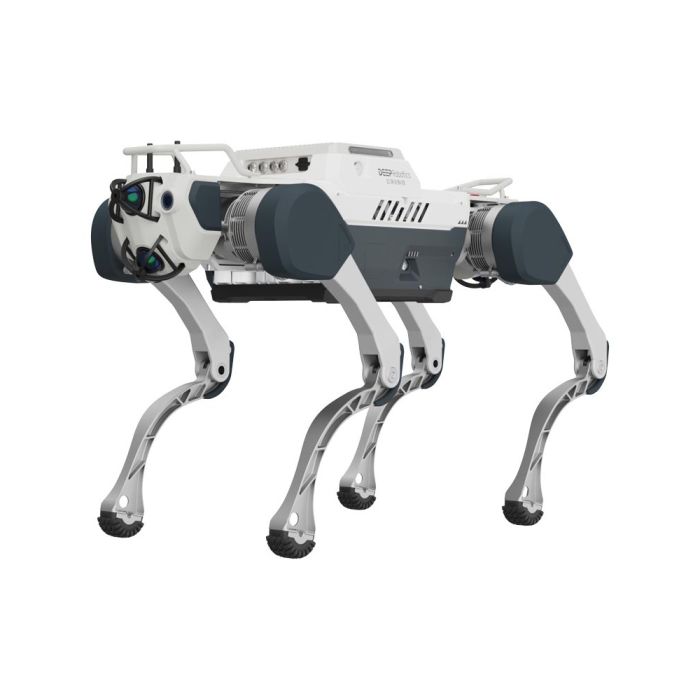
Deep Robotics X30 Pro Industrial Quadruped Robot Dog
In stock
- ຍີ່ຫໍ້:
- DEEP ROBOTICS
- ພາກທີ #:
- X30 Pro
- ORIGIN:
- ຈີນ
- AVAILABILITY:
- ALLOW 2-4 WEEKS FOR DELIVERY
- SKU:
- Deep-Robotics-X30-Pro
Deep Robotics X30 Pro Industrial Quadruped Robot Dog
The Deep Robotics X30 Pro Industrial Quadruped Robot Dog is an all-terrain legged robot built for autonomous and semi-autonomous inspection, patrol, and data collection in environments that are difficult or hazardous for people and impractical for wheeled machines. It belongs to Deep Robotics' X30 series of industrial quadruped platforms and is promoted for power substation patrols, factory and industrial facility inspection, pipeline corridor monitoring, emergency-response support, and public-safety patrol scenarios. With an IP67 ingress rating, a -20°C to 55°C operating temperature range, and published mobility figures covering 45-degree slopes and 20 cm obstacles, the X30 Pro is positioned as a rugged, repeatable carrier for inspection sensors rather than a laboratory demonstrator. This page summarizes its design, published specifications, applications, and the questions buyers most often ask before requesting a quotation.
Background
Legged robots earn their place in industry by going where wheels cannot. Inspection routes in substations, plants, and pipeline corridors were designed for human access — stairs, curbs, grates, gravel, and debris — and the X30 series was developed to walk those routes without modifying the environment.
Why quadrupeds for industrial inspection
Wheeled and tracked inspection robots are constrained by stairs, uneven terrain, curbs, grates, and scattered debris — exactly the features common in older plants and outdoor utility sites. A quadruped body plan maintains mobility across such mixed terrain, which is why four-legged platforms have become the preferred form factor for patrol routes that follow human footpaths. Deep Robotics highlights fusion perception as a core enabling feature of the X30 platform, supporting obstacle traversal and navigation in challenging lighting, including the ability to negotiate open-riser industrial stairs in relevant scenarios.
The X30 series and the Pro configuration
The X30 series is Deep Robotics' industrial-grade all-terrain line, hardened for outdoor and plant environments. The Pro variant is commonly described as a 12-DOF quadruped — the typical arrangement of three actuated joints per leg — and series collateral emphasizes quick battery replacement, often described as quick swap, so that patrol shifts can continue with minimal downtime between cycles. Environmental hardening is central to the design: the published IP67 rating and wide temperature range are consistent with deployments involving rain, dust, and large temperature swings.
Technical Specifications
The figures below are drawn from published X30-series specification materials and Deep Robotics' product documentation.
| Specification | Published value |
|---|---|
| Standing dimensions | 1000 × 715 × 470 mm |
| Weight | 59 kg (including battery) |
| Maximum speed | ≥ 4 m/s |
| Maximum slope | ≤ 45° |
| Step/obstacle height | ≥ 20 cm |
| Endurance | 2.5-4 hours (configuration- and mission-dependent) |
| Range per charge | ≥ 10 km |
| Ingress protection | IP67 |
| Operating temperature | -20°C to 55°C |
| Degrees of freedom | Commonly described as 12-DOF (Pro variant) |
| Battery | Quick-swap replacement supported |
Note that several of these values are series-level headline figures that depend on configuration, payload, terrain, and mission profile; exact performance for a specific build, payload options, and included equipment should be confirmed during quotation.
How does the Deep Robotics X30 Pro handle stairs and rough terrain?
The X30 Pro combines four-legged locomotion with onboard fusion perception to sense and traverse obstacles in real time. Published mobility specifications — slopes up to 45 degrees and step heights of 20 cm or more — cover most industrial stairways, curbs, and thresholds found on inspection routes. Deep Robotics specifically cites the ability to negotiate open-riser industrial stairs, a notoriously difficult structure for vision-guided legged robots because the tread gaps confuse depth sensing in poor light. Fusion perception is credited with supporting navigation in challenging lighting conditions, which matters for night patrols, indoor plant floors, and shaded outdoor corridors where lighting is inconsistent.
What does an X30 Pro inspection workflow look like?
A defining aspect of X30 Pro deployments is the inspection stack around the robot, not just the mobility platform itself. Deep Robotics' power patrol inspection solution documentation describes an end-to-end workflow: data acquisition, backend access, analysis, report generation, and defect warning. In practice, the robot carries payload sensors such as RGB and thermal cameras or inspection optics, executes predefined patrol routes, and feeds captured data into a backend pipeline that produces reports and flags anomalies. This positions the X30 Pro as part of a repeatable, auditable inspection process — replacing or augmenting manual inspection routes with the stated intent of improving efficiency and inspection quality while reducing labor intensity.
Who is the Deep Robotics X30 Pro for?
The X30 Pro is aimed at organizations that run recurring inspection or patrol routes across mixed or hazardous terrain: electric utilities patrolling substations, industrial operators inspecting factories and process plants, pipeline operators monitoring corridors, public-safety agencies running security patrols, and emergency-response teams that need a mobile sensor carrier for areas unsafe for personnel. It suits teams that want structured, repeatable data collection rather than one-off teleoperation, and that can integrate the robot's data pipeline with their existing maintenance or security workflows. Research groups working on legged autonomy in industrial settings are also a natural fit.
What is the Deep Robotics X30 Pro used for?
- Power substation patrol — executing scheduled inspection routes in substations, where legged mobility handles mixed terrain and reaches inspection points without changing the environment.
- Factory and industrial facility inspection — scheduled patrols, anomaly documentation, and condition monitoring where human access is hazardous, time-consuming, or inconsistent.
- Pipeline corridor monitoring — walking long outdoor corridors to collect visual and sensor data along infrastructure that wheeled platforms struggle to follow.
- Public safety and security patrol — security inspection, exploration, and patrol tasks where cameras, thermal imaging, audio, and lighting payloads provide situational awareness.
- Emergency response and rescue support — entering areas that may be unsafe for responders, with documentation referencing emergency rescue and fire detection use cases.
- Repeatable data collection — serving as the mobile front end of an inspection data pipeline, from acquisition through analysis, reporting, and defect warning.
Pricing and Availability
Pricing for the Deep Robotics X30 Pro depends on configuration, sensor payloads, software integration, support, and delivery location, so a single list price would not reflect the actual cost of a deployment-ready system. Configuration and final pricing should be confirmed during quotation. To receive a formal offer, submit a quotation request with your intended use case, required payloads, and destination country, and a specialist will respond with configuration options, lead times, and commercial terms.
Frequently Asked Questions
What is the Deep Robotics X30 Pro?
It is an industrial quadruped robot — often called a robot dog — designed for autonomous or semi-autonomous inspection, patrol, and data collection in complex environments such as substations, factories, and pipeline corridors.
How fast can the X30 Pro move?
Published X30-series specifications list a maximum speed of at least 4 m/s, with real-world speed depending on terrain, payload, and mission configuration.
How long does the X30 Pro run on one battery?
Published endurance is 2.5-4 hours depending on configuration and mission, with a range of at least 10 km per charge. Quick battery replacement supports longer shifts with minimal downtime.
Can the X30 Pro work outdoors in bad weather?
Yes. Deep Robotics publishes an IP67 ingress rating and an operating temperature range of -20°C to 55°C, consistent with deployments involving rain, dust, and wide temperature swings.
Can the X30 Pro climb stairs?
Published figures cover slopes up to 45 degrees and obstacles of 20 cm or more, and Deep Robotics cites the ability to negotiate open-riser industrial stairs using fusion perception.
What sensors and payloads does the X30 Pro carry?
Deployments typically combine payload sensors such as RGB and thermal cameras or inspection optics with route execution and data pipeline integration. Exact payload options should be confirmed during quotation.
Where can I buy the Deep Robotics X30 Pro Industrial Quadruped Robot Dog and what does it cost?
The X30 Pro is sold on a quotation basis. Pricing depends on configuration, payloads, and destination, so submit a quotation request through this page and a specialist will confirm availability, configuration, and final pricing.
Summary
The Deep Robotics X30 Pro Industrial Quadruped Robot Dog pairs rugged, all-terrain legged mobility with a documented inspection workflow, making it a credible platform for substation patrol, industrial inspection, pipeline monitoring, public safety, and emergency-response support. Its published IP67 rating, wide temperature range, 45-degree slope capability, and quick-swap batteries address the practical realities of industrial patrol work, while fusion perception handles stairs and difficult lighting. For any organization evaluating legged inspection robots and preparing a quotation request, this page is the starting point.
Specifications
General
Physical
Performance
Connectivity
Software
Battery + Power
What's included
Videos
Downloads
Related Products
Out of stock