
Wonik Robotics WR-ACS AMR Control System
In stock
- ᲑᲠᲔᲜᲓᲘ:
- Wonik Robotics
- ᲛᲝᲓᲔᲚᲘ:
- WR-ACS
- ᲜᲐᲬᲘᲚᲘ #:
- WR-ACS
- Warranty:
- 12 MONTHS
- AVAILABILITY:
- SUBJECT TO AVAILABILITY
- SKU:
- Wonik-WR-ACS
Wonik Robotics WR-ACS AMR Control System
Overview
The Wonik Robotics WR-ACS is an AMR Control System: an integrated software platform designed for controlling autonomous mobile robots (AMRs) in operational environments. According to the manufacturer, the system monitors and controls up to 100 robots in real time and integrates with higher-level enterprise systems such as ERP and MES, allowing robot operations to be coordinated with broader production and logistics management processes. Because the platform is delivered as a web-based responsive control system, operators interact with it through a browser-style interface that adapts to the screen being used, rather than through a dedicated fixed console.
The purpose of WR-ACS is operational management of a robot fleet as a whole, not control of a single machine in isolation. It brings together mission creation, traffic coordination, live monitoring, historical record keeping, and statistical analysis in one platform. The manufacturer also describes IoT integration, in which the control system is extended into a unified platform that systematically monitors connected IoT devices alongside the robot fleet. Taken together, these functions position WR-ACS as the supervisory layer that sits above individual AMRs and connects them to the systems a facility already uses to plan and track work.
Design
WR-ACS is structured around a web-based responsive interface. This design choice has a practical implication: the control screens are reached through a web client, and the responsive layout means the same system can be viewed on different display sizes. The manufacturer additionally describes a user-customized GUI, meaning the graphical interface can be adapted so that operators monitor AMR status and manage records organized by robot, by type, and by date in a way that suits their workflow. Alerts are used to surface motion history, so operators do not need to search through raw logs to notice relevant events.
A central design element is the map edition capability. Maps are configured using geofencing, which in this context means defining zones on the facility map and attaching functions to those zones. Based on geofencing, multiple AMRs can be monitored and controlled in real time, which allows operators to identify robot status and manage traffic within defined areas of the site. Mission creation follows a different design principle: missions are assigned to AMRs using an open-source Scratch framework, a block-style visual programming approach. The practical implication is that mission logic is assembled from visual building blocks rather than written as conventional code, which the manufacturer presents as a way for users to create a wide range of missions and control AMRs intuitively. It should be noted that the use of an open-source framework for mission building describes how missions are authored; it does not define the licensing terms of the WR-ACS product itself, which should be confirmed with the supplier.
Specifications
| Attribute | Details (as published by the manufacturer) |
|---|---|
| Product type | AMR Control System (ACS) software platform |
| Interface | Web-based responsive control system with user-customizable GUI |
| Fleet capacity | Monitors and controls up to 100 robots in real time |
| Enterprise integration | Integrates with higher-level systems such as ERP and MES |
| Map configuration | Geofencing-based configuration of various functions |
| Mission creation | Scratch framework-based mission platform (open-source visual framework) |
| Fleet coordination | Multi-robot traffic control, destination calling, route navigation |
| Monitoring | Real-time AMR operation status and driving history |
| Records | Operation history managed by robot, type, and date; issue causes and solutions recorded |
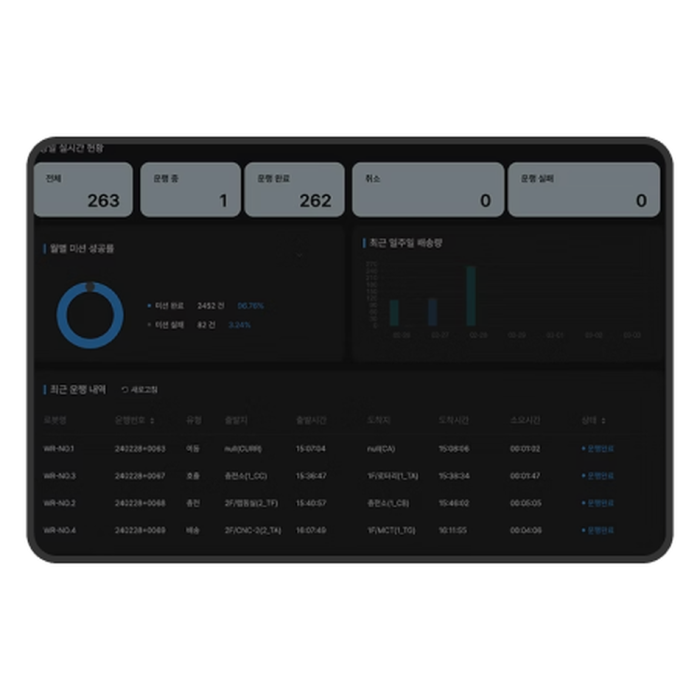
| Statistics | Daily, weekly, and monthly operation data; per-robot success rate visualized in graphs |
| IoT integration | Unified monitoring of IoT devices with real-time status and direct control when necessary |
Operational Considerations
Several points are worth weighing when evaluating WR-ACS for a facility. First, the stated real-time capacity of up to 100 robots is a manufacturer figure describing the upper bound of the fleet the system is designed to supervise; sites planning deployments near that scale should discuss their specific layout and workload with the supplier. Second, the published material does not state that the system is compatible with AMRs from every manufacturer, so prospective users should confirm which robot models can be connected before planning a mixed-fleet deployment. Third, because WR-ACS is software, questions such as licensing terms, hosting arrangements, and installation requirements are not covered in the published description and should be clarified directly with the supplier.
Operationally, the record-keeping functions deserve attention. Operation records are logged and analyzed so the resulting data can inform future improvements, and when issues occur, root causes and solutions are recorded to manage problems and prevent recurrence. This means the platform is intended not only for live supervision but also for building a structured history that supports troubleshooting and continuous improvement. Functions can be adjusted and edited according to factory conditions, which allows the configuration to evolve as a site changes rather than remaining fixed at commissioning.
Applications
WR-ACS is oriented toward environments where multiple autonomous mobile robots operate together and need centralized coordination. The manufacturer's references to factory conditions, ERP and MES integration, and multi-robot traffic control point toward manufacturing plants and similar industrial sites where material movement is tied to production planning systems. In such settings, destination calling and route navigation allow transport tasks to be dispatched to the fleet, while geofencing-based zones help manage how robots behave in different areas of the facility.
The analytics functions extend the platform's relevance to operations teams responsible for performance. Daily, weekly, and monthly operation data is comprehensively analyzed, and each robot's success rate is visualized through graphs, giving supervisors intuitive insight into how the fleet is performing over time. The IoT integrated monitoring capability further suits facilities that want robot supervision and connected-device monitoring consolidated on one platform, with real-time status checks and direct device control when necessary.
Frequently Asked Questions
How many robots can WR-ACS manage?
According to the manufacturer, the system monitors and controls up to 100 robots in real time. Sites planning large fleets should confirm sizing details for their specific environment with the supplier.
How are missions created in WR-ACS?
Missions are assigned to AMRs using an open-source Scratch framework, a block-based visual approach. The manufacturer states that users can easily create a wide range of missions and control AMRs intuitively, improving overall task productivity.
Does WR-ACS integrate with factory IT systems?
Yes, the platform integrates with higher-level systems such as ERP and MES to enable efficient operation management, so fleet activity can be connected to production and resource-planning workflows.
What monitoring and reporting does the system provide?
It provides real-time monitoring of AMR operation status and driving history, with records managed by robot, type, and date. Daily, weekly, and monthly data is analyzed, per-robot success rates are shown as graphs, and issue root causes and solutions are recorded to prevent recurrence.
Is WR-ACS compatible with AMRs from any manufacturer?
The published material does not state universal compatibility with third-party robots. Buyers intending to control AMRs from other brands should verify supported models with the supplier before deployment.
What is geofencing used for in WR-ACS?
Geofencing is used to configure various functions on the facility map and to monitor and control multiple AMRs in real time within defined zones, helping operators identify robot status and manage traffic efficiently.
Summary
The Wonik Robotics WR-ACS is a web-based, responsive AMR control system that supervises up to 100 robots in real time and integrates with ERP and MES systems. It combines geofencing-based map configuration, Scratch framework-based mission creation, multi-robot traffic control, destination calling, and route navigation with systematic operation records, issue management, and daily, weekly, and monthly statistics. With a customizable GUI and IoT integrated monitoring, it serves as a central supervisory platform for facilities operating autonomous mobile robot fleets; compatibility, licensing, and deployment details should be confirmed with the supplier.
Request a quotation to confirm configuration, pricing and availability. Catalog stock status is not confirmation of physical inventory or immediate shipment.