
Unitree R1-A5-D Mobile Base Dual-Arm Humanoid Robot
સ્ટોકમાં
- બ્રાન્ડ:
- UNITREE ROBOTICS
- મોડલ:
- R1-A5-D
- ORIGIN:
- ચીન
- Warranty:
- 12 MONTHS
- AVAILABILITY:
- SUBJECT TO AVAILABILITY
- SKU:
- Unitree-R1-A5-D
Unitree R1-A5-D Mobile Base Dual-Arm Humanoid Robot
The R1-A5-D is not one robot but a small matrix of them, and the fastest way to choose is to understand the four decisions behind the names rather than to compare sixteen listings.
What it is
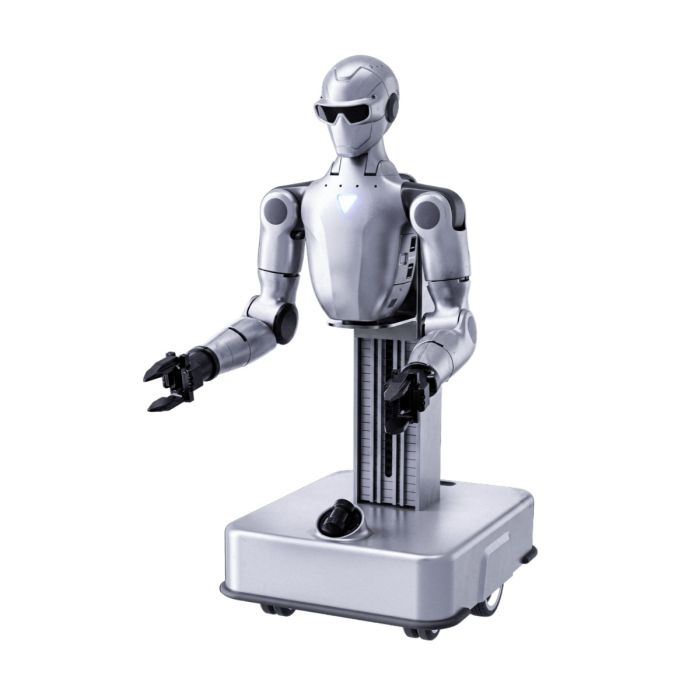
The Unitree R1-A5-D is a dual-arm mobile manipulation platform from Unitree's R1 family: two arms with five degrees of freedom each, a rotating waist and a two-degree-of-freedom sensor head, mounted on a wheeled chassis with a powered lifting column and a chassis LiDAR. That gives 16 degrees of freedom excluding the hands. It weighs about 30 kg with battery, rises to roughly 1.6 m and collapses to 683 × 520 × 440 mm. It is sold as a development platform with documented interfaces rather than as a closed product.
Four decisions, not seventeen products
The R1 dual-arm range looks bewildering until you see that every configuration is a combination of four independent choices. Each one changes exactly one thing.
| Decision | Options | What it changes |
|---|---|---|
| Arms | A5 or A7 | Five or seven degrees of freedom per arm. The seventh axis adds redundancy — the ability to reach the same point with the elbow somewhere else |
| Base | Fixed, or D for wheeled | A wheeled chassis with a powered lifting column, chassis LiDAR and a battery, instead of a bench mount on mains power |
| Compute trim | Smart or Ultimate | An NVIDIA Jetson Orin Nano at 40 TOPS, or an Orin NX at 100 TOPS. Nothing else differs |
| Hands | Eight options, A to H | From a two-finger gripper to tactile five-finger hands |
This page is an A5 with the wheeled base. Everything else about the torso — waist, sensor head, lifting column, sensing — is common across the range.
A5 or A7? The cheapest upgrade in the range
This deserves a straight answer rather than a shrug, because the A7 arms are the least expensive meaningful upgrade anywhere in this family — a few hundred dollars on a robot costing tens of thousands.
What the seventh axis buys is redundancy. A 5-DOF arm can reach a point in space; a 7-DOF arm can reach the same point with its elbow in a different place. That is what lets an arm work around an obstacle, hold a wrist orientation steady while the rest of the arm moves, or avoid an awkward singularity mid-trajectory. For planning-heavy manipulation research it genuinely matters.
Buy the A5 if your tasks are simple and repeatable enough that redundancy would go unused, or if you are fitting out several stations and the saving compounds across all of them. Otherwise, ask us for both prices before you commit — on most research briefs the A7 is worth it, and we would rather tell you that than sell you the cheaper robot twice.
What the wheeled base gives you, and what it costs
The D models put the same dual-arm torso on a wheeled chassis with a powered lifting column and a chassis LiDAR for navigation. It collapses to 683 × 520 × 440 mm and rises to about 1.6 m, weighing around 30 kg with battery.
The cost is not only the price. A fixed-base R1-A5 weighs about 11 kg, runs from mains power and never stops to charge; the wheeled version is roughly three times the mass and works in bursts between battery swaps. So buy the wheeled base when the robot genuinely has to travel — between workstations, around a building, following a person — and buy the fixed base when your manipulation research happens in one place. Mobility is a capability, not an upgrade.
The eight hand options
Listed cheapest first, which is also roughly the order of increasing capability. The same eight are offered on every base, arm and trim combination.
| Letter | Hands | Tactile sensing |
|---|---|---|
| A | Dex1-1 two-finger gripper | No |
| H | Tendon-driven dexterous hands with wrist-mounted RGB cameras | No |
| F | LinkerBot O6 hands | No |
| G | LinkerBot O6 hands with tactile sensing | Yes |
| D | BrainCo Revo 2 Basic five-finger hands | No |
| B | Dex3-1 force-controlled three-finger hands | No |
| E | BrainCo Revo 2 five-finger hands with tactile sensing | Yes |
| C | Dex3-1 force-controlled three-finger hands with tactile sensing | Yes |
Decide the arms from how much planning your tasks need, the base from whether the robot travels, the trim from where your models run, and the hands from what it has to hold. All four price independently.
R1-A5-D platform specifications
| Specification | Value |
|---|---|
| Degrees of freedom | 5 per arm × 2, plus 1 waist, 2 head, 1 lifting column and 2 base — 16 excluding hands |
| Arm payload | 2 to 4 kg per arm, varying considerably with arm extension |
| Weight | About 30 kg with battery |
| Height | Rises to about 1.6 m on the powered lifting column |
| Dimensions, collapsed | 683 × 520 × 440 mm |
| Mobility | Wheeled mobile chassis with powered lifting column |
| AI compute | Orin Nano 40 TOPS (Smart) or Orin NX 100 TOPS (Ultimate) |
| Onboard compute | 8-core CPU with a 10 TOPS module |
| Perception | Chassis LiDAR, sensor head |
| Power | Removable chassis battery |
| Hands | Eight options, gripper through tactile five-finger |
| Development | Documented interfaces for secondary development |
Published degree-of-freedom totals differ depending on how end effectors are counted, so the breakdown above is given rather than a single figure. All specifications vary by production batch — confirm the exact build on your quotation before ordering.
Who buys the R1-A5-D
- Mobile manipulation and bimanual coordination research
- Indoor logistics, fetch-and-carry and service robotics development
- Teaching laboratories wanting a mobile platform rather than a bench rig
- Teleoperation and imitation-learning groups
- Integrators prototyping mobile manipulation before committing to a larger platform
- Buyers who want dual arms and mobility without the cost of a bipedal humanoid
How to choose a configuration
Start with the arms. The A7 upgrade is the cheapest worthwhile change in the family, so ask for both prices unless your tasks are simple enough that arm redundancy would go unused.
Then the base — and be honest about whether the robot really needs to move. A fixed-base R1-A5 is about 11 kg, runs indefinitely on mains power and costs appreciably less. The wheeled chassis is the right choice only when travel is part of the work.
Then the trim. Smart at 40 TOPS covers navigation, teleoperation, data collection and classical manipulation; Ultimate at 100 TOPS is for running large models on the robot itself. Most buyers are not compute-bound.
Then the hands, which is where the real money sits. A two-finger gripper does more research than people expect. The LinkerBot O6 options give genuine dexterity for far less than the premium hands. Choose Dex3-1 three-finger hands for robustness and force control, or five-finger hands when human hand shape matters for teleoperation and imitation learning — and add tactile sensing only if your work will actually read it.
Safety and standards
The R1-A5-D is research and development equipment. The industrial robot safety standards — ISO 10218 and the ANSI/RIA R15.06 family — and the mobile robot standard R15.08 do not cover it, so the duty of care sits with the operator. Define and mark a working area, keep untrained people outside it, keep a trained operator with the emergency stop within reach, and complete a written risk assessment before any public demonstration. A driving robot with two arms carrying several kilos each needs that discipline whatever it weighs.
Lithium batteries are regulated dangerous goods in transit, which affects how spares ship and how quickly.
Deployment and running costs
Budget for at least one spare chassis battery, so the robot is not idle while a pack charges. Beyond that the platform asks little: reasonably flat, clear floor to drive on and somewhere to store it folded. End-effector spares are worth planning for, since hands are the most frequently damaged part of any manipulation platform; related parts are listed under robot accessories. International buyers should add duty and import charges. Current pricing is shown on the listing above; for quantities, grant purchases or bundles, request a written quotation.
Import and delivery
Units ship from the manufacturer and lead times follow production batches rather than a fixed schedule. Lithium batteries restrict some routes and add documentation. The folded size does at least make this one of the easier mobile manipulators to ship. Tell us the destination country when you enquire and we will confirm delivered cost, a realistic lead time and the paperwork required before you commit.
Support before and after the sale
Before you buy, our team will work through the four decisions above with you and quote the specific configuration that fits, rather than the most expensive one. Given how close these names are, that conversation prevents the most expensive mistake in this range. After delivery, we help with training, set up and ongoing support. The specifics for your order are confirmed on your quotation.
Where to buy
The individual configurations are listed with current prices and availability under Unitree R1-A5-D, with the fixed-base models under Unitree R1-A5 and the seven-axis versions under Unitree R1-A7 and Unitree R1-A7-D. Contact our team for a formal quotation including delivery to your country. Universities and institutions buying against a purchase order should request a written quotation first.
Frequently asked questions
How much does a Unitree R1-A5-D cost?
Price depends on the four choices above — arms, base, compute trim and hands. The individual configurations are listed with current prices; contact us for a quotation covering delivery to your country.
What is the difference between A5 and A7?
Arm freedom. A5 arms have five degrees of freedom, A7 arms seven. The seventh axis adds redundancy for planning around obstacles, and it is the cheapest worthwhile upgrade in this family.
What is the difference between R1-A5 and R1-A5-D?
The base. The R1-A5 is a fixed bench mount on mains power at about 11 kg; the D adds a wheeled chassis, a powered lifting column, chassis LiDAR and a battery, at about 30 kg.
What is the difference between Smart and Ultimate?
Only the compute module — Orin Nano at 40 TOPS against Orin NX at 100 TOPS.
How many hand options are there?
Eight, labelled A to H, from a Dex1-1 two-finger gripper to tactile five-finger hands. The same eight are offered on every base, arm and trim combination.
How many degrees of freedom does it have?
16 excluding the hands: 5 per arm, plus 1 in the waist, 2 in the head, 1 in the lifting column and 2 in the base.
How much can each arm lift?
Between 2 and 4 kg per arm. Unitree notes the figure varies a great deal with how far the arm is extended, so plan against the lower end.
Does the R1-A5-D walk?
No. It is a dual-arm upper body on a wheeled chassis. For a bipedal robot, see the Unitree R1 or the G1.
Is it open for development?
Yes. It ships with documented interfaces for secondary development.
Do you ship internationally?
Yes. Lithium batteries affect routing and lead time, so confirm the destination country when you enquire.