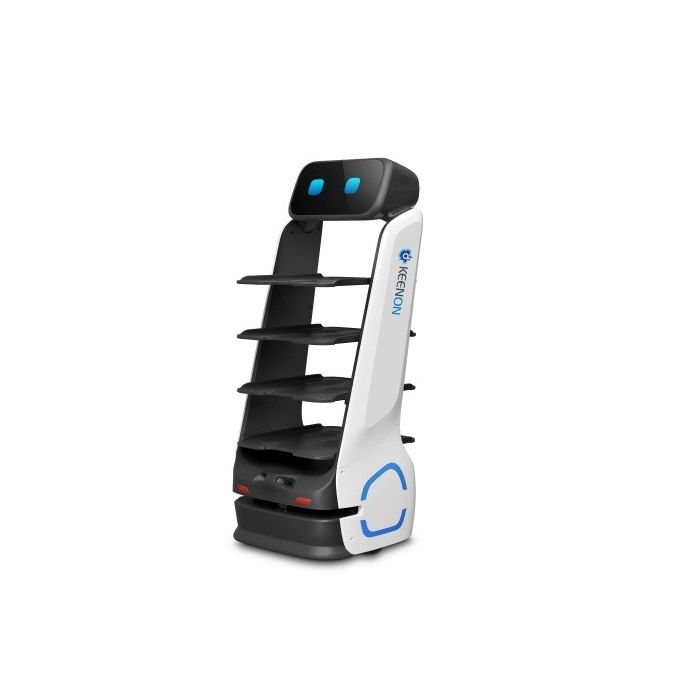
Keenon DINERBOT T9 High-load Capacity Restaurant Robot with 5 Year Warranty
In stock
- מותג:
- KEENON
- דגם:
- T9
- ORIGIN:
- סין
- Warranty:
- 60 MONTHS
- AVAILABILITY:
- ALLOW 2-4 WEEKS FOR DELIVERY
- SKU:
- KEENON-T9
Keenon DINERBOT T9 High-load Capacity Restaurant Robot with 5 Year Warranty
DINERBOT T9: The Restaurant Operator's ROI Guide to KEENON's Global Delivery Standard
The DINERBOT T9 addresses the transport component of this labor challenge specifically, not the full range of restaurant labor but the portion consumed by delivery trips between the kitchen and tables. This is the task with the lowest conversational and customer-interaction value in a server's job, and the one where a robot's consistent, always-available performance can most directly substitute for human labor without reducing service quality.
T9 Specifications: The Technical Foundation of the ROI Case
The 40-Kilogram, Four-Shelf System
The T9's 40-kilogram total load capacity is the direct enabler of multi-table delivery efficiency. Four adjustable shelves with specific configured heights of 19.5, 16.9, 25.3, and 22.8 centimeters (confirmed by Dominion Drones' product specification) accommodate the full range of restaurant service items:
The 19.5 and 16.9-centimeter layers handle standard dinner plates, entrée service, and most plated courses for two to three separate tables simultaneously. The 25.3-centimeter layer accommodates tall beverage service including wine carafes, cocktail glasses, and covered hot beverages. The 22.8-centimeter layer handles dessert presentations and specialty service items between the plate and glass height categories.
Loading three or four separate tables' courses simultaneously in a single trip from the kitchen dispatch station, then delivering sequentially to each table, multiplies the delivery throughput of a single robot against the throughput of a server making single-table trips. A server making 15 single-table delivery trips per hour, each taking three to four minutes from kitchen to table and back, spends 45 to 60 minutes per hour on delivery alone. A T9 making five four-table trips per hour covers the same 20-table delivery volume while freeing the server's equivalent time for customer interaction.
18-Hour Battery: The Full-Day Commitment
The 18-hour battery life is not a marginal improvement over competing platforms. For a restaurant operating from 7 AM through 1 AM, a single charge covers the complete operating day. The smart auto-charging system manages the charging cycle autonomously during low-activity periods (mid-morning, mid-afternoon slow periods) without requiring any staff intervention. This means the robot's operational readiness is never a management task: it charges when it has time, and it is available when needed.
Competing platforms with shorter battery life may require battery swaps, scheduled recharges during service, or planned operational gaps that create exactly the kind of unpredictable unavailability that erodes operator confidence in robot deployment.
VSLAM Navigation in Practice
The T9's VSLAM navigation builds its map of the restaurant floor during an initial mapping session, after which it navigates autonomously without the floor markers or infrastructure modifications that older-generation robots required. The 70-centimeter minimum passage width accommodates the typical aisle widths of most commercial restaurant floor plans globally, and 3D perception handles the dynamic obstacle environment of a live restaurant service: guests pushing back chairs, servers crossing the robot's path, children moving unpredictably, and temporary furniture rearrangements for events.
TOD System's European distributor documentation describes the obstacle detection system specifically: "Equipped with intelligent sensors, the Keenon Dinerbot T9 detects and bypasses obstacles from all directions, adapting its speed according to the context. This ability enables it to move safely and smoothly in crowded or complex spaces, ensuring accuracy and stability at all times."
Three Deployment Scenarios: ROI in Different Venue Types
Wedding Banquet and Event Catering
Large-scale event catering, particularly wedding banquets in the 100 to 300-guest range, creates temporary extremely high delivery demand concentrated in a two to three-hour service window. A typical wedding banquet requires delivering six to eight courses to dozens of tables simultaneously, with tight timing coordination between courses.
Two or three T9 units with coordinated multi-robot dispatching can handle the bulk of course delivery transport for a 200-person banquet, allowing the service team to focus on tableside pouring, guest interaction, and the presentation elements that require human judgment. The T9's four-shelf configuration is particularly appropriate for banquet service where multiple tables' identical course deliveries can be loaded simultaneously at kitchen dispatch.
School Cafeteria and Corporate Dining
School cafeterias and corporate dining facilities have the most predictable delivery demand pattern of any food service environment: a compressed peak period (typically 30 to 90 minutes) with very high volume, followed by an immediate return to low activity. This predictability is ideal for robot deployment: the T9 can be programmed to expect peak periods, pre-positioned at kitchen dispatch points at peak start times, and scheduled for charging during off-peak periods.
For a school cafeteria serving 400 students in a 45-minute lunch window, a two-T9 fleet with coordinated dispatching can handle the tray delivery component of service while cafeteria staff focus on supervision, food assembly, and the student interaction that improves the cafeteria experience.
Hotel Buffet and Continuous Restaurant Service
Hotel buffet restaurants operating continuous service from breakfast through late evening are the environment where the T9's 18-hour battery life is most directly commercially valuable. A hotel restaurant running from 6:30 AM breakfast through 11 PM evening service with continuous coverage across three meal periods can deploy the T9 through all three periods on a single charge, with autonomous charging management between breakfast and lunch, and between lunch and dinner, ensuring readiness for each peak period.
Fleet Economics: The Case for Two or More T9 Units
Why Single-Robot Deployments Under-Deliver ROI
A single T9 in a 100-cover restaurant makes one delivery at a time, creating a delivery queue during peak periods. While the single robot improves on no automation, its throughput is limited by a single robot's cycle time. A single T9 handling 20 percent of table deliveries saves a limited amount of server transport time that may not clearly exceed the robot's acquisition cost amortization on a standard payback model.
Two T9 units with KEENON's multi-robot dispatching, by contrast, operate in coordinated parallel: the dispatching system assigns tasks to the nearest available robot, coordinates routes to prevent robot-to-robot conflicts, and manages the kitchen dispatch queue to maximize throughput. Two T9 units handling 40 percent of table deliveries in a 100-cover restaurant shifts the labor substitution calculation substantially, freeing the equivalent of roughly one server's transport time per shift.
The acquisition cost of a two-T9 fleet at USD $9,800 each (USD $19,600 total) against an annual labor saving of USD $25,000 to $36,500 for a USD $1 million restaurant produces a payback period of six to nine months for a two-unit fleet.
Fleet Scaling: When to Add a Third and Fourth Unit
For restaurants above 100 covers, or those with complex floor plans requiring longer robot travel times between kitchen and tables, three to four T9 units provide a more complete coverage model. KEENON's multi-robot dispatching supports coordination of multiple units without creating congestion, and the per-unit cost remains constant as fleets scale.
Summary
The Keenon DINERBOT T9 represents the most commercially proven and economically accessible delivery robot available to international food service operators. Its 40-kilogram four-shelf capacity for multi-table delivery in a single trip, 18-hour battery covering full service-day operation, VSLAM and 3D perception navigation for safe crowded-space performance, and coordinated multi-robot dispatching for fleet deployments have been validated across more than 25,000 restaurants globally. At USD $9,800 with free delivery from Open Bot Solutions, the T9's payback period against the NRA-documented 36.5 percent labor cost burden facing US full-service operators ranges from three to nine months for single and two-unit deployments, making it the highest-ROI capital investment available to the restaurant sector in 2026.
Frequently Asked Questions (FAQ)
What are the documented labor cost savings from deploying the DINERBOT T9?
Restaurant automation research consistently documents 10 to 25 percent labor savings from deployment. Against the National Restaurant Association's documented median labor cost of 36.5 percent of full-service restaurant sales in 2024, a 10 percent saving on labor for a USD $1 million restaurant produces approximately USD $36,500 annually. Against a USD $9,800 T9 purchase price with free delivery through Open Bot Solutions, this produces a payback period of approximately four months. Specific savings depend on the restaurant's service model, existing staffing structure, and the proportion of labor currently consumed by delivery tasks.
How does the DINERBOT T9's 40-kilogram capacity create operational value?
The T9's 40-kilogram capacity across four adjustable shelves enables loading orders for multiple tables simultaneously, each on a separate shelf level, and delivering them sequentially in a single trip from the kitchen. This multiplies delivery throughput per robot trip compared to single-order delivery systems. A server making 15 single-table trips per hour spends 45 to 60 minutes per hour on delivery alone; a T9 making five four-table trips per hour covers the same volume while freeing equivalent server time for customer interaction, upselling, and service recovery tasks where human engagement creates commercial value.
Why is the 18-hour battery important for restaurant economics?
The T9's 18-hour battery eliminates the operational management burden of mid-shift robot recharging, which is one of the most common sources of operator dissatisfaction with shorter-battery-life robots. A restaurant operating from 7 AM through 1 AM can deploy the T9 at opening and trust it to manage its charging cycle autonomously during natural low-activity periods (mid-morning, mid-afternoon) without any staff intervention. This operational reliability is the practical prerequisite for treating the robot as a standard service team member rather than a piece of equipment requiring active management.
How does the DINERBOT T9 compare to Bear Robotics Servi Plus?
The T9 (USD $9,800 purchase) and Bear Robotics Servi Plus (subscription model) are the two most commonly compared restaurant delivery robots in the North American market. The T9's advantages are a 40-kilogram four-shelf payload capacity, 18-hour battery life, lower purchase price for outright ownership, and broader global deployment evidence (25,000-plus restaurants across 60-plus countries). Bear Robotics Servi Plus has documented US casual dining chain partnerships and well-established US retail distribution infrastructure. For US operators whose primary consideration is domestic support and POS integration, evaluating both platforms' specific system compatibility is recommended.
Specifications
- Dimensions(WxDxH): 50.0 x 52.7 x 126.6cm (19.69" x 20.75" x 49.84")
- Weight*: 63kg (139lbs)
- Moving Speed: 0.1-1.0 m/s (0.33-3.28 ft/s)
- Battery Life**: Up to 18h
- Charging Time***: 4h
- Slope Angle: 5°
- Total Load Capacity: 40kg (88lbs)
- Minimum Passage Width: 70cm (27.56")
Keenon DINERBOT T9 high-load restaurant delivery robot
Official Keenon source highlights
- Large 11.6-inch operation screen for clearer information and easier operation.
- LiDAR plus dual stereo vision sensors support upper and lower obstacle perception.
- Supports simple deployment, multi-robot collaboration and restaurant delivery workflows.
Source-backed specifications
| Robot size | 500 x 527 x 1266 mm (W x D x H) |
|---|---|
| Net weight | 65 kg with battery |
| Load capacity | 40 kg, 10 kg per layer including bottom layer without tray |
| Layer amount | 4 |
| Space of each layer | First layer 490 x 404 x 185 mm; remaining layers 490 x 404 x 169 mm |
| Moving speed | 0.1-0.8 m/s adjustable |
| Battery life | 13-18h |
| Charging time | 4-5h |
| Operation screen | 11.6-inch |
| Minimum passage width | 70 cm |
Updated from the official Keenon Drive product materials supplied for this catalogue refresh.