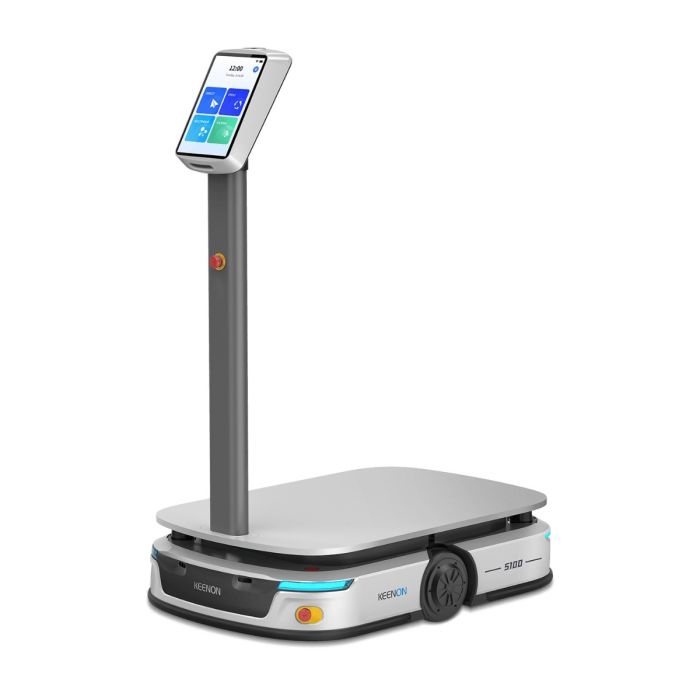
KEENON S100 Heavy-Load Courier Robot with 5 Year Warranty
In stock
- 상표:
- KEENON
- 모델:
- S100
- ORIGIN:
- 중국
- Warranty:
- 60 MONTHS
- AVAILABILITY:
- ALLOW 2-4 WEEKS FOR DELIVERY
- SKU:
- KEENON-S100
KEENON S100: The Autonomous 100-Kilogram Courier Robot for Industrial and Commercial Environments
Officially described as a "heavy-duty delivery robot that can be activated on the same day by performing simple initial settings using the installed OS and apps," the S100 is built around four operational commitments confirmed across multiple distributor specifications: load capacity over 100 kilograms for reliable heavy goods transport; same-day plug-and-play deployment through a pre-installed operating system; 24/7 continuous operation through three charging options including a 15-second battery swap; and safety prioritization through 360-degree obstacle avoidance, bumper sensors, and three emergency stop buttons.
The Material Transport Problem the S100 Solves
The Cost and Risk of Manual Heavy Carrying
Industrial material handling using human labor is one of the most thoroughly documented sources of workplace injury across sectors. US Bureau of Labor Statistics data consistently identifies musculoskeletal disorders from overexertion and repetitive lifting as among the most common non-fatal injury categories in manufacturing, wholesale trade, and healthcare industries. These injuries represent not only direct costs through workers' compensation, medical treatment, and productivity loss but also indirect costs through reduced morale, difficulty recruiting for physically demanding positions, and the operational disruptions created when experienced workers are temporarily or permanently unable to return to their roles.
The specific weight range that the S100 addresses, 50 to 120 kilograms, corresponds to the most frequent source of serious industrial lifting injuries. Loads in this range are heavy enough to cause immediate injury from a single lift executed with poor form or from a slip during transport, but light enough that facilities have historically relied on human workers rather than investing in fixed conveyor or forklift infrastructure for every transport point.
The S100 displaces human workers from this injury-prone transport function entirely, operating continuously without the fatigue accumulation that increases injury risk in the final hours of a manual transport shift and without the ergonomic constraints that limit how quickly a human worker can safely move a 100-kilogram load.
The Operational Economics Context
At a fully-loaded cost of approximately USD $22 to $30 per hour for industrial materials handling workers in US major markets (wages, FICA, workers' compensation premium, healthcare contribution, and overhead), the S100's 8-hour continuous operation per charge covers a full work shift at a fixed robot capital and operating cost that does not vary with local minimum wage legislation, labor market tightness, or overtime requirements.
European industrial labor markets, particularly in Germany, France, and the Netherlands, carry still higher total employment costs, making the economic case for the S100 progressively more favorable as those markets' labor costs increase through 2026 and beyond. TOD System's Italian distributor listing for the S100 positions it explicitly for "automation in industrial and commercial environments," confirming that European industrial buyers are among the primary target market segments for this platform.
Design and Physical Characteristics
Compact Footprint for Real Industrial Environments
The S100's 92.5 by 62.0 centimeter footprint is designed for the real passage widths of industrial facilities rather than idealized open warehouse environments. TOD System's detailed specification documentation notes that the S100 "enables stable transport of goods through spaces with narrow passageways up to 90 cm wide," confirming that the robot is designed for aisle widths slightly above its own 62-centimeter width. Other distributor specifications note a 75-centimeter minimum passage width. For industrial buyers evaluating deployment in existing facilities where aisle widths were designed for human and standard pallet equipment rather than AMRs, the 62 to 92.5-centimeter footprint enables deployment in most standard industrial aisle configurations without requiring facility layout modification.
The 128.2-centimeter height positions the S100's cargo platform at a height comparable to a standard industrial workbench, enabling loading and unloading without the bending and reaching that lower-profile platforms require. This ergonomic consideration for the human workers who load and unload the robot is relevant for facilities where the S100 will be repeatedly loaded and unloaded by the same workers across a shift.
Four-Tier Modular Tray System
The S100's payload system uses a four-tier modular tray configuration that accommodates diverse payload types and shapes. The modular design allows the tray configuration to be adapted for specific facility requirements: large open trays for bulk supply delivery, compartment dividers for multi-item component kitting, bin configurations for bulk granular or packaged materials, and enclosed boxes for temperature-sensitive or hygiene-critical items. This adaptability means the same S100 chassis can serve multiple transport functions within a single facility, reducing the number of specialized robot types a facility needs to manage.
Helping Hand Robotics' documentation confirms: "Four-Tier Modular Tray System Configurable to accommodate diverse payloads including dishes, tools, medical kits, or packaged goods," reflecting the cross-sector applicability of the modular tray approach.
Technology and Specifications
PID-Based Stability Control System
TOD System's detailed specification documentation reveals a technical capability not commonly described in English-language distributor listings: the S100 uses "an advanced control system based on PID algorithms, maintaining optimal balance during acceleration, braking and cornering." PID (Proportional-Integral-Derivative) control is a feedback-based control algorithm that continuously measures the difference between the robot's actual motion state and its target motion state, and applies corrective motor commands in proportion to the measured error. For a robot carrying 100 kilograms of dynamic load, PID stability control is what prevents load shifting during acceleration and deceleration phases that could damage the transported goods or create a safety hazard from moving loads.
This active stability control is what enables the S100 to carry liquids, fragile items, and unsecured loads safely at 1 meter per second, rather than requiring slow creep speeds or dedicated load restraint systems for every transported item.
Three-Mode Sensing: LiDAR, Stereo Vision, and Imaging Modules
TOD System's specification documentation confirms the S100's full sensor complement: "LiDAR sensors, stereo vision and imaging modules" that "accurately detect both ground and suspended obstacles." This three-modality approach provides comprehensive obstacle detection across the vertical range that industrial environments present:
LiDAR sensors provide 360-degree horizontal distance measurement at the robot's scan plane height, building precise geometric maps of the environment and enabling reliable positioning against those maps. The consistent scan timing and precision of LiDAR enables the S100 to navigate in environments where visual conditions (lighting, surface reflectivity, visual complexity) would challenge vision-only systems.
Stereo vision sensors provide 3D depth perception for objects at close range and at heights that LiDAR's horizontal scan plane may not cover. Ground-level obstacles including dropped pallets, equipment left on the floor, and low-profile floor features fall into this category.
Imaging modules add visual context to the geometric and depth data from LiDAR and stereo vision, enabling the robot to distinguish between types of obstacles and make more sophisticated navigation decisions than geometry-only systems allow.
TOD System notes specifically that this sensing combination handles "complex terrain and uneven surfaces, ensuring consistent and safe movements," which is relevant for industrial facilities where floor surfaces are rarely perfectly uniform.
Three Charging Options: The 24/7 Continuity System
The S100's three charging options represent a deliberate design choice to accommodate the operational realities of diverse facility configurations. TOD System and IPROS both confirm the three-mode charging system, and Useabot's documentation states it explicitly: "three charging options, charging pile, adapter, and a quick-swap battery that takes just 15 seconds, you can ensure around-the-clock delivery."
Charging pile (dedicated charging station): The primary charging mode for facilities with a fixed robot parking and charging area. The robot autonomously navigates to its charging station during low-activity periods (shift breaks, overnight, between task queues) and connects to the charging dock without human intervention. Full recharge takes 2.5 hours.
Adapter (manual/AC charging): A backup charging option using a standard AC power adapter, appropriate for temporary deployments, facilities where charging station installation has not been completed, or for maintaining charge levels during extended low-activity periods without occupying a dedicated charging station.
15-second battery swap: The operational cornerstone for facilities requiring genuine 24/7 coverage without any recharge gap. A spare battery, pre-charged to full capacity, can be inserted in the S100 in approximately 15 seconds by a single worker. This swap time is short enough to be completed during a task handover or brief operational pause without creating a meaningful service gap. For a hospital operating 24-hour continuous material transport, two batteries per S100 unit, with one always on charge while the other is installed, enable fully continuous operation with no downtime for recharging.
Fleet Management and Task Coordination
Like all Keenon robots, the S100 operates within the company's fleet management software when deployed in multi-robot configurations. Task assignment, route planning, conflict resolution, and operational monitoring are managed through the platform's cloud-based management interface, enabling facility operators to monitor all deployed S100 units' status, location, battery level, and task progress in real time without physical supervision.
FieldBots' integration documentation specifically addresses the S100's fleet coordination capability for warehouse management system integration, enabling automatic task generation from existing WMS platforms rather than requiring manual task assignment for each delivery.
Applications and Use Cases
Manufacturing Component Transport
In manufacturing environments, the S100 performs the intra-logistics function of moving raw materials, components, work-in-progress, and finished goods between receiving areas, storage, production workstations, quality inspection, and shipping staging. TOD System's description of the S100 as "perfect for complex environments" and capable of handling "complex terrain and uneven surfaces" directly addresses the real floor conditions of manufacturing facilities where production equipment, cable management systems, and floor drains create surface irregularities that challenge simpler AMR systems.
The S100's 100-kilogram payload accommodates the weight range of most manufacturing component transport tasks in industries including automotive (stampings, castings, assemblies), electronics (circuit boards, chassis, component kits), food and beverage (ingredient containers, packaging materials), and pharmaceutical (bulk supply, in-process materials).
Hospital Supply Chain Transport
Hospital material transport is among the most compelling applications for the S100's specific capabilities. Hospitals require regular transport of pharmaceutical supplies, sterile instruments, linen, patient meals, laboratory samples, and equipment between central supply, sterilization, pharmacy, laundry, kitchen, and clinical areas. This transport work is typically performed by dedicated transport staff whose time on transport is time unavailable for other productive functions.
The 15-second battery swap capability is particularly valuable in hospital settings, where transport operations are continuous across 24 hours and cannot accommodate the 2.5-hour recharge cycle that interrupts coverage in other operational models. A hospital deploying two or three S100 units with two batteries each maintains continuous transport capacity across all hours of operation, with batteries swapped at nursing station handover or during natural transport lulls.
The S100's 360-degree obstacle avoidance is essential in hospital corridors where patients, visitors, wheelchairs, IV poles, and treatment carts create a highly dynamic and unpredictable obstacle environment that forward-only sensing systems cannot reliably navigate safely.
Large Hotel and Resort Logistics
Large hotel and resort properties represent a deployment context where the S100 specifically addresses the high-payload supply transport function that the BUTLERBOT W3 and T9 Pro's lower payload capacities cannot accommodate. Full linen trolleys for a hotel floor, bulk food service supplies from receiving to kitchen, and equipment transport for conference and banquet setups regularly involve 50 to 120-kilogram loads that require the S100's capacity.
Hero LifeCare's product listing explicitly identifies resorts as an S100 deployment context: "use the S100 in resorts to deliver bags to rooms with ease and impress your guests at the same time as you reduce labor costs," identifying guest luggage transport as a specific use case where the 220-pound payload capacity handles typical baggage loads while the robot's novel presence creates a distinctive guest experience.
Advantages and Benefits
Same-day plug-and-play deployment without IT integration: The pre-installed OS and application software enable same-day operational start following facility mapping, without the weeks-long custom integration that many industrial automation systems require. For facilities evaluating automation for the first time, this immediacy dramatically reduces deployment risk.
15-second battery swap enables uninterrupted 24/7 operation: The 15-second swap time is short enough to execute during natural operational pauses without creating service gaps. Combined with a pre-charged spare battery, this enables truly continuous operation without the 2.5-hour recharge downtime that limits other autonomous mobile robots to partial-day coverage.
PID stability control for safe high-speed heavy-load transport: The active stability control system enables the S100 to carry 100-kilogram loads at 1 meter per second with liquid and fragile item compatibility that passive tray systems at equivalent speeds cannot match.
Three-modality sensing for reliable real industrial navigation: The LiDAR, stereo vision, and imaging sensor combination handles the full range of obstacle types and surface conditions encountered in real industrial, hospital, and hotel environments, including ground-level obstacles, suspended hazards, and uneven surfaces.
Ergonomic injury elimination for the most common heavy lifting weight range: The 50 to 120-kilogram weight range that the S100 handles is precisely the range most associated with serious workplace lifting injuries, making each deployed S100 unit a measurable risk reduction as well as a productivity improvement.
Summary
The KEENON S100 is one of the most practically deployable heavy-load autonomous mobile robots available to international industrial, commercial, and healthcare buyers in 2026. Its combination of same-day plug-and-play deployment, 100-kilogram payload with PID-stabilized transport at 1 meter per second, three charging options including a 15-second battery swap for 24/7 coverage, LiDAR and stereo vision sensing for reliable real-world navigation, and 360-degree safety architecture positions it as the accessible commercial starting point for heavy-load AMR deployment in the operational weight range most associated with workplace ergonomic injury. Backed by Keenon's 15-year service robot manufacturing heritage, global subsidiary network across 60-plus countries, and fleet management technology refined through the world's most commercially deployed service robot fleet, the S100 provides industrial, hospital, and hospitality buyers with the most operationally proven and globally supported 100-kilogram autonomous delivery robot accessible through standard commercial distribution channels.
Frequently Asked Questions (FAQ)
What is the KEENON S100?
The KEENON S100 is an autonomous heavy-load delivery robot developed by KEENON Robotics Co., Ltd. for industrial, commercial, and healthcare material transport. Key specifications: dimensions 92.5 × 62.0 × 128.2 cm (36.42" × 24.41" × 50.47"), 87.5 kg robot weight, 100+ kg payload capacity (up to 120 kg), 1 m/s maximum speed, 8-hour battery life per charge, 2.5-hour full recharge, 15-second hot-swap battery, LiDAR + stereo vision + imaging sensor navigation, 360° obstacle avoidance, three emergency stop buttons, and same-day plug-and-play deployment. Applications include manufacturing, warehousing, hospitals, hotels, and resorts.
How does the KEENON S100 operate continuously for 24 hours?
The S100 achieves 24/7 operation through its three-charging-mode system. The 15-second battery swap is the key to true 24/7 operation: a pre-charged spare battery can be inserted by a single worker in 15 seconds, replacing the depleted battery without requiring the robot to be taken out of service for the 2.5-hour full recharge cycle. Facilities maintain two batteries per S100 unit: one installed and operating, one on the charging station. When the installed battery reaches low charge, a worker swaps it with the fully charged standby battery in 15 seconds, and the depleted battery begins recharging while the robot continues operating with the fresh battery. This cycle enables completely uninterrupted transport coverage across all operating hours.
How does the KEENON S100 maintain stability when carrying 100-kilogram loads?
The S100 uses a PID (Proportional-Integral-Derivative) control system that continuously monitors the robot's actual motion state and applies corrective motor commands to maintain balance and stability during acceleration, braking, and turning. TOD System's documentation confirms this system "maintains optimal balance during acceleration, braking and cornering" and handles "complex terrain and uneven surfaces." This active stability control is what enables the S100 to transport liquids, fragile items, and unsecured loads safely at 1 m/s rather than requiring slow creep speeds for sensitive cargo.
What are the main differences between the KEENON S100 and S300?
The S100 and S300 differ primarily in payload capacity (100 to 120 kg versus 300 kg) and structural design for their respective load ranges. Both use SLAM/LiDAR autonomous navigation, modular cargo systems, and industrial-grade construction for continuous shift operation. The S100 is appropriate for transport tasks where individual load weights stay under 120 kg, covering the majority of manufacturing, hospital supply, and light-logistics applications. The S300 is required when loads regularly reach 200 to 300 kg, which applies to heavy automotive components, bulk hospital supply runs, full hotel linen loads, and heavy raw material deliveries. Both can operate within coordinated fleets managed through Keenon's fleet management platform, enabling optimal allocation of payload capacity across different transport tasks within a single facility.
Specifications
- Dimensions(WxDxH): 92.5 x 62.0 x 128.2cm (36.42" x 24.41" x 50.47")
- Total Load Capacity: 100kg+ (220lbs+)
- Max. Moving Speed: 1m/s (3.28ft/s)
- Battery Life*: Up to 8h
- Charging Time**: 2.5h
- Standard Shelf Size: 86.5 x 60.0 x 80.0cm (34.06" x 23.62" x 31.50")
- Weight: 87.5kg (192.9lbs)
- Minimum Passage Width: 90cm (29.53") - without rotation
Keenon S100 heavy-load autonomous delivery robot
Official Keenon source highlights
- Designed to reduce manual heavy-object handling risks and improve material flow efficiency.
- Supports integration with elevators, access-control gates and remote calling systems.
- Built for autonomous logistics workflows rather than restaurant table delivery.
Source-backed specifications
| Product class | Heavy-load autonomous delivery robot |
|---|---|
| Application scenarios | Factories, hotels, supermarkets, warehouses, hospitals and industrial logistics |
| Capabilities | Heavy-object transport, IoT integration, elevator and access-control integration, remote calling |
| System features | App/cloud management, multi-robot collaboration and hardware/software expansion interfaces |
Updated from the official Keenon Drive product materials supplied for this catalogue refresh.