
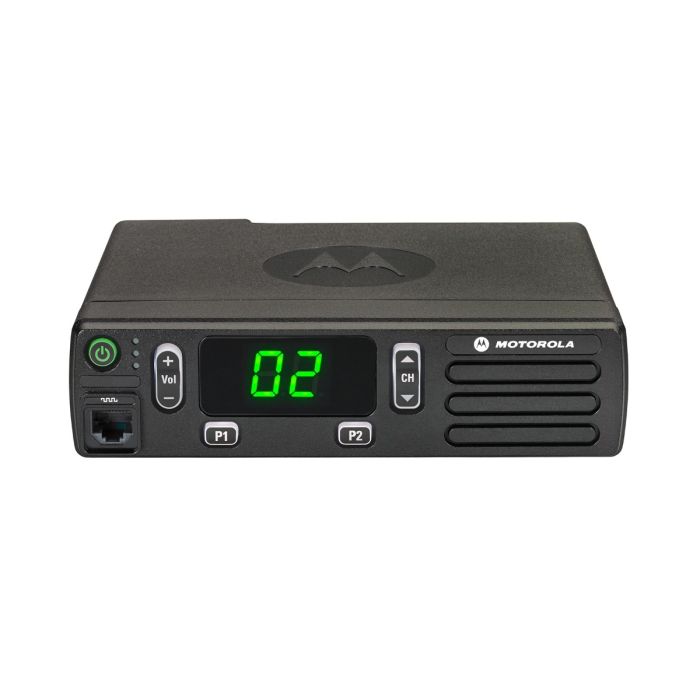
Motorola CM200d-AU-40 PKG Analog Mobile Two-Way UHF Radio (AAM01QPC9JC1_N)
有货
- 品牌:
- MOTOROLA
- 型號:
- CM200d-AU-40 PKG
- 零件#:
- AAM01QPC9JC1_N
- AVAILABILITY:
- USUALLY SHIPS IN 3-5 BUSINESS DAYS
- SKU:
- Motorola-CM200d-AU-40-PKG
Motorola CM200d-AU-40 PKG Analog Mobile Two-Way UHF Radio (AAM01QPC9JC1_N)
Within the CM Series, the CM200d is the simpler model. Motorola’s official product spec sheet lists the CM200d with 16 conventional channels, while the CM300d offers more channels and a more advanced display. That makes the CM200d especially suitable for users who want straightforward controls, a lighter channel plan, and essential business-radio functionality without added complexity.
The exact model requested here, AAM01QPC9JC1_N, is commonly listed by resellers as the CM200d-AU-40 PKG, an analog, UHF, 403–470 MHz, 40-watt version of the radio. Multiple reseller listings map this part number to that configuration, and those details fit Motorola’s published CM Series family specifications for UHF CM200d variants.
Although this version is sold as an analog radio, several reseller descriptions note that the analog-only CM200d platform can later be upgraded to digital through software, which is consistent with Motorola’s broader CM Series positioning as a bridge between legacy analog fleets and future digital deployments. This upgrade path appears in reseller materials rather than the core spec sheet for the analog SKU, so buyers should confirm it with the seller for the exact package being purchased.
Design and Features
Compact mobile form factor
Motorola’s official CM Series specification sheet lists the radio dimensions at approximately 44 x 169 x 134 mm and the weight at about 1.3 kg. That compact footprint makes the CM200d suitable for vehicle dashboards, under-dash brackets, service counters, and dispatch positions where space is limited but reliable communications are still essential.
Simple display and operational layout
The CM200d is designed as a more straightforward mobile radio than the CM300d. Motorola and reseller descriptions indicate that the CM200d uses a simple display focused on basic channel information, helping drivers, technicians, and dispatch users stay connected without distraction. This simplicity is one of the model’s defining characteristics.
Analog voice operation
The CM200d-AU-40 PKG is sold as an analog mobile radio, making it useful for organizations that already operate analog systems and want compatibility with existing infrastructure. Reseller listings for AAM01QPC9JC1_N consistently identify it as an analog UHF model, rather than the analog/digital SKU variant.
Business-radio features
Reseller feature summaries for this exact part number list functions such as Auto/Priority/Dual Priority Scan, Quik Call II call alert/selective call (decode), MDC1200 PTT ID encode, audio indicator tones, time-out timer, VOX, and busy channel lockout. These are typical business-radio features aimed at safer, more controlled day-to-day communications. Because these items come from dealer listings rather than Motorola’s official CM spec sheet for the whole family, they should be treated as model-specific reseller-provided details.
Technology and Specifications
Frequency range and power output
Multiple sources identify AAM01QPC9JC1_N as a UHF 403–470 MHz radio with 40 watts of output power. Motorola’s official CM Series sheet confirms that UHF CM200d models are available in the 403–470 MHz range and that the family includes 40W UHF options.
Channel capacity
The CM200d supports 16 conventional channels, according to Motorola’s official product specification. That channel count is sufficient for many fleets, maintenance teams, utility crews, school transport systems, and service businesses that need clear communications but do not require complex multi-zone channel plans.
Audio performance
Motorola’s official CM Series materials list 4 watts internal audio output, with support for higher audio output through external speakers depending on impedance. That is useful in vehicles and noisy work environments where intelligibility matters.
Environmental durability
Motorola rates the CM Series at IP54 for dust and splash resistance when properly configured, and the official sheet also states that the radios meet multiple MIL-STD 810 environmental test methods. The operating temperature range is listed as -30°C to +60°C, with storage from -40°C to +85°C.
Dimensions and programming
A reseller listing for AAM01QPC9JC1_N gives the dimensions in inches as 1.7 x 6.7 x 5.3, matching Motorola’s family dimensions in metric, and notes PC programming, repeater capability, and channel scan. These are reseller-provided operational details rather than full Motorola primary-source specs for the exact analog package SKU, but they are consistent with the product family.
Applications and Use Cases
Transportation and fleet operations
Motorola’s official CM Series literature specifically frames these radios as useful for people “delivering packages or transporting passengers.” That makes the CM200d-AU-40 a strong fit for delivery fleets, shuttle services, service vans, school transport, and mobile supervisors who need direct push-to-talk coordination.
Utilities and field service
For utility teams, installers, road crews, and general field service organizations, a 40W UHF analog mobile radio offers strong in-vehicle communications with simple deployment. UHF is commonly preferred in mixed urban and building-heavy environments, though exact performance depends on installation, antenna system, and terrain. The UHF band and 40W rating are sourced; the planning implication is an industry-standard inference.
Construction and industrial sites
Construction firms and industrial operations often favor radios that are easy to standardize, simple to train on, and durable enough for regular use. The CM200d’s limited but practical 16-channel structure and analog compatibility make it appealing where users want straightforward operation and interoperability with existing analog fleets.
Education, facilities, and commercial campuses
Schools, campuses, hotels, warehouses, and commercial facilities can use the CM200d as a dispatch or maintenance mobile radio. In those environments, the modest channel count can be a benefit because it reduces complexity for users who only need a few core communications paths. This last point is an inference based on the official 16-channel design.
Advantages / Benefits
Strong compatibility with legacy analog systems
The biggest benefit of the CM200d-AU-40 PKG is its analog focus. Organizations with established analog fleets can deploy it without needing an immediate system migration, which can simplify purchasing and rollout.
High-power UHF mobile performance
At 40 watts, this model sits in the higher-power end of the CM200d UHF family. That makes it well suited to mobile use where stronger transmit power is desirable. Real-world coverage will still depend on antenna selection, installation quality, repeater design, and terrain.
Easy operation and low training burden
The combination of a simple display, 16 channels, and conventional analog operation makes the CM200d relatively easy to deploy across larger user groups. That can be valuable in transportation, facilities, and maintenance environments where not every user needs advanced radio features. This is an inference from the documented design.
Potential path to future digital migration
Several reseller sources state that analog-only CM models can be upgraded later to digital via software. That can make the radio more future-friendly than a permanently fixed analog-only design, although buyers should verify that point for the exact SKU and region before purchasing.
FAQ Section
What is the Motorola CM200d-AU-40 PKG Analog Mobile Two-Way UHF Radio?
It is a Motorola CM Series mobile radio sold as an analog UHF 403–470 MHz, 40W, 16-channel model. The exact part number AAM01QPC9JC1_N is commonly mapped by resellers to the CM200d-AU-40 PKG configuration.
How does the Motorola CM200d-AU-40 work?
It works as a vehicle-mounted or desk-mounted analog push-to-talk radio operating on licensed UHF frequencies. Users communicate over programmed channels using standard two-way radio operation, making it suitable for fleet, dispatch, and service coordination.
Why is the Motorola CM200d-AU-40 important?
It is important because it provides a simple, high-power analog mobile radio for organizations that still rely on legacy analog systems but want a professional, commercially durable platform. Reseller materials also suggest it may offer a later software path to digital migration.
What are the benefits of the Motorola CM200d-AU-40?
Its main benefits include 403–470 MHz UHF coverage, 40W output, 16 channels, analog fleet compatibility, IP54 commercial durability, and a simple operational design suited to transportation, field service, and facilities use.
Summary
The Motorola CM200d-AU-40 PKG Analog Mobile Two-Way UHF Radio (AAM01QPC9JC1_N) is a straightforward commercial mobile radio aimed at buyers who need dependable analog UHF communications in a professional vehicle or dispatch form factor. With 403–470 MHz coverage, 40W output, 16 channels, IP54 durability, and a design centered on simple fleet use, it remains a practical choice for transportation, utilities, maintenance, and general service operations. Reseller sources also suggest a potential software path to digital migration, which may add long-term value for some buyers.
Specifications
| 型號 | CM200d-AU-40 PKG |
|---|---|
| 零件# | AAM01QPC9JC1_N |
| 產品類型 | 雙向無線電 |
| 品牌 | MOTOROLA |