
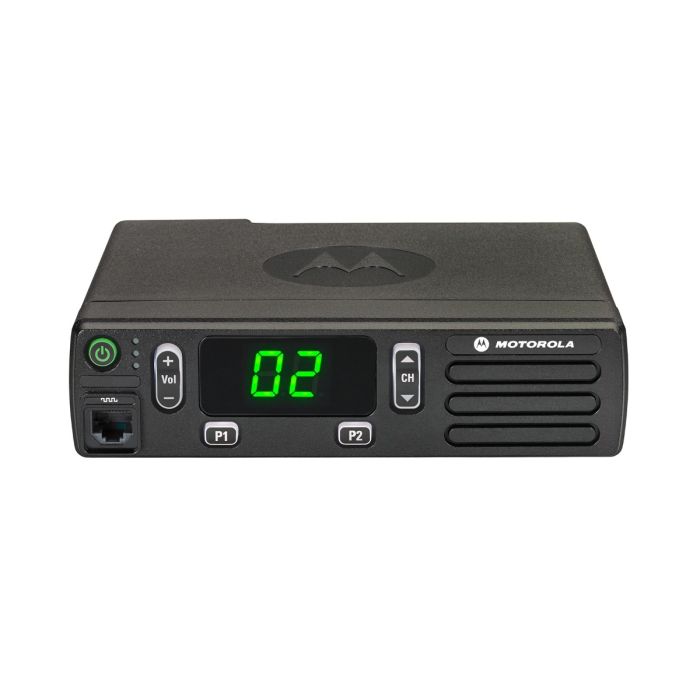
Motorola CM200d-DU-25 PKG Digital Mobile Two-Way UHF Radio (AAM01QNC9JA1_N)
有货
- 品牌:
- MOTOROLA
- 型號:
- CM200d-DU-25 PKG
- 零件#:
- AAM01QNC9JA1_N
- AVAILABILITY:
- USUALLY SHIPS IN 3-5 BUSINESS DAYS
- SKU:
- Motorola-CM200d-DU-25-PKG
Motorola CM200d-DU-25 PKG Digital Mobile Two-Way UHF Radio (AAM01QNC9JA1_N)
Within that family, the CM200d is the simpler model. Motorola’s official specifications list it with 16 conventional channels, while the CM300d offers 99 channels and an alphanumeric display. That makes the CM200d especially suitable for organizations that need dependable voice communications without a more complex channel structure or more advanced user interface.
The exact part number AAM01QNC9JA1_N is mapped by reseller listings to the CM200d-DU-25 PKG, a UHF 403–470 MHz, 25-watt, 16-channel digital-capable model. Multiple public dealer pages describe this SKU as the digital conventional CM200d variant and tie it to the CM200d-DU-25 PKG naming used in commerce.
For buyers researching a Motorola UHF mobile two-way radio for fleet communications, utilities, delivery operations, construction, warehousing, or commercial facilities, the CM200d-DU-25 is best understood as a practical, lower-complexity MOTOTRBO mobile that balances simplicity, durability, and digital readiness. That positioning is grounded in Motorola’s CM Series documentation and the exact SKU mapping in dealer listings.
Design and Features
Compact mobile form factor
Motorola’s official CM Series specification sheet lists the radio dimensions at approximately 44 x 169 x 134 mm and the weight at about 1.3 kg. This gives the CM200d a compact form suitable for dashboard, under-dash, bracket, or desk installation in working environments where space is limited.
Straightforward operating layout
The CM200d is positioned as the simpler member of the CM mobile family. Its 16-channel design and more basic control layout make it easier to standardize across users such as drivers, technicians, and support staff who need reliable communications more than advanced on-screen features. The 16-channel fact is official; the operational simplicity is an inference from that design.
Analog and digital capability
A major benefit of the CM200d-DU-25 is support for both analog and digital operation. Motorola’s CM Series materials emphasize that the product line is built to help customers migrate from analog to digital at their own pace, and dealer listings for the exact SKU describe it as a digital conventional model.
Business-radio features
Motorola’s official CM Series sheet lists family-level capabilities such as Radio Management, Dual Capacity Direct Mode, and Transmit Interrupt capability (decode only). Dealer pages for AAM01QNC9JA1_N add SKU-level descriptions such as Basic Privacy, Radio Check, Remote Monitor, Radio Inhibit, and Dual Priority Scan, which fit the radio’s role as a managed commercial device rather than a basic consumer transceiver.
Technology and Specifications
Frequency range and power output
Motorola’s official CM Series sheet lists UHF CM200d models in the 403–470 MHz range, with UHF power options of 25W or 40W. Dealer listings for AAM01QNC9JA1_N specifically identify this part number as the 25W UHF version, matching the “DU-25” designation.
Channel capacity
The CM200d supports 16 conventional channels, according to Motorola’s published specifications. For many businesses, that is enough for dispatch, supervisors, maintenance, service, and vehicle groups without requiring more complex radio programming. The channel count is official; the use-case fit is an inference.
Audio performance
Motorola specifies 4 watts internal audio output for the CM Series, with higher output available through supported external speakers depending on impedance. This is relevant in vehicle cabs, shop floors, and other noisy environments where intelligibility matters.
Digital standards and channel efficiency
Motorola states that the CM Series uses 2-slot TDMA DMR technology and complies with ETSI TS 102 361-1, -2, and -3. The company also highlights Dual Capacity Direct Mode, which improves efficiency in supported direct-mode digital configurations.
Environmental durability
Motorola rates the CM Series at IP54 for dust and splash resistance when properly configured, and the official sheet says the radios meet multiple MIL-STD 810 environmental test methods. The published operating temperature range is -30°C to +60°C.
Applications and Use Cases
Transportation and fleet communications
Motorola’s CM Series materials specifically frame the radios as suitable for people “delivering packages or transporting passengers,” which makes the CM200d-DU-25 a natural fit for service fleets, delivery vehicles, shuttle operations, and field supervisors.
Utilities and field service
For utility crews, telecom technicians, and mobile service teams, a 25W UHF mobile radio can provide practical voice coverage in mixed urban, suburban, or building-rich environments. The UHF suitability point is a standard radio-planning inference; the frequency range and power class are directly supported by Motorola’s specs and dealer mapping.
Construction and industrial operations
Construction firms and industrial facilities often need radios that are easy to deploy, easy to train on, and rugged enough for regular operational use. The CM200d’s modest channel plan and analog/digital flexibility make it a practical choice for teams that want straightforward communications today with a migration path for tomorrow. Motorola supports the migration path directly; the deployment fit is an inference from the radio’s structure.
Warehousing, campuses, and facilities
Schools, warehouses, campuses, hotels, and commercial maintenance departments can use the CM200d as a vehicle or desk radio for routine dispatch and coordination. In these settings, the simpler 16-channel structure can actually be an advantage because it reduces operational complexity.
Advantages / Benefits
Practical analog-to-digital migration
One of the CM200d-DU-25’s strongest benefits is that it supports both legacy analog environments and MOTOTRBO digital operation. Motorola explicitly positions the CM Series as a bridge for customers moving from analog to digital systems.
Reliable UHF commercial platform
Because AAM01QNC9JA1_N is the 25W UHF version, it offers a balanced mobile-radio profile for organizations that need professional UHF communications without moving up to the higher-power 40W variant. The coverage outcome still depends on antenna choice, installation, terrain, and system design.
Operational simplicity
The CM200d’s 16-channel structure makes it easier to standardize across employees than higher-complexity mobile radios. In many fleet and facilities environments, simplicity improves training and day-to-day usability. The design basis is official; the operational benefit is an inference.
Accessory ecosystem
Motorola also supports the CM200d/CM300d family with a dedicated accessory range, including microphones and installation accessories designed specifically for the platform. That helps buyers tailor the radio to vehicle and work-environment needs.
Comparisons
Motorola CM200d-DU-25 vs. CM200d-DU-40
The closest comparison is the CM200d-DU-40, which shares the same family, same 16-channel structure, and same analog/digital positioning but increases UHF output from 25W to 40W. Buyers focused on lower power draw or smaller coverage requirements may prefer the DU-25, while those needing stronger mobile transmit power may prefer the DU-40. The wattage distinction is directly supported by Motorola’s CM Series sheet.
Motorola CM200d vs. CM300d
Motorola’s official CM Series sheet shows the CM200d with 16 channels, while the CM300d offers 99 channels and an alphanumeric display. Both share the same general analog/digital platform, but the CM300d is better suited to larger operations with more complex channel structures.
Motorola CM200d digital vs. analog-only UHF variants
Dealer listings also show analog-only CM200d UHF models with closely related part numbers, while AAM01QNC9JA1_N is identified as the digital-capable model. That distinction matters for buyers planning future MOTOTRBO deployment rather than staying entirely analog.
FAQ Section
What is the Motorola CM200d-DU-25 PKG Digital Mobile Two-Way UHF Radio?
The Motorola CM200d-DU-25 PKG is a MOTOTRBO CM Series mobile two-way radio. The part number AAM01QNC9JA1_N is widely listed as a UHF 403–470 MHz, 25W, 16-channel model with analog and digital capability.
How does the Motorola CM200d-DU-25 work?
It works as a vehicle-mounted or desk-mounted push-to-talk radio operating on licensed UHF channels. It supports both analog and digital DMR-based MOTOTRBO communications, allowing use in current analog systems or newer digital deployments depending on programming and infrastructure.
Why is the Motorola CM200d-DU-25 important?
It is important because it combines commercial durability, UHF mobile performance, and a practical analog-to-digital migration path in a straightforward 16-channel platform that is easy for many organizations to deploy.
What are the benefits of the Motorola CM200d-DU-25?
Its main benefits include 25W UHF power, 16 channels, analog/digital capability, IP54 durability, and access to Motorola CM Series features such as Radio Management, Dual Capacity Direct Mode, and supported accessory options.
Summary
The Motorola CM200d-DU-25 PKG Digital Mobile Two-Way UHF Radio (AAM01QNC9JA1_N) is a practical professional mobile radio for organizations that need dependable UHF communications, straightforward daily operation, and a manageable path from analog to digital. With 403–470 MHz coverage, 25W output, 16 channels, IP54 durability, and integration into Motorola’s MOTOTRBO CM Series, it remains a strong fit for transport, service fleets, utilities, facilities, and commercial field operations.
Specifications
| 型號 | CM200d-DU-25 PKG |
|---|---|
| 零件# | AAM01QNC9JA1_N |
| 產品類型 | 雙向無線電 |
| 品牌 | MOTOROLA |