
Motorola CM200d-AV-25 Mobile Two-Way VHF Radio (AAM01JNC9JC1_N)
有货
- 品牌:
- MOTOROLA
- 型號:
- CM200d-AV-25
- 零件#:
- AAM01JNC9JC1_N
- AVAILABILITY:
- USUALLY SHIPS IN 3-5 BUSINESS DAYS
- SKU:
- Motorola-CM200d-AV-25
Motorola CM200d-AV-25 Mobile Two-Way VHF Radio (AAM01JNC9JC1_N)
The exact AAM01JNC9JC1_N configuration is widely listed by dealers as the CM200d-AV-25, a 136–174 MHz VHF, 25-watt, 16-channel, analog mobile radio. Dealer listings for the exact part number also consistently identify features such as Auto/Priority/Dual Priority Scan, Quik Call II selective call, MDC1200 PTT ID encode, VOX, Busy Channel Lockout, Audio Indicator Tones, and Time-Out Timer.
For buyers searching terms such as Motorola CM200d-AV-25, AAM01JNC9JC1_N, Motorola VHF mobile radio, or 25 watt commercial mobile two-way radio, this model stands out as a practical analog-first fleet radio with a simple interface, strong VHF output for open-area coverage, and the option to migrate later into MOTOTRBO digital operation. Motorola’s broader MOTOTRBO materials explicitly state that CM200d and CM300d radios give affordable analog voice communications with the option to upgrade to MOTOTRBO digital when ready.
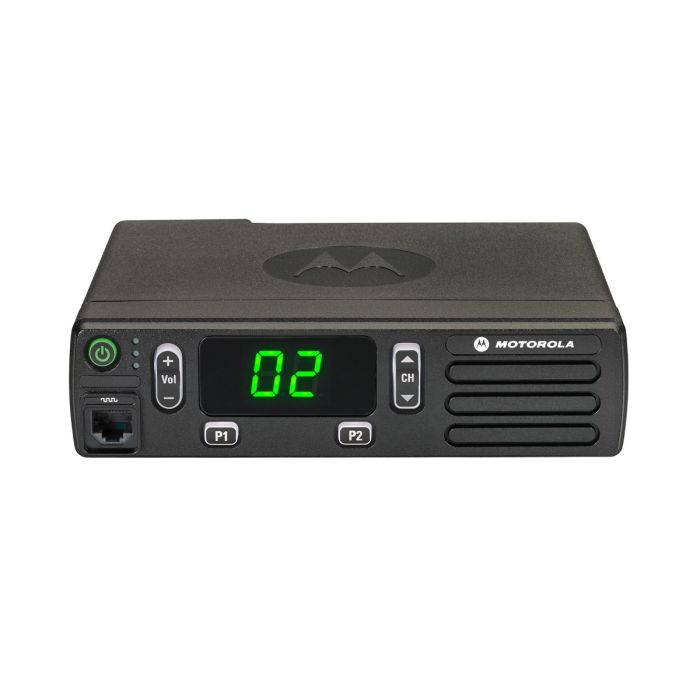
The CM200d is one of the two main radios in Motorola’s CM Series Mobile Two-Way Radio family, alongside the CM300d. Motorola’s official specification sheet shows that the CM200d is the simpler model, using a numeric display and supporting 16 channels, while the CM300d adds an alphanumeric display and 99 channels. That distinction makes the CM200d especially suitable for users who need straightforward mobile voice communications without the added channel capacity and display complexity of the higher model.
The exact CM200d-AV-25 is the VHF 25-watt analog member of that family. Current dealer listings for AAM01JNC9JC1_N align closely on the configuration: VHF 136–174 MHz, 25 watts, 16 channels, and analog. Multiple sellers use nearly identical phrasing, which supports strong confidence in the exact variant identity.
Although sold as an analog radio, the CM200d platform is part of Motorola’s broader MOTOTRBO architecture. Motorola’s MOTOTRBO brochure and multiple dealer listings state that the radio can be upgraded to digital operation later, which makes it attractive to organizations that still rely on conventional analog systems but want a lower-risk migration path.
Design and Features
Numeric display and simple front-panel layout
Motorola’s official CM Series specification sheet identifies the CM200d as the numeric-display model in the family. This matters because it keeps operation simple for drivers, technicians, field crews, and vehicle-based teams that need quick access to channels and core functions without a more complex interface.
In practical use, a simple numeric-display mobile radio is often easier to train across mixed workforces. Users can identify the selected channel and basic status without navigating a larger menu structure. That makes the CM200d-AV-25 especially well suited to fleets where radio use is important but not highly specialized. This is an inference based on Motorola’s model hierarchy and feature layout.
Analog operation with digital upgrade path
A major strength of the CM200d-AV-25 is that it is sold as an analog unit while still fitting into Motorola’s upgradeable MOTOTRBO ecosystem. Dealer listings for the exact model say it is upgradeable to MOTOTRBO DMR digital operation with HKVN4223 programming key, and Motorola’s official MOTOTRBO brochure echoes the same analog-now, digital-later positioning for CM200d and CM300d radios.
This makes the radio particularly useful for smaller businesses, municipal fleets, and commercial operators who want to maintain legacy analog compatibility now while preserving a future migration route. That strategy reduces near-term infrastructure changes while protecting the hardware investment.
Fleet-oriented signaling and scan features
Dealer listings for AAM01JNC9JC1_N consistently name a practical set of commercial radio features:
- Auto Scan
- Priority Scan
- Dual Priority Scan
- Quik Call II Call Alert / Selective Call
- MDC1200 PTT ID encode
- VOX
- Audio Indicator Tones
- Time-Out Timer
- Busy Channel Lockout.
These are important because they show the CM200d-AV-25 is more than a bare-bones mobile radio. It supports common fleet-management and voice-call discipline functions used in transport, service, and site operations. MDC1200 identification, for example, helps identify transmitting units in compatible systems, while scan features help mobile users monitor multiple channels more efficiently. The functional significance is an inference based on standard radio use of these features.
Voice announcement and Motorola accessory ecosystem
Motorola’s MOTOTRBO materials and reseller product summaries for similar CM200d units also mention voice announcement, which helps users confirm channel changes and key functions audibly. In vehicle and field environments, that reduces the need to look directly at the radio.
Motorola also publishes a dedicated CM200d / CM300d accessory fact sheet, showing the platform is supported by microphones, external speakers, remote mount kits, and other accessories intended for both analog and digital performance. Motorola’s commercial-tier accessory catalog also notes remote mount kits for CM200d and CM300d when dash space is limited.
Technology and Specifications
Core technical specifications
Motorola’s official CM Series specification sheet lists the following platform-level specifications for the CM200d VHF family:
- Frequency range: 136–174 MHz
- Channel capacity: 16
- Power range: 1–25 W low power / 25–45 W high power
- Dimensions: 1.7 x 6.7 x 5.3 in (44 x 169 x 134 mm)
- Weight: 2.9 lb (1.3 kg).
Dealer listings refine that for the exact AAM01JNC9JC1_N part number as VHF, 136–174 MHz, 25 watts, 16 channels, and analog.
Receiver, audio, and channel performance
Motorola’s official spec sheet lists these performance figures for the CM platform:
- Channel spacing: 12.5 / 25 kHz
- Frequency stability: ±0.5 ppm
- Analog sensitivity: 0.3 µV (12 dB SINAD), 0.22 µV typical
- Digital sensitivity: 0.25 µV (5% BER), 0.19 µV typical
- Internal audio output: 4 W
- External audio output: 7.5 W at 8 ohms, 13 W at 4 ohms.
Even though the CM200d-AV-25 is sold as an analog unit, Motorola publishes digital sensitivity figures because the CM platform itself can be upgraded within the MOTOTRBO system. That indicates the hardware family was designed with mixed-mode or future digital support in mind. This is an inference based on the combined official platform spec and analog upgrade messaging.
Power and environmental specifications
Motorola’s official CM Series sheet lists IP54 ingress protection, along with operating conditions including:
- Operating temperature: -30°C to +60°C
- Storage temperature: -40°C to +85°C
- ESD: IEC 61000-4-2 Level 3.
Resellers and Motorola-aligned commercial radio pages also describe the CM200d as meeting MIL-SPEC 810-class environmental expectations and being suitable for demanding work environments.
These ruggedness specifications matter for a mobile radio, because vehicle-installed communications equipment is frequently exposed to dust, vibration, thermal cycling, and routine handling.
Applications and Use Cases
Transportation and delivery fleets
Motorola’s official CM Series spec sheet says CM200d and CM300d radios are ideal for keeping crews connected “whether they’re delivering packages or transporting passengers.” That makes the CM200d-AV-25 a direct fit for transportation fleets, delivery operations, shuttle services, and school transport support.
Agriculture and rural operations
Dealer listings for the exact VHF analog 25-watt CM200d say the VHF model is ideal for agriculture, transportation, retail, and hospitality businesses that need to increase range. The agriculture reference is especially relevant because VHF is commonly preferred in broader open-area environments. The propagation point is an inference; the sector mention comes directly from the dealer listing.
Facilities, maintenance, and service vehicles
The CM200d-AV-25 is also well suited to utility vehicles, facilities teams, campus services, and mobile maintenance crews. Its 25-watt VHF output, 16-channel simplicity, and scan/signaling features make it a strong match for coordinated mobile work without requiring a higher-end control interface. This use case is an inference based on the published feature set and Motorola’s broader mobile-workforce positioning.
Fixed local base-style use
One dealer explicitly notes that users can add a 120V AC power supply and a base antenna to improve coverage within the area of operation. That means the CM200d-AV-25 can also serve in a fixed local base-style role, not only as a vehicle-mounted unit.
Advantages / Benefits
Practical 25-watt VHF output
The most obvious benefit of the CM200d-AV-25 is its 25-watt VHF mobile-radio configuration. Compared with a handheld portable, a vehicle radio at this power level can provide stronger transmit capability for fleet operations.
Straightforward 16-channel operation
The 16-channel layout keeps the radio simple. For many businesses, that is enough channel capacity for real fleet operations without introducing unnecessary complexity. Motorola’s official CM Series sheet consistently identifies the CM200d as a 16-channel platform.
Analog simplicity with future digital option
Motorola’s official MOTOTRBO material and dealer listings both support the radio’s analog now, digital later identity. That is a major benefit for businesses that want to avoid replacing their infrastructure all at once.
Rugged commercial durability
The IP54 rating and Motorola’s rugged commercial-radio positioning make the CM200d-AV-25 more suitable for real vehicle fleets than light-duty communications devices.
Accessory ecosystem support
Motorola’s official accessory and catalog documents show that the CM200d supports a real accessory ecosystem, including microphones, speakers, and remote mount kits. That increases the model’s practical deployment flexibility.
FAQ Section
What is the Motorola CM200d-AV-25 Mobile Two-Way VHF Radio?
The Motorola CM200d-AV-25 (AAM01JNC9JC1_N) is a VHF analog commercial mobile radio in the MOTOTRBO CM Series. Dealer listings identify it as a 136–174 MHz, 25-watt, 16-channel model.
How does the Motorola CM200d-AV-25 work?
It works as a vehicle-mounted or fixed-mobile two-way radio, transmitting and receiving voice traffic over programmed VHF channels. Motorola’s broader MOTOTRBO materials and dealer listings indicate it is sold as analog, with a later upgrade path to digital capability.
Why is the Motorola CM200d-AV-25 important?
It is important because it offers simple 16-channel fleet communications, 25-watt VHF mobile performance, and a practical migration path from analog operation toward MOTOTRBO digital use.
What are the benefits of the Motorola CM200d-AV-25?
Its main benefits are 25-watt VHF output, 16-channel simplicity, scan and signaling features, IP54 ruggedness, and upgradeability toward digital MOTOTRBO operation.
Is the Motorola CM200d-AV-25 analog or digital?
The exact AAM01JNC9JC1_N model is widely listed as analog by dealers. However, Motorola’s MOTOTRBO materials and dealer listings also state that the CM200d platform can be upgraded to digital capability.
Summary
The Motorola CM200d-AV-25 Mobile Two-Way VHF Radio (AAM01JNC9JC1_N) is a practical 136–174 MHz VHF, 25-watt, 16-channel mobile radio designed for fleets and field teams that need reliable communications without unnecessary complexity. Motorola’s official materials and current reseller listings show that it combines simple analog operation, fleet-ready scan and signaling features, IP54 durability, and a documented path toward MOTOTRBO digital capability. For transportation, agriculture, facilities, maintenance, and service fleets seeking a Motorola VHF mobile two-way radio, the CM200d-AV-25 remains a strong fit.
Specifications
| 型號 | CM200d-AV-25 |
|---|---|
| 零件# | AAM01JNC9JC1_N |
| 產品類型 | 雙向無線電 |
| 品牌 | MOTOROLA |