
Wonik Robotics Allegro Hand V5 Sense
In stock
- ម៉ាក:
- Wonik Robotics
- គំរូ:
- Allegro Hand V5 Sense
- ផ្នែក #:
- Allegro Hand V5 Sense
- Warranty:
- 12 MONTHS
- AVAILABILITY:
- SUBJECT TO AVAILABILITY
- SKU:
- Wonik-Allegro-Hand-V5-Sense
Wonik Robotics Allegro Hand V5 Sense
Overview
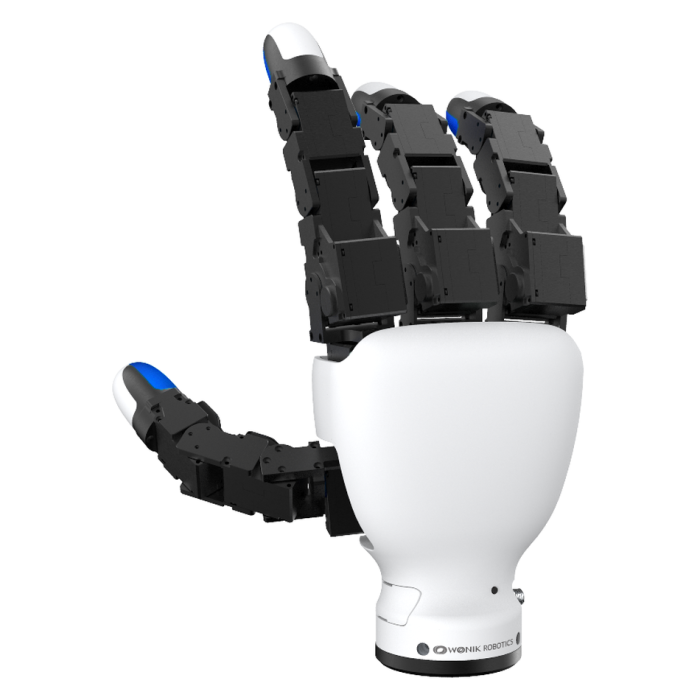
The Wonik Robotics Allegro Hand V5 Sense is a four-fingered robotic hand developed for dexterous manipulation work in research and industry. It pairs sixteen independently current-controlled joints with an integrated tactile sensing system that uses sixteen pressure sensing channels to capture detailed force distribution, with the stated aim of supporting precise tactile feedback during grasping and fine manipulation.
Watch the manufacturer product demonstration
According to the manufacturer, the hand provides adduction and abduction capability of the fingers, enabling more natural and versatile grasping similar in character to a human hand. The platform is positioned as a low-cost option for dexterous manipulation and is described as supporting multiple ready-to-use grasping algorithms capable of handling a variety of object geometries, along with support for real-time control and online simulation.
Design
The V5 Sense uses a configuration of three fingers plus one thumb, for four fingers in total. Each finger carries four degrees of freedom, giving sixteen active degrees of freedom across the hand. Actuation is provided by DC motors, with gear ratios of 288.35:1, or 576.7:1 at the second joint of each finger excluding the thumb.
The fingertip was redesigned with a sharper, human-inspired shape intended to improve manipulability for small objects. The rear side of the fingertip serves as a mechanical structure, while the front is dedicated to pressure sensing, a division the manufacturer describes as enhancing grasping and fine manipulation performance.
The fingertip pressure sensor is described as having stiffness similar to a human hand, which the manufacturer links to flexible manipulation of objects ranging from rigid items to deformable soft materials. The sensor surface also acts as a visual indicator: its color changes based on tactile sensitivity at the fingertip, giving an at-a-glance cue about contact pressure.
Verified Specifications
The table below reproduces the specifications published by the manufacturer for this exact model. Values that carry qualifiers in the source are shown with those qualifiers intact.
| Specification | Value |
|---|---|
| Number of fingers | 3 fingers + 1 thumb = 4 |
| Degrees of freedom | 4 fingers x 4 = 16 (active) |
| Actuation type | DC motor |
| Gear ratio | 288.35:1 / 576.7:1 (2nd joint of the finger excluding the thumb) |
| Stall torque | 0.92 Nm / 1.84 Nm (2nd joint of the finger excluding the thumb) |
| Nominal torque | 0.23 Nm / 0.46 Nm (2nd joint of the finger excluding the thumb) |
| Payload | 15 kg (depending on the measurement method) |
| Weight | 1,240 g |
| Joint resolution | 0.088 deg |
| Communication | CAN; Ethernet listed as planned support only |
| Control frequency | 333 Hz (CAN) |
| Power requirement | 24.0 V / 5.0 A / 120 W |
Tactile Sensing System
Tactile sensing on the V5 Sense is based on an air pressure measurement method using a capacitive pressure sensor. Omnidirectional tactile sensors are applied to each fingertip, and the design increases the number of sensing points to sixteen. The manufacturer notes that the new model is equipped with temperature compensation, and that sensor values therefore differ from the existing model due to this functional change.
Both the fingertip sensor and the joint tactile sensor are specified with a pressure operating range of 0 to 400 kPa, a pressure accuracy of 0.1 kPa, and a temperature operating range of 0 to 60 °C. These figures describe the operating envelope of the sensors themselves and should not be read as grasp force ratings.
The fingertip color indicator returns a reading of 0 at atmospheric pressure (101.3 kPa) and maps measured pressure to color bands:
- Blue: 0 to 5 kPa
- Cyan: 5 to 10 kPa
- Green: 10 to 20 kPa
- Yellow: 20 to 30 kPa
- Red: 30 to 40 kPa
Controls and Monitoring
The hand supports real-time hand status monitoring with real-time visualization of contact and pressure, which the manufacturer presents as a basis for stable, precise manipulation. Monitoring views cover the finger joint sensors and the fingertip sensors, and a combined sensor view brings both data sources together.
An intuitive joint gain tuning interface is provided as an application designed to adjust every joint angle and precisely control vibration response. Joint-level control runs over CAN at a frequency of 333 Hz, and the sixteen joints are independently current-controlled, which supports fine adjustment of finger behavior during contact-rich tasks.
Research Context
The manufacturer highlights several application cases that illustrate how the tactile system can be used. These include tactile sensor-based grasp force control demonstrated on a bread model and on a plastic cup, where contact feedback helps modulate grip on delicate or deformable objects.
Further cases cover adaptive grasping in confined space, shown through a cabinet door opening task, and power grasping with reaction force handling, shown with a bottle opener. The omnidirectional fingertip sensors are described as enabling a variety of research applications beyond these examples.
Integration Considerations
Before planning deployment, the following points are worth checking against your own environment rather than assuming:
- Confirm that your host system provides a suitable CAN interface, since CAN is the supported communication type and the published control frequency of 333 Hz applies to CAN.
- Note that Ethernet is listed by the manufacturer as planned support only; verify its actual status before designing any workflow around it.
- Check that your power infrastructure can supply the stated requirement of 24.0 V, 5.0 A, and 120 W.
- Review how the 15 kg payload figure, which depends on the measurement method, relates to the loads and grasp types in your application.
- If you have data or calibrations from an existing model, verify them against the new temperature-compensated sensors, since sensor values differ between models.
- Confirm that your intended operating conditions fall within the sensors' 0 to 60 °C temperature operating range and 0 to 400 kPa pressure operating range.
Frequently Asked Questions
How many fingers and degrees of freedom does the Allegro Hand V5 Sense have?
The V5 Sense has four fingers in a three fingers plus one thumb arrangement. Each finger provides four degrees of freedom, giving sixteen active degrees of freedom in total, implemented as sixteen independent current-controlled joints.
What tactile sensing does the hand include?
It is equipped with sixteen pressure sensing channels that capture detailed force distribution. Omnidirectional tactile sensors are applied to each fingertip, using an air pressure measurement method with a capacitive pressure sensor, and joint tactile sensors are specified alongside the fingertip sensors.
Does the hand support Ethernet communication?
Ethernet is listed by the manufacturer as planned support only. The supported communication type is CAN, with a published control frequency of 333 Hz, so current integration plans should be based on CAN rather than Ethernet.
What does the fingertip color indicator show?
The fingertip color changes based on tactile sensitivity. It returns 0 at atmospheric pressure (101.3 kPa) and shifts from blue through cyan, green, and yellow to red as measured pressure rises from 0 up to 40 kPa, giving a quick visual read of contact pressure.
How does the new model differ from the existing model?
The manufacturer notes that the new model is equipped with temperature compensation, and that sensor values differ from the existing model as a result of this functional change. Users migrating data or calibrations should account for this difference.
What payload does the manufacturer specify?
The published payload is 15 kg, qualified as depending on the measurement method. The weight of the hand itself is 1,240 g, and joint resolution is specified at 0.088 degrees.
Summary
The Wonik Robotics Allegro Hand V5 Sense combines a four-finger, sixteen-degree-of-freedom mechanical design with sixteen-channel capacitive pressure sensing, color-indicating fingertips, and real-time contact visualization. With independently current-controlled joints, finger adduction and abduction, ready-to-use grasping algorithms, and documented application cases spanning delicate grasp force control and power grasping, it is presented as a research-oriented platform for tactile dexterous manipulation, with CAN communication today and Ethernet noted only as planned.
Request a quotation to confirm configuration, pricing and availability. Catalog stock status is not confirmation of physical inventory or immediate shipment.