
Unitree H1 Humanoid Robot - Fastest Robot In The World
재고 있음
- 상표:
- UNITREE ROBOTICS
- 모델:
- H1
- ORIGIN:
- 중국
- AVAILABILITY:
- SUBJECT TO AVAILABILITY
- SKU:
- Unitree-H1
Unitree H1 Humanoid Robot - Fastest Robot In The World
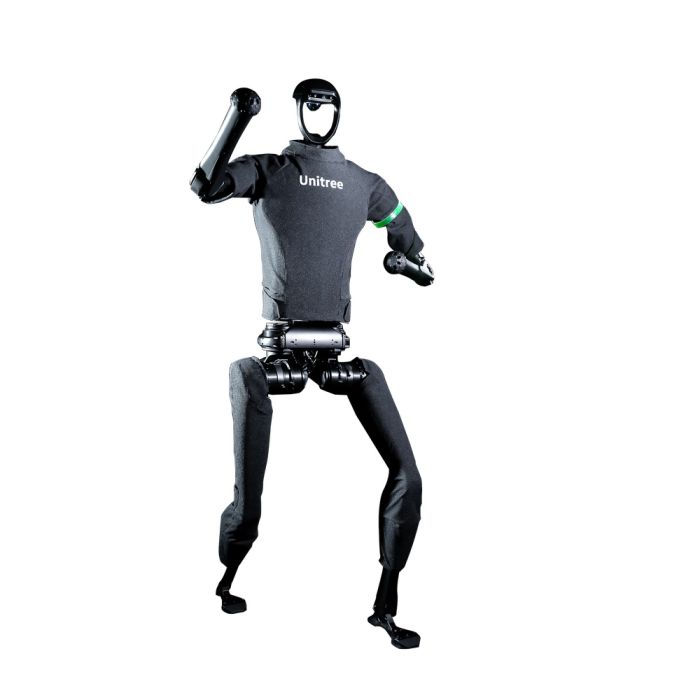
In March 2024 this robot ran at 3.3 metres per second and took the world record for a full-size humanoid. That is the H1 in one fact — and it explains almost every other decision in its specification.
What it is
The Unitree H1 is a full-size bipedal research humanoid: about 1.80 m tall, roughly 47 kg, with 18 degrees of freedom — four in each arm and five in each leg — leg joints rated to 360 N·m and a peak torque density of 189 N·m per kilogram. It runs from an 864 Wh battery and is sold as a development platform rather than as a closed product.
Why it is fast, and what that cost
Speed in a legged robot is largely a mass problem. Every kilogram out at a hand or a foot has to be accelerated and decelerated on every stride, so the H1 keeps its extremities light: four degrees of freedom per arm rather than seven, no waist, and 47 kg all in. Combine that with 360 N·m leg joints and an exceptional torque-to-weight ratio and you get a machine that runs rather than walks — Unitree has indicated mobility potential beyond 5 m/s.
The cost is manipulation. Four-axis arms can gesture, balance and carry lightly, but they are not a manipulation research platform, and there is no waist to lean or twist with. If that matters to your work, the H1-2 exists precisely for it.
H1 or H1-2? The H1 runs, the H1-2 works
These are not two generations of the same robot in the usual sense. They are two different answers to what a full-size humanoid is for, and the specifications make the trade explicit.
| Unitree H1 | Unitree H1-2 | |
|---|---|---|
| Height | About 1.80 m | About 1.78 m |
| Weight | About 47 kg | About 70 kg |
| Degrees of freedom | 18 — 4 per arm, 5 per leg | 27 — 7 per arm, 6 per leg, plus waist |
| Arm payload | Not the design priority | 7 kg rated, up to 21 kg peak |
| Speed | 3.3 m/s — a world record for a full-size humanoid | Under 2 m/s |
| Leg joint torque | Up to 360 N·m | Up to 360 N·m |
The H1 is light, minimally articulated and extremely fast. Forty-seven kilograms with four degrees of freedom in each arm is a locomotion platform: there is very little mass out at the extremities to swing around, which is exactly why it can run. The H1-2 adds twenty-three kilograms, nine more degrees of freedom, seven-axis arms and a waist, and carries 7 kg per arm — then tops out at under 2 m/s.
So choose on the research question, not the model number. If your work is high-speed locomotion, dynamic balance, running gaits or whole-body control at speed, the H1 is the platform and its lighter arms are a feature. If your work involves manipulation, bimanual coordination or carrying anything, the H1-2 is the only sensible choice of the two.
Where the H1 family sits
The H1 and H1-2 are Unitree's enterprise and research-grade full-size humanoids, positioned above the compact G1 and R1 platforms in both capability and price. Both run from an 864 Wh battery — 15 Ah at up to 67.2 V — and both accept the same family of compute modules, dexterous hands and accessories, several of which are listed alongside them.
If you are comparing against the newer H2 range, the H2 is a different platform again: 31 body joints at about 70 kg, with its own hand package scheme. The H1 family remains the choice where locomotion performance, a long-established SDK and a lower price matter more than the latest hand options.
Unitree H1 specifications
| Specification | Value |
|---|---|
| Height | About 1.80 m |
| Weight | About 47 kg |
| Degrees of freedom | 18 — 4 per arm, 5 per leg |
| Maximum joint torque | 360 N·m |
| Peak torque density | 189 N·m/kg |
| Top speed | 3.3 m/s — world record for a full-size humanoid, March 2024 |
| Battery | 864 Wh — 15 Ah at up to 67.2 V |
| Compute | Dedicated modules at 100 or 200 TOPS, or AGX modules at 275 or 550 TOPS, sold separately |
| Hands | Dexterous hands available separately |
| Development | SDK access for secondary development |
Figures follow published specifications and vary by production batch. Confirm the exact build, compute module and hand option on your quotation before ordering.
Who buys it
- High-speed locomotion and running-gait research
- Dynamic balance and whole-body control at speed
- Reinforcement-learning groups training locomotion policies
- Demonstration and outreach where the speed is the spectacle
- Programmes wanting a full-size humanoid below the price of the newer ranges
How to choose
Buy the H1 if locomotion is the research and light arms are acceptable — or an advantage. Buy the H1-2 if you need manipulation, a waist or arm payload. Look at the newer H2 range if you want 31 body joints and the current hand package options. Compare the whole field in our humanoid robots category.
Safety and standards
These are full-size research humanoids and they are not covered by the industrial robot safety standards — ISO 10218 and the ANSI/RIA R15.06 family — nor by the mobile robot standard R15.08. The duty of care sits entirely with the operator.
Mark a working area that untrained people cannot enter, keep a trained operator with the emergency stop within reach whenever the robot is powered, use a gantry during locomotion development, and complete a written risk assessment before any public demonstration. The speed deserves specific respect: a 47 kg machine travelling at 3.3 m/s carries serious energy, and a robot developing running gaits will fall. Plan the fall before it happens rather than after.
Lithium batteries are regulated dangerous goods in transit, which affects how spares ship and how quickly.
Deployment and running costs
Budget beyond the robot. A spare 864 Wh battery keeps a lab working rather than waiting. A gantry is close to essential for locomotion development, because the robot will fall repeatedly and that is the process working rather than failing. Compute is a separate decision: dedicated modules and AGX modules are available across a wide range of performance, and the right one depends on whether your models run onboard or on a workstation. Related parts are listed under robot accessories. International buyers should add duty and import charges.
Import and delivery
Units ship from the manufacturer and lead times follow production batches rather than a fixed schedule. This is a heavy, bulky crate and the lithium battery restricts some routes and adds documentation. Tell us the destination country when you enquire and we will confirm delivered cost, a realistic lead time and the paperwork required before you commit.
Support before and after the sale
Before you buy, our team will confirm that light four-axis arms suit your work, because that is the one specification people regret on this platform. We will also go through compute and hand options with you rather than leaving them to a line item. After delivery, we help with training, set up and ongoing support. The specifics for your order are confirmed on your quotation.
Where to buy
This robot is listed above with current price and availability, alongside the other H1-family configuration and the compute modules, hands and accessories that fit it. Order directly, or contact our team for a formal quotation including delivery to your country. Universities and institutions buying against a purchase order should request a written quotation first.
Frequently asked questions
How much does a Unitree H1 cost?
Current pricing is shown on the listing above. Request a quotation for delivered pricing or quantities.
How fast is the Unitree H1?
3.3 m/s, set in March 2024 as a world record for a full-size humanoid. Unitree has indicated mobility potential beyond 5 m/s.
How many degrees of freedom does it have?
18 — four in each arm and five in each leg. There is no waist.
Can the H1 do manipulation research?
Not really. Four-axis arms gesture, balance and carry lightly but are not a manipulation platform. Choose the H1-2 for that.
How heavy is it?
About 47 kg, which is light for a full-size humanoid and is the main reason it can run.
What is the difference between the H1 and the H1-2?
The H1 is 47 kg with 18 degrees of freedom and runs at 3.3 m/s. The H1-2 is 70 kg with 27 degrees of freedom, seven-axis arms and a waist, carries 7 kg per arm, and tops out under 2 m/s. The H1 is a locomotion platform; the H1-2 is a manipulation platform.
How long does the battery last?
Both use an 864 Wh pack, 15 Ah at up to 67.2 V. Plan at least one spare for a full working day.
Can I add dexterous hands?
Yes. Hands for the H1 family are sold separately, including the Dex5-1P tactile hand and the H1-2 dexterous hand.
What compute options are there?
Dedicated computing modules at 100 and 200 TOPS, AGX modules at 275 and 550 TOPS, and an Intel Core i7 board. Which is right depends on whether your models run on the robot or on a workstation.
Is it open for development?
Yes. The H1 family is sold as a development platform with SDK access.
Is it safe to demonstrate in public?
Only with a defined working area, a trained operator holding the emergency stop and a written risk assessment. At 3.3 m/s the H1 in particular carries serious energy.
Do you ship internationally?
Yes. The crate is heavy and the lithium battery affects routing, so confirm the destination country when you enquire.
사양
General
Physical
Performance
포함 내용
관련 상품
품절