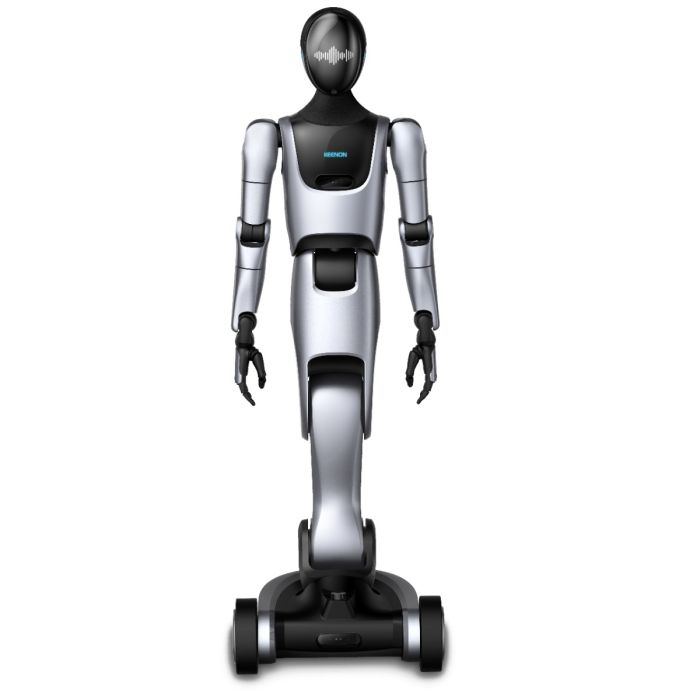
Keenon XMAN-R1 Wheeled Humanoid Robot
In stock
- ब्रांड:
- KEENON
- मॉडल:
- XMAN-R1
- ORIGIN:
- चीन
- AVAILABILITY:
- SUBJECT TO AVAILABILITY
- SKU:
- KEENON-XMAN-R1
Keenon XMAN-R1 Wheeled Humanoid Robot
Keenon XMAN-R1: The Wheeled Humanoid Service Robot Powered by the World's First Service Industry VLA Model
The KOM2.0 designation is commercially significant. VLA (Vision-Language-Action) models represent the current frontier of embodied AI, combining visual perception, natural language understanding, and physical action planning in a unified model that allows a robot to receive instructions in natural language, perceive the visual environment, and generate the corresponding physical action sequence to complete the task. KEENON's claim that KOM2.0 is the world's first VLA model specifically built for the service industry, rather than for general-purpose robotics or laboratory research, reflects the company's accumulated commercial advantage: it has access to more real-world service robot operational data from more deployment environments than any other commercial robot company, and KOM2.0 is trained on that data.
The Shangri-La Traders Hotel Deployment: A Case Study in Collaborative Hotel Robotics
What Makes This Deployment Historically Significant
The October 2025 deployment at the Shangri-La Traders Hotel, Shanghai Hongqiao Airport is the most comprehensively documented real-world humanoid hotel deployment from any manufacturer as of 2025. KEENON's official PRNewswire announcement and Interesting Engineering's independent coverage together provide a complete picture of the deployment architecture, the specific task assignments, and the operational model.
The deployment is significant for four reasons:
It is at a globally recognized luxury hotel brand. The Shangri-La Group operates premium and luxury hotels across Asia, Europe, and North America, with rigorous service quality standards. Shangri-La's adoption of the XMAN-R1 signals that the robot's capabilities met the operational requirements of one of the world's most exacting hospitality brands.
It is at an airport hotel, where the operational demands are particularly challenging. Shangri-La Traders Hotel at Shanghai Hongqiao Airport serves airline crews, business travelers, and transit passengers around the clock, with continuous service requirements that 9-to-5 staffing cannot fully address.
It implements the "General-Purpose + Special-Purpose" collaborative robot model that KEENON's Wang Yongtang has articulated as the commercial architecture for humanoid deployment. The XMAN-R1 does not operate alone.
It provides specific, named supporting robot assignments that enable an operational analysis of how the model works in practice.
The Complete Robot Matrix at the Shangri-La
Interesting Engineering's coverage provides the most specific documentation of how the full KEENON robot matrix is distributed across the hotel's operations:
XMAN-R1 (General-Purpose Humanoid): Front desk greetings, human-facing interaction, and the tasks requiring a humanoid's physical presence, expressiveness, and dexterous interaction capability.
BUTLERBOT W3: In-room delivery. The W3's enclosed compartment system with individually lockable doors and multi-floor elevator navigation makes it the appropriate robot for delivering room service orders, amenities, and guest items to specific guest rooms.
KEENON S100: Luggage transport. The S100's 100-kilogram payload capacity handles the weight of multiple guest bags in a single trip from reception to room floors.
KLEENBOT C40: Room cleaning and facility cleaning. The C40's 4-in-1 wet scrubbing capability with the self-maintaining workstation option (C40S) provides the hotel's floor cleaning.
DINERBOT T10 and T3: Restaurant food and item delivery. The T10's advertising screen and the T3's enclosed hygienic cabin serve different aspects of the hotel's food service operations.
This complete robot ecosystem, with each robot type assigned to the specific operational function it performs most efficiently and reliably, is the practical implementation of the General-Purpose + Special-Purpose model. The XMAN-R1 is the humanoid face of the team, performing the tasks that require its humanoid capabilities, while each specialist robot handles the logistics and service functions it is optimized for.
"Through Lifelike Movements and Speech": The Guest Experience
Interesting Engineering's description of the XMAN-R1's hotel contribution focuses on the experiential dimension: "Through lifelike movements and speech, the robot creates a highly immersive and futuristic experience for visitors." The Shangri-La deployment announcement described the hotel's ambition as "a benchmark for a new generation of business hotels combining efficiency and enjoyment."
This framing positions the XMAN-R1 not only as an operational efficiency tool but as a guest experience differentiator. For a hotel competing for business travelers and airline crew accommodation at a major international airport hub, the presence of a sophisticated humanoid robot at the front desk creates a distinctive property identity that no amount of conventional service quality investment could replicate.
KOM2.0: The World's First Service Industry VLA Model
What VLA Models Are and Why They Matter
Vision-Language-Action (VLA) models are a class of AI model that processes visual input (what the robot sees), language input (what the robot is told), and generates physical action sequences (what the robot does) within a single unified architecture. This end-to-end approach, where the model directly generates robot actions from perceptual and language inputs, contrasts with older robotic AI architectures where perception, language understanding, and action planning were separate systems with explicit handoffs between them.
The significance for service robots is that VLA models enable the kind of flexible, instruction-following behavior that real-world service environments require. A customer who says "Can you bring me a warm blanket?" is giving an instruction that requires understanding the request in natural language, identifying the appropriate supply item from a hotel inventory context, and executing the physical task sequence of locating, picking up, and delivering the blanket. A VLA model trained on real hotel service data can learn the patterns of these instruction-to-action sequences directly from operational experience.
KEENON's Data Advantage for Service VLA Training
The KEENON claim that KOM2.0 is "the world's first Vision-Language-Action model for the service industry" rests on a data advantage that no competing humanoid robot manufacturer could match. KEENON's commercial deployments in restaurants, hotels, hospitals, and aged care facilities across more than 60 countries have generated a proprietary dataset of real-world service interactions, navigation trajectories, task sequences, and human-robot interaction patterns that is unmatched in the service robot industry.
Training a VLA model on this data produces a model specifically optimized for service environments rather than for general robotic manipulation or laboratory tasks. The XMAN-R1's description as "developed based on vast amounts of real-world data collected over years of research into service environments" confirms that KOM2.0's training data is domain-specific rather than generically collected.
Design Philosophy: Role-Oriented, User-Friendly, and Safety-First
KEENON's three-attribute description of the XMAN-R1 reflects a deliberate design philosophy:
Role-Oriented
A role-oriented humanoid is designed to perform specific, defined service roles with high reliability rather than to demonstrate broad general capability across any task. For the XMAN-R1's initial commercial deployment context of luxury hotel service, the defined roles are front desk greeting, guest interaction, and the human-facing tasks that require the presence and expressiveness of a humanoid body. Role orientation enables optimization: the robot's KOM2.0 model, its physical design, and its ecosystem coordination are all optimized for the specific service roles it is deployed to perform.
User-Friendly
User-friendly in the XMAN-R1 context refers to two distinct user groups. For guests, user-friendliness means natural language interaction through KOM2.0, lifelike expressive movements that create comfortable rather than unsettling interactions, and the ability to respond to the same kinds of requests a human front desk staff member would handle. For hotel operations staff, user-friendliness means straightforward task assignment through the KEENON fleet management system, integration with the hotel's existing KEENON robot infrastructure, and operational transparency through the management platform.
Safety-First
Safety in a humanoid operating in hotel lobbies and service areas means physical safety for guests and staff who share the space, data safety for the hotel's guest information systems, and operational safety that prevents service disruptions from robot failures. The XMAN-R1's wheeled base (as opposed to a bipedal base that could fall) provides an inherently more stable platform for the hotel service environment where the primary requirement is smooth, reliable movement through well-mapped indoor spaces rather than stair climbing or rough terrain navigation.
CES 2026: The International Debut
Las Vegas, January 6, 2026
KEENON's CES 2026 press release described the XMAN-R1 as "a major global player in humanoid robotics" that "has already gained fame worldwide for tasks from making popcorn to pouring drinks." At the Las Vegas Convention Center, the robot "greet[ed] attendees and offer[ed] candies, becoming a focal point. It not only demonstrates potential for understanding and executing complex tasks but also engages the crowd with vivid interactions, deftly handing out candies and performing anthropomorphic gestures like making a heart shape or waving, showcasing the potential for natural, friendly interaction in future service robots."
The CES 2026 debut introduced the XMAN-R1 to the North American and international technology press and business community, building on the Shangri-La deployment credibility established in October 2025. The robot's approachable candy-distribution demonstration, while simpler than the Shangri-La operational deployment, effectively communicated the robot's warmth and expressiveness to a general-audience context where building public comfort with humanoid robots is a relevant commercial objective.
Applications Beyond Hotels
While the Shangri-La deployment is the most documented XMAN-R1 application, KEENON's March 31, 2025 introduction announcement positioned the robot for "a wide range of commercial settings," including the DINERBOT T10, KLEENBOT C30, and KEENON S100 collaborator partnerships that suggest the full range of KEENON's deployment sectors: restaurants, corporate campuses, retail, hospitals, and aged care facilities all represent environments where the XMAN-R1's human-facing interaction capability adds a dimension that KEENON's established wheeled robots cannot provide.
The XMAN-R1's description as designed to "collaborate with other KEENON robots" rather than operate as a standalone system means its application scope is bounded by the deployment contexts where KEENON's specialized robot ecosystem is available, which reflects the full global footprint of KEENON's commercial operations.
Advantages and Benefits
KOM2.0: the world's first service-industry-specific VLA model trained on real commercial deployment data: The domain-specific training data from 100,000-plus deployed commercial robots across 60-plus countries gives KOM2.0 a service task intelligence advantage that general-purpose VLA models trained on laboratory or internet data cannot match.
World's first documented General-Purpose + Special-Purpose hotel robot collaboration: The Shangri-La Traders Hotel deployment validates the collaborative model with deployment evidence at a globally recognized luxury brand, providing hospitality buyers with a reference case at a property most operators consider a service quality benchmark.
"Star robot" commercial recognition at CES 2026: KEENON's description of the XMAN-R1 as a "star humanoid robot" at CES 2026, following the Shangri-La deployment, establishes a brand-name recognition trajectory that commercial buyers can reference in their own marketing when they deploy the robot.
Wheeled stability for hotel and commercial interior environments: The wheeled base provides the smooth, stable navigation that hotel lobbies and commercial interiors require, without the bipedal fall risk that makes bipedal humanoids more complex to deploy in customer-facing environments.
Integration with existing KEENON robot infrastructure: For the large global customer base already operating DINERBOT, KLEENBOT, BUTLERBOT, and S Series robots, the XMAN-R1 augments a known and managed system rather than introducing a new vendor relationship.
Summary
The KEENON XMAN-R1 is the most commercially validated wheeled humanoid service robot available in 2026, powered by KOM2.0 as the world's first VLA model specifically trained for the service industry using real-world operational data from KEENON's global commercial robot fleet. The Shangri-La Traders Hotel deployment in October 2025 established the "General-Purpose + Special-Purpose" collaborative robot model as a functioning reality at a globally recognized luxury hospitality brand, with the XMAN-R1 handling front desk greetings and human-facing tasks while the W3, S100, C40, T10, and T3 handle their respective specialized operational functions. The CES 2026 debut extended this commercial credibility to the international technology and business audience. For hospitality, retail, healthcare, and commercial operators evaluating humanoid service robots, the XMAN-R1 represents the first humanoid built by the world's largest commercial service robot manufacturer using that manufacturer's unique dataset of real-world service operations.
Frequently Asked Questions (FAQ)
What is the KEENON XMAN-R1?
The KEENON XMAN-R1 is a wheeled humanoid service robot developed by KEENON Robotics Co., Ltd. and introduced on March 31, 2025. It is designed to interact with people and collaborate with KEENON's special-purpose robots including the DINERBOT T10, KLEENBOT C30, S100, and others. The robot is described as "Role-Oriented, User-Friendly, and Safety-First" and is powered by KOM2.0, identified by Interesting Engineering as "the world's first Vision-Language-Action (VLA) model for the service industry." It was commercially deployed at the Shangri-La Traders Hotel at Shanghai Hongqiao Airport in October 2025 and demonstrated at CES 2026 in Las Vegas in January 2026.
What is KOM2.0 and why is it significant?
KOM2.0 is KEENON's proprietary Vision-Language-Action (VLA) model, described as the world's first VLA model specifically built for the service industry. VLA models process visual input, natural language instructions, and generate physical action sequences in a unified architecture, enabling robots to understand complex instructions and execute corresponding physical tasks. KOM2.0's significance is that it is trained on real-world service industry data accumulated from KEENON's commercial robot deployments across more than 60 countries and 600 cities. This service-specific training gives it a task execution advantage in hospitality, retail, and healthcare environments that general-purpose VLA models trained on non-service data cannot replicate.
How does the XMAN-R1 work at the Shangri-La Hotel?
The XMAN-R1 at the Shangri-La Traders Hotel, Shanghai Hongqiao Airport operates as the general-purpose humanoid component of a coordinated robot team. It handles front desk greetings, guest-facing interaction through lifelike movements and speech, and the human-facing service tasks that benefit from a humanoid's expressiveness and conversational interaction capability. Supporting the XMAN-R1 are KEENON's special-purpose robots: the BUTLERBOT W3 manages in-room deliveries, the S100 handles luggage transport, the C40 oversees floor cleaning, and the T10 and T3 handle restaurant food deliveries. All robots are coordinated through KEENON's fleet management system.
Where was the XMAN-R1 demonstrated internationally?
The XMAN-R1 was demonstrated at CES 2026 in Las Vegas, Nevada, on January 6, 2026, where it greeted attendees, distributed candies, and performed expressive anthropomorphic gestures including making a heart shape and waving. KEENON's CES 2026 press release described it as a "star humanoid robot" that "has already gained fame worldwide for tasks from making popcorn to pouring drinks." Prior to CES 2026, the XMAN-R1 was commercially deployed at the Shangri-La Traders Hotel in October 2025 and introduced publicly at the March 31, 2025 product launch alongside the KLEENBOT C40, C55, and C20.
Who should consider deploying the KEENON XMAN-R1?
The XMAN-R1 is most appropriate for organizations that already operate or plan to operate KEENON's specialized robot ecosystem, including restaurants with DINERBOT units, hotels with BUTLERBOT W3 and KLEENBOT C-series robots, and commercial facilities with S-series heavy logistics robots. Adding the XMAN-R1 to an existing KEENON fleet augments the established system with humanoid interaction capability without introducing a new vendor relationship. Hotels, large restaurants, corporate campuses, retail flagships, healthcare facilities, and public-facing venues seeking to add a humanoid's expressive presence and KOM2.0-powered natural interaction to their robot team are the XMAN-R1's primary target customers.
Keenon XMAN-R1 wheeled humanoid service robot
Official Keenon source highlights
- Wheel-driven multi-scenario service robot for adaptable operation.
- Deep reinforcement learning and VLA-based end-to-end model for fast iteration and robustness.
- Self-developed communication protocol and open hardware/software ecosystem for expansion.
- VR dual-arm teleoperation with multimodal sensing and feedback.
Source-backed specifications
| Height | 172 cm |
|---|---|
| Weight | 110 kg |
| Whole-body DoF | 36 |
| Arms | 7 DoF x 2 |
| Waist and legs | 6 DoF |
| Head | 2 DoF |
| Wheeled chassis | 2 DoF |
| Dexterous hands | 6 DoF x 2 |
| Sensing | LiDAR x2, depth vision cameras x4, HD wide-angle cameras x4 |
| AI computing | 275 TOPS, 64 GB VRAM, 64 GB storage |
Updated from the official Keenon Drive product materials supplied for this catalogue refresh.