DYNA Taku (Dyna-2.1) Wheeled Humanoid Robot
In stock
- ব্র্যান্ড:
- DYNA
- মডেল:
- Taku
- AVAILABILITY:
- SUBJECT TO AVAILABILITY
- SKU:
- DYNA-Taku
DYNA Taku (Dyna-2.1) Wheeled Humanoid Robot
DYNA Taku (Dyna-2.1) Wheeled Humanoid Robot
DYNA Taku is a mobile semi-humanoid robot introduced by Dyna Robotics as the hardware platform for its Dyna-2.1 physical agent. Rather than treating movement, manipulation and workflow planning as separate demonstrations, the system brings them together to carry out sequences of physical work. Its human-shaped upper body, folding lower body, two articulated arms and wheeled base are designed to reach equipment and work surfaces at different heights.
Watch DYNA's official Taku whole-body demonstration.
Design and Physical Architecture
Taku combines two seven-degree-of-freedom arms with a stable base supported by four steerable wheels. This arrangement makes it a wheeled humanoid rather than a bipedal walking robot. The manufacturer explains that the workflows it targets primarily require reach and manipulation precision, so wheels provide movement between stations while the upper body handles objects. A folding lower body extends the range of working postures for low and elevated tasks.
The body is sized to approximate an average person so that human wrist, elbow and chest movements can provide useful targets for robot learning. DYNA identifies low-ratio planetary actuators in the arms as part of its approach to responsive motion. These design descriptions do not establish a published payload, maximum travel speed or reach envelope; those values should be confirmed for a proposed installation rather than inferred from videos.
The Dyna-2.1 Physical Agent
Dyna-2.1 describes the integrated physical agent, while Taku names the robot hardware. Its architecture separates responsibilities across three layers. A whole-body controller coordinates posture and movement, a Dyna-2 action policy generates trajectories for physical skills, and a vision-language workflow orchestrator decides what should happen next. This distinction is important when specifying a system: the robot body and the software that operates it are related components, not three independent robot models.
According to DYNA, the whole-body controller is trained using reinforcement learning in simulation and converts task-space targets into joint targets and wheel velocities at 100 Hz. The action policy provides coordinated targets for elements such as the wrists, elbows, chest and footprint. The orchestrator works at a slower decision timescale, following workflow progress and directing the policy to the next activity.
Learning from Human Experience
DYNA uses a Unified Robot Representation to express body movement in a form shared by human recordings and robot demonstrations. The representation describes task-space poses rather than relying solely on a particular robot's joint configuration. This provides a way to use human motion as learning material while leaving the controller to coordinate the mechanical details of Taku's body.
The manufacturer describes pre-training its improved Dyna-2 policy on human video mixed with data from its robot fleet. Robot-specific demonstrations then teach the system how to apply those skills with its own hardware. This is an approach to teachability and data reuse, not a guarantee that an arbitrary customer task can be deployed immediately. New procedures still require evaluation against the actual equipment, materials and acceptance criteria involved.
Laundry and Multi-Station Workflows
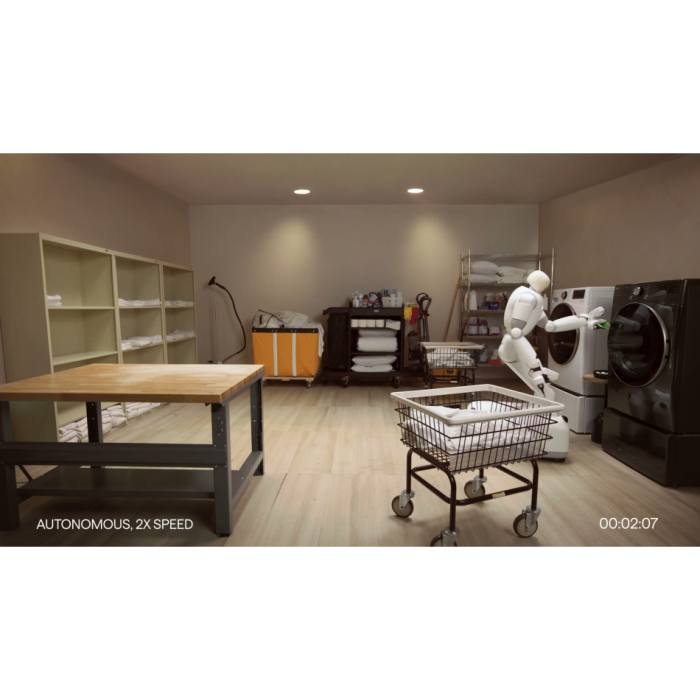
The principal published Dyna-2.1 example is a commercial laundry workflow. DYNA shows Taku working between washers, dryers, a folding table and storage shelves. The sequence involves manipulating machines and textiles, moving between work areas, folding and stacking towels, and attending to equipment as different stages finish. It illustrates why coordinated whole-body manipulation matters in an environment built around human work.
Laundry is not simply a fixed list of motions. Machines complete their cycles at different times, and folding may need to pause so that another station can be serviced. The orchestrator therefore tracks progress and chooses between available activities. DYNA describes a text-based memory of relevant observations, such as machine state and the number of towels folded, to support decisions when the necessary information is no longer directly visible.
Recovery and Operational Assessment
The manufacturer emphasizes recovery from mistakes as a requirement for longer workflows. Examples include retrying a grasp, correcting an interrupted operation and responding to a dropped object. Recovery should be understood as a capability demonstrated within particular tasks, not a promise of unrestricted autonomy or universal safety. A deployment assessment should distinguish recoverable task errors from situations that require an operator to intervene.
For procurement, useful questions include which procedures are supported, how performance is measured, what supervision is required and how the robot interacts with people and equipment. Site layout, floor conditions, station spacing, object variation and machine interfaces all affect the suitability of a mobile manipulation system. Published demonstrations provide context, but they do not replace application-specific validation.
Pricing and Availability
This listing is supplied on a quotation basis. No public purchase price, delivery commitment or physical inventory level is asserted here. Request a quotation to discuss the required workflow, deployment location, configuration and commercial terms. Published dimensions, mass, payload, battery runtime and warranty information have not been established in the source material used for this listing and should be confirmed before an order is placed.
Frequently Asked Questions
What is DYNA Taku?
Taku is DYNA's wheeled semi-humanoid robot, introduced as the hardware platform for the Dyna-2.1 physical agent. It combines a human-shaped upper body and two articulated arms with a steerable wheeled base.
How does Taku work?
A workflow orchestrator selects the next activity, the Dyna-2 policy generates targets for physical skills, and a whole-body controller coordinates the robot's joints and wheels to execute those targets.
Why is Dyna-2.1 important?
Its stated focus is completing connected workflows rather than isolated tasks. The published laundry example combines movement, manipulation, planning and recovery across several workstations.
Does Taku walk on legs?
No. The published hardware uses four steerable wheels. Its folding lower body helps position the upper body for manipulation, but it is not a bipedal walking platform.
Where can I buy DYNA Taku?
Use the quotation inquiry on this listing to discuss sourcing and deployment requirements. Final configuration, supported applications, availability and purchase terms require confirmation.
What are the benefits of Taku's design?
The wheeled base and articulated upper body are intended to support movement between stations and manipulation at varied heights. The software architecture separates workflow decisions from skill execution and precise body control.
Summary
DYNA Taku brings wheeled mobility and two-arm manipulation together with the Dyna-2.1 physical-agent architecture. Its published demonstrations make it relevant to the evaluation of multi-station laundry and related physical workflows, with application suitability and commercial terms established through a quotation and technical review.
Manufacturer source: Dyna-2.1: A Physical Agent for End-to-End Workflows.