
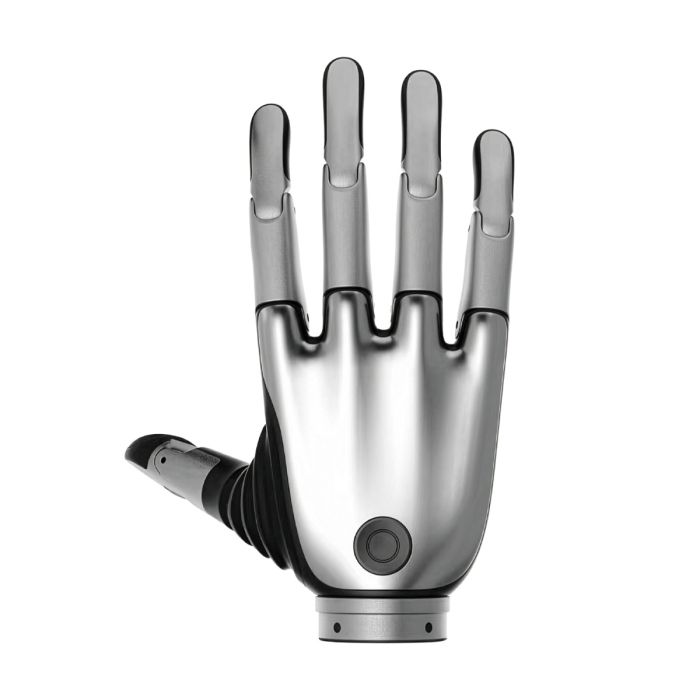
BrainCo Revo 2 Pro Dexterous Right Hand (XER)
In stock
- BREND:
- BRAINCO
- MODEL:
- REVO 2 PRO
- HISSƏ #:
- XER
- ORIGIN:
- Çin
- Warranty:
- 12 AY
- AVAILABILITY:
- SUBJECT TO AVAILABILITY
- SKU:
- BrainCo-Revo-2-Pro
BrainCo Revo 2 Pro Dexterous Right Hand (XER)
In humanoid robotics, the right-hand end-effector serves as the dominant manipulation hand in most task sequences — opening containers, using tools designed for right-handed use, and performing the fine motor leading operations in bimanual coordination where one hand holds and the other manipulates. The selection of a right-hand model (XER) versus left-hand model (XEL) is not merely mechanical: it determines which arm and wrist attachment port the hand mounts to, and — when both are purchased — which hand the robot's AI policies treat as the primary versus supportive manipulator.
For bimanual humanoid robots, purchasing the XEL and XER as a pair creates the bilateral dexterous manipulation capability needed for the most research-rich manipulation tasks: object handover between hands, two-handed object assembly, stabilizing an object with one hand while manipulating with the other, and the social handshake and physical HRI interactions that require both hands to operate in coordinated contact with a human.
The BrainCo Revo 2 Pro is currently integrated in Unitree's G1 EDU Ultimate humanoid robot lineup (appearing in higher-tier EDU configurations) and in multiple other humanoid robot platforms. In all these integrations, both XEL and XER are required for full bilateral capability.
Design and Physical Features
Mirrored Anatomical Configuration
The XER is a physical mirror image of the XEL. Every structural component — finger attachment points, joint positions, palm orientation, wrist interface, and communication connector location — is mirrored to mount on the right wrist of a humanoid robot arm. The thumb is positioned on the left side of the hand (as viewed from the palm), matching the human right-hand thumb position, and the four fingers are positioned across the palm accordingly.
This anatomical mirroring is not merely cosmetic: correct handedness is required for natural grasp geometry. A right-hand-shaped mechanism mounted on a left wrist would produce inverted grasp orientations, placing the thumb on the wrong side for all grasps that require thumb-finger opposition. The XER is designed specifically for right-wrist mounting to ensure correct hand geometry.
383g at Human Female Hand Scale
BrainCo launched the Revo 2 with a specific sizing target: "At just 16 cm long — similar in size to an average adult female hand — Revo2 weighs only 383 grams, about the weight of six eggs." The 160 mm length and 76 mm width of the XER match this scale, enabling deployment on humanoid robot arms designed for human-hand-scale end-effectors without requiring custom wrist adapters or arm length modifications.
The 20% weight advantage over industry average that BrainCo cites reflects the "millimeter-level subtraction" material engineering approach: aerospace-grade aluminum alloy for the structural elements that require stiffness, food-grade polymer for the shell elements that require only surface durability and compliance — allocating mass precisely where it is structurally necessary and eliminating it where it is not.
11 Degrees of Freedom: Balanced Active and Passive Articulation
The Revo 2 Pro XER's 11 total DOF (6 active, 5 passive) are distributed as follows, confirmed from BrainCo's official specification document:
Thumb (3 DOF total): 2 active DOF for abduction/adduction (the opposition motion moving the thumb across the palm) plus 1 passive DOF for flexion/extension of the thumb tip.
Each of four fingers (2 DOF each, 8 total): 1 active DOF for finger flexion/extension (the opening/closing motion) plus 1 passive DOF for distal phalanx flexion, enabling the fingertip to naturally conform to the surface being grasped.
This design places independent motor control on the joints that most affect grasp configuration — thumb opposition and finger closure angles — while passive compliance handles the fine surface-conformation adjustments that don't require precise independent command. The result is a 6-motor system (6 active DOF) that behaves as an 11-DOF hand because the 5 passive joints naturally track the contact geometry.
Anti-Collision and Ultra-Small Gap Engineering
BrainCo's design specifically addresses two common failure modes in dexterous robotic hands: collision damage and object entrapment.
The anti-collision finger design provides structural protection against impact loads from unexpected contact — the finger mechanism is engineered to withstand collision forces that would damage less robust hands, extending operational life in unstructured manipulation environments.
The ultra-small joint gap design prevents objects, clothing, hair, or skin from becoming trapped in the finger mechanisms during closing — a safety feature critical for any hand operating in contact with humans, and a quality feature for precision manipulation where foreign object entrapment in the hand would disrupt the grasp.
Technology and Specifications
BrainCo Revo 2 Pro XER Full Specifications
| Specification | Value |
|---|---|
| Handedness | Right (XER) |
| Weight | 383 g |
| Hand Length | 160 mm |
| Hand Width | 76 mm |
| Total DOF | 11 |
| Active Joints | 6 |
| Power Grasp Force | 50 N |
| Finger Pinch Force | 15 N |
| Active Grip Force | 5 kg |
| Static Load Capacity | 20 kg |
| Grip-to-Weight Ratio | ~53 |
| Open/Close Time | ≤0.65 s |
| Repeat Accuracy | 0.1° |
| Operating Noise | ≤50 dB |
| Materials | Aerospace-grade aluminum alloy + food-grade polymer |
| Colors | Space Black / Silver (customizable) |
| Communication | RS-485, CAN-FD, EtherCAT |
| Max Communication Rate | 1 kHz |
| Voltage Range | 9–64 V |
| Control Algorithm | Adaptive Impedance Control |
| Tactile Sensing | None (see Revo 2 Touch for tactile) |
| Secondary Development | Yes |
| SDK | Python, C, ROS (Windows/Linux) |
| Protocols | Modbus, Protobuf |
| OTA Updates | Yes |
| Protection Systems | Overcurrent, overvoltage, high-temperature |
| Turbo Mode | Yes (periodic stop-and-continue for stall recovery) |
| Auto Power-On Calibration | Yes |
| Free Shipping | Yes (American Satellite) |
| Lead Time | 7–14 business days |
| SKU | BrainCo-Revo-2-Pro |
Adaptive Impedance Control: The Pro's Core Algorithm
The Revo 2 Pro's Adaptive Impedance Control (AIC) is the software intelligence layer that separates its manipulation capability from the Basic variant's position-only control. To understand the significance:
In position control, the motor drives the finger to a commanded angle regardless of what it contacts on the way there. If the object is harder than expected, the finger presses at full commanded force; if softer, the finger may over-travel into the object. This works reliably for rigid, well-characterized objects but fails or produces excessive force on soft, deformable, or variable objects.
Impedance control adds a virtual spring-damper model between the commanded position and the actual position — the "stiffness" of this virtual spring determines how much force the finger applies per unit of position error when contacting an object. A high-stiffness setting produces near-rigid position-following behavior; a low-stiffness setting allows the finger to comply to objects with minimal force. Adjusting stiffness in real time based on contact force history is what makes the control "adaptive": the algorithm infers the object's local compliance and updates the stiffness model to match it, enabling the finger to grasp consistently across objects of unknown compliance.
In practice, this enables the XER to pick up a soft foam block using the same command as a rigid metal cylinder without the foam being deformed by excessive grip force or the cylinder being dropped from insufficient grip. For industrial and service deployment where object diversity is high and per-object parameter tuning is impractical, this adaptive capability is the primary value of the Pro tier.
EtherCAT Integration: Why It Matters for Industrial Deployment
EtherCAT is the dominant real-time Ethernet protocol in industrial automation. Machine tool controllers, semiconductor manufacturing systems, and high-end industrial robots all standardize on EtherCAT because it provides deterministic communication latency (every device response time is bounded to microseconds) and enables synchronization of multiple devices on the same network to sub-microsecond accuracy.
For the Revo 2 Pro XER, EtherCAT support enables:
Direct PLC integration: Connecting to Beckhoff TwinCAT, Siemens, and other EtherCAT-based industrial controllers without custom communication bridges.
Synchronized multi-device operation: Synchronizing the XER with other EtherCAT devices on the same network — servo drives, other hands, sensors — to ensure coordinated motion timing.
Industrial quality assurance: EtherCAT's deterministic communication supports the cycle-time guarantees that industrial quality control systems require, enabling the XER to report grasp quality data to factory management systems in real time.
Turbo Mode and Stall Recovery
OpenELAB's documentation describes Turbo Mode: "After the motor stalls for a defined stall time, it resumes movement, periodically executing stop-and-continue motion." Turbo Mode provides stall recovery without requiring external intervention — when a finger motor stalls against an immovable object, the control system detects the stall and automatically resumes movement after a defined interval. This prevents the hand from becoming stuck in a stalled state during manipulation tasks where unexpected resistance is encountered.
Applications and Use Cases
Bimanual Industrial Manipulation
When paired with the XEL left hand, the XER completes the bilateral manipulation capability needed for industrial tasks requiring two hands: assembling connectors, tightening screws while holding a workpiece, packaging operations, and the two-handed material handling that represents a large portion of manufacturing labor. The EtherCAT interface enables both hands to be synchronized on the same network for coordinated bilateral motion control.
Service Robotics Deployed in Diverse Object Environments
Service robots in retail, hospitality, and healthcare encounter object diversity that static position-controlled grippers handle poorly — from rigid bottles and containers through soft bags, packaged foods, and deformable pharmaceutical packaging. The XER's Adaptive Impedance Control enables the service robot to handle this object diversity without manual per-product parameter tuning.
Teleoperation Systems for Remote Presence
The 1 kHz communication rate and EtherCAT's deterministic latency make the Revo 2 Pro XER appropriate for teleoperation systems where a human operator controls the robot hand remotely, especially systems implementing haptic force feedback. The low-latency bidirectional force data enables the operator to sense what the hand is grasping as close to real-time as the network latency allows.
AI Training Data Collection at Scale
For humanoid AI research programs that use the robot to collect large-scale manipulation demonstration datasets — needed for training imitation learning and reinforcement learning policies — the XER's 1 kHz data rate provides high-frequency joint state, force, and (if EtherCAT telemetry is configured) grasp event data that creates rich training datasets capturing the fine-grained temporal dynamics of dexterous manipulation.
STEM Education and University Research Labs
AlphaGeo UK notes that the Revo 2 family is suited for students and educators needing "precise, responsive robotic hand control for general research and integration tasks." The XER's Python/C/ROS SDK with OTA updates provides an accessible development platform for university robotics courses covering grasping, manipulation control, and human-robot interaction.
Advantages and Benefits
383g World-Class Weight at 20kg Load Capacity: The grip-to-weight ratio of ~53 enables maximum manipulation capability at minimum arm payload cost — every gram added at the wrist increases the arm's effective inertia and reduces its achievable speed.
Adaptive Impedance Control for Diverse Object Environments: Enabling reliable grasping across the full object compliance spectrum without per-object tuning, the Pro is the appropriate choice for any deployment environment where object diversity is high and object properties are not fully pre-characterized.
EtherCAT for Industrial-Grade Integration: Direct integration with industrial PLCs and motion controllers without custom protocol adaptation, enabling production-grade factory deployment.
$6,744.38 with Free Shipping: The confirmed price with free shipping from American Satellite provides transparent total procurement cost without shipping variable.
Five-Year Prosthetics Heritage Manufacturing Maturity: BrainCo's production line stability from prosthetics manufacturing reduces the quality inconsistency risk of early-stage robotic hand products.
OTA and SDK Future-Proofing: Over-the-air firmware updates and open SDK access ensure the XER can receive improved control algorithms and support new integration requirements post-delivery.
Frequently Asked Questions (FAQ)
What is the BrainCo Revo 2 Pro Right Hand (XER)? The BrainCo Revo 2 Pro Right Hand (XER) is the right-handed configuration of BrainCo's Revo 2 Pro advanced-tier bionic dexterous hand. It weighs 383 grams, measures 160 × 76 mm, and features 11 total degrees of freedom (6 active motors). It delivers 50 N power grip force and 15 N pinch force with 20 kg static load capacity, closes in under 0.65 seconds at 0.1-degree repeat accuracy, and operates under 50 dB. Key Pro-tier features: Adaptive Impedance Control algorithm for compliant object grasping, EtherCAT industrial communication alongside RS-485 and CAN-FD, and 9–64V voltage range. Priced at $6,744.38 with free shipping from American Satellite. Ships in 7 to 14 business days.
Does the Revo 2 Pro Right Hand (XER) work as a bilateral pair with the Left Hand (XEL)? Yes. The XEL (Left) and XER (Right) are designed as a bilateral pair sharing identical specifications in mirrored anatomical configurations — one mounts on the left wrist, the other on the right. Purchasing both creates complete bilateral five-finger dexterous manipulation capability on a humanoid robot, enabling bimanual tasks including object assembly, two-handed grasping of large objects, object handover between hands, and physical HRI interactions requiring both hands. Both are priced at $6,744.38 each with free shipping at American Satellite, totaling $13,488.76 for the bilateral pair.
What is the difference between the Revo 2 Pro (XER) and the Revo 2 Touch? Both the Revo 2 Pro and Revo 2 Touch include EtherCAT, 9–64V, and identical physical specifications (383g, 11 DOF, 50N/20kg). The Touch adds multi-modal tactile sensing with 0.01N resolution detecting pressure, friction, force direction, and proximity — enabling contact-aware manipulation that the Pro cannot provide. The Touch's control algorithm adds Adaptive Tactile Control alongside Adaptive Compliance Control. The Pro is appropriate for industrial deployment and adaptive grasping without contact sensing requirements; the Touch is appropriate for research requiring tactile feedback and delicate object handling with distributed contact sensing.
What SDKs and communication protocols does the Revo 2 Pro XER support? The Revo 2 Pro XER supports Python, C, and ROS software development kits on Windows and Linux. Communication protocols include Modbus and Protobuf. Hardware interfaces include RS-485, CAN-FD, and EtherCAT — with 1 kHz maximum communication rate. OTA firmware updates enable post-delivery control algorithm improvements. This multi-protocol, multi-SDK architecture enables integration from research lab embedded systems (RS-485/CAN-FD with Python/ROS) through industrial PLC environments (EtherCAT with Modbus) within the same hardware.
Summary
The BrainCo Revo 2 Pro Dexterous Right Hand (XER) is the right-side counterpart in BrainCo's Revo 2 Pro bilateral dexterous hand pair — sharing the XEL's complete specification of 383 grams, 11 degrees of freedom, 50 Newton grip force, 20 kilogram static load, Adaptive Impedance Control for variable-compliance grasping, EtherCAT industrial communication, and full Python/C/ROS SDK support, in an anatomically mirrored right-hand configuration for right-wrist mounting. Available at $6,744.38 with free shipping from American Satellite in a 7 to 14 business day lead time, the XER is the necessary counterpart for any bilateral humanoid manipulation deployment using the Revo 2 Pro family — completing the bimanual five-finger dexterous manipulation capability that the full-body humanoid research and deployment context requires.
Specifications
General
Physical
Mobility
Performance
Connectivity
Software
Hand
Feature
1. High quality and stability – five years of product iteration and professional production lines.
2. Lightweight (383 grams), with 5 kg active grip force, 20 kg single-hand load capacity, and a grip-to-weight ratio of 53.
3. Ergonomic Bionic Design – supports curved surface grasping with anti- collision finger design.
4. Multi-dimensional tactile perception – pressure, friction, direction, proximity, and surface texture.
5. High Sensitivity Tactile Perception – max resolution of 0.01N.
6. Wide voltage support – 64V.
7. Universal Interfaces – RS485 & CAN-FD, and EtherCAT.
8. Standard Protocols and SDKs – Modbus & Protobuf protocols, SDKs for Python / C / ROS.