
AgiBot A2-W Flexible Manufacturing Wheeled Humanoid Robot
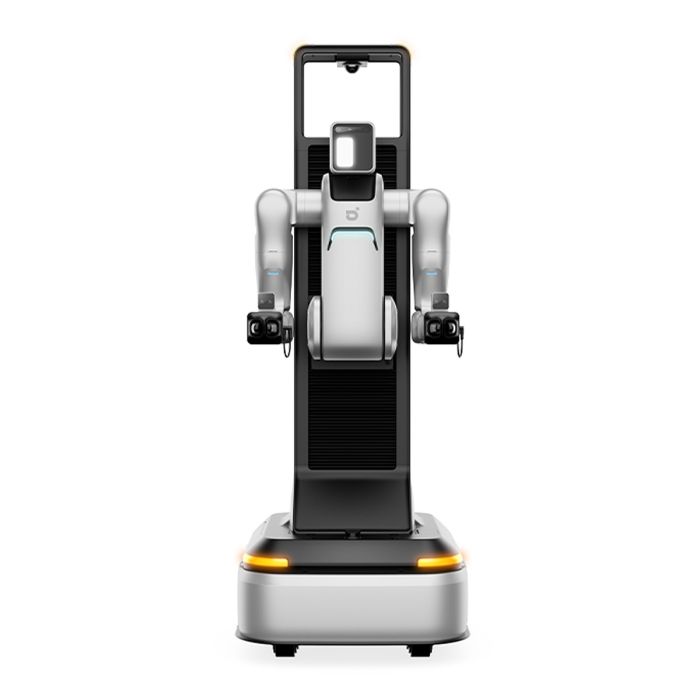
The AgiBot A2-W is a wheeled general-purpose humanoid robot developed by AgiBot (Zhiyuan Robotics; Chinese: 智元机器人), a Shanghai-based robotics company founded in February 2023. The A2-W is the industrial manufacturing variant within AgiBot's Yuanzheng A2 product family, distinguished from its bipedal siblings by its four-wheel-drive mobile base, extended five-hour battery runtime, and specialized optimization for factory floor tasks including loading and unloading, terminal plugging, vibratory feeder loading, logistics transportation, pallet transport, and quality inspection handling.
In stock
- BREND:
- AGIBOT
- HISSƏ #:
- A2-W
- ORIGIN:
- Çin
- AVAILABILITY:
- SUBJECT TO AVAILABILITY
- SKU:
- AgiBot-A2-W
Design and Physical Features
Body Dimensions and Construction
The A2-W has a footprint of 770mm (length) x 620mm (width) and stands 1,630mm (163 cm) in height, weighing approximately 230 kilograms. This substantial mass reflects the robot's industrial construction, which prioritizes structural rigidity and stability for arm operations over the lightweight design criteria that govern bipedal humanoids.
The robot's physical design integrates the chassis, dual arms, and perception system into a unified body structure. AgiBot describes this as a "fully integrated design" that allows for out-of-the-box deployment — the robot arrives configured with its navigation, manipulation, and perception systems pre-calibrated, reducing commissioning time at the deployment site. AgiBot and its integration partners have reported initial deployments taking three to four months for first installations, with subsequent deployments at familiar facility types achievable in as little as three weeks or even hours as familiarity with the robot's capabilities grows.
Bionic Dual-Arm System
The A2-W's most distinctive feature is its dual-arm configuration. Each arm offers seven degrees of freedom, enabling a range of motion comparable to the human arm from shoulder rotation through to wrist orientation. The bionic seven-degree-of-freedom dual arms support parallel and asynchronous operations, enabling mid-air relay and hand-off to easily handle complex workpieces and specific postures.
Each arm can handle a payload of up to five kilograms, providing sufficient capacity for standard industrial components, packaged goods, and manufacturing subassemblies. The dual-arm configuration enables the robot to perform hand-off maneuvers — passing an object from one arm to the other mid-air — allowing it to reorient components during a single handling sequence without setting them down. This capability is particularly useful in assembly line contexts where parts must be presented in a specific orientation to a fixture or tool.
Waist and Working Envelope
The A2-W's waist mechanism can elevate and tilt, offering 22 degrees of freedom across the full waist and arm system to fully cover the human working space. This working envelope allows the A2-W to reach workstations at varying heights — from floor-level storage to counter-height assembly fixtures — without repositioning its wheeled base. The waist elevation range and tilt capability mimic the postural adjustments a human worker makes naturally when reaching across a workbench or bending to access a lower shelf, enabling the robot to serve the same range of workstation heights that human workers occupy.
Four-Wheel Drive Mobility System
The A2-W's four-wheel drive chassis provides omnidirectional mobility including zero turning radius capability and crab-walking — lateral movement perpendicular to the robot's forward direction. This mobility profile allows the robot to maneuver precisely into position at a workstation and align its arm reach with a specific target location without performing a multi-step repositioning maneuver, reducing cycle time and improving repeatability in production environments.
The four-wheel drive system provides the stability advantage of a fixed-base over bipedal locomotion while maintaining the mobility to travel between workstations, follow production flow from one station to the next, or navigate a logistics route within a facility.
Technology and Specifications
Core Specifications at a Glance
| Specification | Value |
|---|---|
| Dimensions | 770 x 620 x 1,630 mm (L x W x H) |
| Weight | ~230 kg |
| Arm Degrees of Freedom | 7 DoF per arm |
| Total Waist and Arm DOF | 22 DoF |
| Payload Per Arm | 5 kg |
| Battery Runtime | 5 hours continuous |
| Battery Capacity | 2,000 Wh (2 kWh) |
| Battery System | Hot-swappable |
| Mobility | Four-wheel drive, zero turning radius, crab-walk |
| Force Control | High-precision |
| Sensors | Multiple depth cameras, vision sensors |
Embodied Intelligence and AI System
The A2-W is powered by AgiBot's proprietary embodied intelligence algorithms, which the company describes as capable of continuous improvement as operational data accumulates. The robot's AI system is trained on a combination of simulated and real-world data. AgiBot has stated that its robot training for the A2-W relies on approximately 95 percent simulated data and 5 percent real-world data, with the real-world component critical for handling the variability and unexpected situations that simulation cannot fully replicate.
The A2-W integrates AgiBot's GO-1 foundation model — the Genie Operator-1 Vision-Language-Latent-Action (ViLLA) system — which enables the robot to interpret natural-language task instructions, understand its environment through visual and sensor data, plan multi-step action sequences, and execute precise physical operations. GO-1's generalization capability means the A2-W can adapt to new product configurations or task variants with less retraining than traditional industrial automation software requires, supporting the "flexible" aspect of its flexible manufacturing positioning.
The AimRT communication middleware framework, developed specifically by AgiBot for humanoid robots in C++20, manages real-time data flow between the A2-W's sensor systems, actuators, and onboard compute, providing lower latency and more stable operation than standard robotics middleware such as ROS.
Sensor System
The A2-W is equipped with multiple depth cameras and vision sensors covering both the arm workspace and the surrounding environment. The perception system supports hand-eye coordination for manipulation tasks — the ability to visually confirm the position and orientation of a workpiece and adjust arm movement accordingly — as well as obstacle detection for safe navigation in shared human-robot factory spaces.
Force-position hybrid control governs the arms during contact tasks. This control mode blends position targeting (moving to a specified location) with force limiting (stopping or backing off when contact forces exceed a threshold), enabling the A2-W to interact with workpieces, fixtures, and tools without causing damage from excessive contact force. The MEMS-based multimodal sensing in the arm system enhances tactile sensitivity for fine-grained manipulation tasks.
Battery and Power Management
The A2-W's 2,000 Wh (2 kWh) battery system is substantially larger than the standard A2 bipedal model's 700 Wh battery, reflecting the A2-W's orientation toward sustained industrial shift operation rather than short-duration service deployments. The hot-swappable battery design allows a depleted battery pack to be exchanged for a fresh one without powering down the robot, minimizing production line downtime during battery management.
The five-hour continuous runtime covers a standard half-shift, and with hot-swap capability, a single A2-W can theoretically operate through a full eight-hour shift with a single mid-shift battery exchange.
Open Interfaces and Secondary Development
The A2-W provides open interfaces and tools for secondary development, allowing manufacturing customers and systems integrators to build custom application logic on top of AgiBot's base capability. This openness is essential for the flexible manufacturing use case: different factories, different production lines, and different product configurations require customized task sequences, and the open interfaces allow integrators to develop these customizations without being restricted to a fixed set of pre-programmed behaviors.
Real-World Deployment: Fulin Precision Engineering
The A2-W's most extensively documented commercial deployment is at Fulin Precision Engineering's manufacturing facility in Mianyang, a city in Sichuan Province, China. Fulin Precision produces parts for electric vehicles and other robots — a demanding environment given the precision requirements and production volumes of the automotive supply chain.
Four A2-W units were installed at the Fulin facility to identify and sort incoming deliveries. During the factory visit documented by Yicai Global, the four robots handled over 800 delivery boxes in three hours. Factory management reported that each A2-W unit could potentially substitute for up to two human workers in appropriate task contexts, and that large-scale adoption is expected to reduce deployment costs as the technology matures.
When a reporter approached one of the A2-W units during operation, it immediately stopped all activity. Deng Yang, head of Fulin Precision's engineering department, explained this was a safety feature designed for the busy factory environment where workers and forklifts operate in close proximity to the robots.
The deployment ecosystem supporting the Fulin installation involved a newly founded company, Anu Intelligent, which handles robot integration at the facility. Anu Intelligent leverages AgiBot's large language models and accumulated experience across factory environments to accelerate new deployments. Initial deployments at the Fulin facility required three to four months, but Anu Intelligent has reduced subsequent deployment timelines at familiar factory types to as little as three weeks or even hours, as operators develop reusable integration templates and the robot's AI system is pre-trained on relevant tasks.
AgiBot's CEO Wang (referenced in the Yicai reporting) noted that real-world variability remains a challenge — the simulated training data that accounts for 95 percent of training does not fully replicate all unexpected situations the robot encounters on a live factory floor, requiring continuous algorithm optimization through real-world data collection. This iterative improvement process is characteristic of how AgiBot approaches robot deployment: initial installation is followed by ongoing AI model updates that progressively expand the robot's reliable task envelope at a given facility.
Applications and Use Cases
The A2-W targets manufacturing, logistics, and quality inspection workflows where mobility, arm dexterity, and extended operational endurance are the primary requirements.
Loading and Unloading Operations
The A2-W's combination of wheeled mobility and dual 7-DoF arms makes it well suited for loading and unloading operations at production workstations — placing components into machines, removing finished parts, and managing the flow of material through production stages. The vibratory feeder loading task demonstrated at the A2-W's August 2024 launch requires the robot to pick small components from a vibrating feed mechanism and place them accurately into a target fixture, a task that demands precise hand-eye coordination under the dynamic conditions of an active production cell.
Terminal Plugging and Connector Assembly
Terminal plugging — inserting electrical connectors, cables, and terminals into sockets and fixtures — requires the combination of controlled insertion force and precise spatial positioning that the A2-W's force-position hybrid control enables. This is a task where conventional rigid industrial automation requires exact fixture alignment, while the A2-W's compliant force control allows it to handle the small position variations typical of real-world connectors and sockets.
Logistics Transportation and Intra-Factory Movement
The A2-W's wheeled base enables it to transport materials, sub-assemblies, and finished goods between workstations and staging areas within a facility. Its five-hour battery life and hot-swap system support sustained transportation routes across a full production shift without extended charging interruptions.
Quality Inspection Support
Loading and unloading for quality inspection — placing finished components into test fixtures, removing them after testing, and routing accepted and rejected items — represents a high-value application for the A2-W given the precision requirements and the human labor typically required for these operations in smaller production volumes.
Pallet Transport and Shelving
The A2-W is capable of pallet transport and pallet shelving tasks, moving loaded pallets within a warehouse or manufacturing facility and placing them in specified storage locations. The five-kilogram arm payload is suitable for box-level handling in palletizing contexts, though it is not designed for full pallet-weight lifting.
Advantages and Benefits
Extended Five-Hour Runtime for Sustained Shift Operation: The A2-W's 2,000 Wh battery system and hot-swap design enable continuous factory floor operation across full or extended shifts without the two-hour runtime constraint that limits the standard bipedal A2's industrial deployment duration.
Stability Advantage Over Bipedal Designs: A wheeled base provides inherently more stable arm operation than a bipedal robot standing on legs. The A2-W's four-wheel drive chassis eliminates the balance computation overhead that reduces operational reliability and increases complexity in bipedal manufacturing robots, while maintaining the mobility to navigate between workstations.
Flexible Redeployment Across Multiple Task Types: Unlike fixed industrial robots that are mechanically and programmatically configured for a single task, the A2-W's general-purpose dual-arm system and embodied AI can be redeployed across different tasks within a facility as production needs change, reducing the capital cost of maintaining dedicated automation for each task type.
Rapid Commissioning Through Integrated Design: The A2-W's fully integrated chassis, arm, and perception design supports rapid out-of-the-box deployment, with integration partners reporting that repeat deployments at familiar facility types can be completed in hours once integration templates and AI training are established.
Continuous AI Improvement Through Operational Data: The A2-W's operational data feeds back into AgiBot's AI training pipeline, progressively improving the robot's task performance as more real-world experience accumulates. This learning flywheel means early adopters benefit from improving capability over the robot's operational lifetime.
Potential Labor Substitution of Up to Two Workers Per Unit: The Fulin Precision deployment demonstrated that each A2-W can handle the delivery identification and sorting work of up to two human workers in suitable task contexts, providing a clear return-on-investment framework for manufacturers evaluating the robot's cost-effectiveness relative to labor expenses.
Frequently Asked Questions (FAQ)
What is the AgiBot A2-W? The AgiBot A2-W is a wheeled general-purpose humanoid robot designed for flexible manufacturing scenarios. It is a variant of the AgiBot Yuanzheng A2 family, replacing the bipedal legs of the standard A2 with a four-wheel drive mobile base. The A2-W features bionic dual 7-DoF arms with a five-kilogram payload per arm, a 22-degree-of-freedom waist and arm system, a five-hour battery runtime with hot-swappable packs, and embodied intelligence algorithms for tasks including loading and unloading, vibratory feeder loading, terminal plugging, logistics transportation, and quality inspection handling.
How does the AgiBot A2-W work? The A2-W navigates factory environments using its four-wheel drive chassis, which supports omnidirectional movement, zero turning radius, and crab-walking for precise positioning at workstations. Its dual 7-DoF arms, controlled by force-position hybrid algorithms, pick, place, transport, and assemble components under the guidance of its GO-1 vision-language-action AI model. Multiple depth cameras and vision sensors provide hand-eye coordination for manipulation tasks and obstacle detection for safe operation in human-occupied factory environments. The robot's training relies on approximately 95 percent simulated data supplemented by real-world operational data that continuously improves its task performance over time.
What is the AgiBot A2-W's battery runtime, and how does hot-swapping work? The AgiBot A2-W operates for up to five hours continuously on a single 2,000 Wh (2 kWh) battery charge — more than twice the two-hour runtime of the standard bipedal A2. The hot-swappable battery system allows a depleted battery pack to be replaced with a fresh one without powering down the robot, enabling continuous operation across full production shifts. With a mid-shift battery exchange, a single A2-W can sustain production through an eight-hour shift without extended downtime.
What real-world factories has the AgiBot A2-W been deployed in? The most extensively documented deployment is at Fulin Precision Engineering's manufacturing facility in Mianyang, China, which produces parts for electric vehicles and robots. Four A2-W units were installed to identify and sort incoming deliveries, handling over 800 boxes in three hours. AgiBot and Fulin Precision management have indicated that each A2-W unit could potentially substitute for up to two human workers in suitable task contexts. AgiBot has also announced a broader contract to supply 100 A2-W units to Fulin Precision's automotive parts manufacturing facilities.
How does the AgiBot A2-W compare to the AgiBot G2? Both the A2-W and the G2 are wheeled humanoid robots with dual 7-DoF arms, but they target different industrial tiers. The G2 is a heavier-duty platform with automotive-grade construction, IP42/IP50 protection, NVIDIA Jetson Thor compute at 2,070 TFLOPS, and sub-millimeter force-control accuracy validated for continuous precision manufacturing. The A2-W has a five-hour battery runtime, omnidirectional mobility, and a broader task focus spanning logistics transportation, loading and unloading, and quality inspection support — positioning it as a versatile flexible manufacturing platform rather than a specialized high-precision assembly system.
Summary
The AgiBot A2-W Flexible Manufacturing Wheeled Humanoid Robot represents a practical, commercially validated approach to introducing dexterous robotic manipulation into factory production lines. Its five-hour battery runtime, hot-swappable power system, zero-radius four-wheel drive mobility, dual 7-DoF arms with a five-kilogram payload per arm, and continuously improving embodied AI system address the real operational requirements of manufacturers who need a flexible, redeployable robot rather than a fixed-function automation cell. The Fulin Precision Engineering deployment — handling over 800 boxes in three hours with four units demonstrates that the A2-W's performance on actual factory floors has crossed the threshold from prototype demonstration to productive commercial operation. For manufacturers in automotive, electronics, and logistics evaluating humanoid robotics for flexible manufacturing applications, the AgiBot A2-W is among the most thoroughly validated platforms available in 2025 and 2026.
Specifications
General
Physical
Mobility
Performance
Computing
Battery + Power
Feature
-
Modular design of atomic capabilities allows for OTA iterative upgrades; the task skill library can be continuously expanded, becoming richer with use.
-
Embodied algorithms can be continuously optimized through data collection and training, becoming smarter and more efficient over time.
-
Integrated design for data collection, simulation training, and inference deployment supports efficient data acquisition and deployment.
-
360° Lidar, 4 AI vision sensors, and 2 six-dimensional force sensors combine to provide multi-sensor fusion perception, enabling millisecond-level detection and intelligent obstacle avoidance.
-
The arm collision detection system, 360° real-time environmental sensing, and redundant perception and control design ensure safety for both personnel and the environment.
- Supports hot-swappable batteries with energy replenishment in minutes and autonomous charging, reducing manual intervention.
- Built-in real-time task self-diagnosis and self-recovery mechanisms minimize unplanned downtime and maintenance efforts.
What's included
Related Products
Out of stock