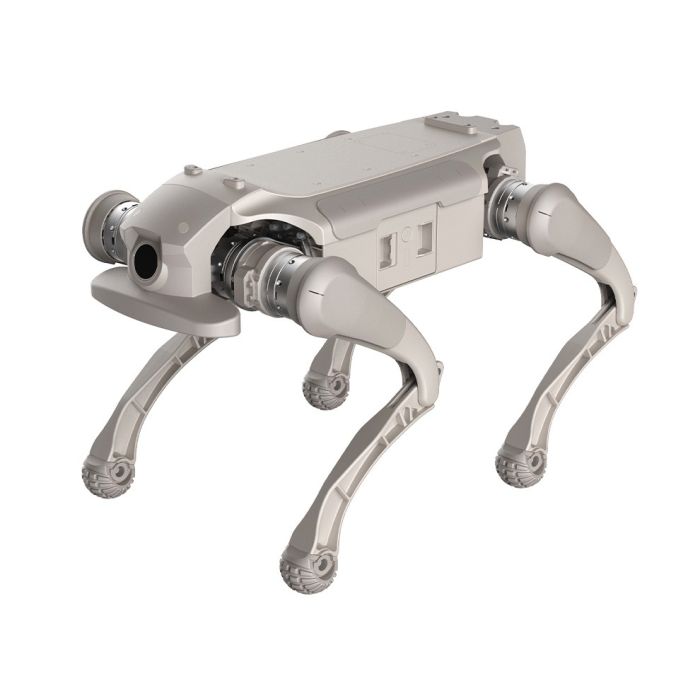
On its official product page, AGIBOT describes the D1 Ultra as a “compact yet powerful” platform with ruggedized construction, reinforcement-learning (RL) gait control for all-terrain mobility, and developer-oriented interfaces for payload integration and secondary development.
AGIBOT positions the D1 Ultra within a broader robotics portfolio aimed at “general-purpose embodied robots and their application ecosystems,” and states that the company was established in February 2023.
In practical terms, the D1 Ultra sits in the fast-growing category of commercial quadruped “robot dog” platforms—machines built to traverse environments where wheeled robots struggle (stairs, uneven terrain, rubble, muddy or sandy ground), while providing standardized interfaces for sensors, communications modules, and task-specific payloads.
Design and Features
Ruggedized compact chassis
AGIBOT emphasizes dustproof and waterproof design priorities for the D1 Ultra, describing high dust/water resistance intended to handle splashes, damp, muddy, and sandy environments, supported by sealed protection for key components and anti-corrosion treatment.
Mobility-first legged locomotion
A defining feature of the D1 Ultra is its RL-based gait control—marketed as enabling adaptation to complex terrain with self-balancing, anti-tipping, and disturbance rejection capabilities.
AGIBOT’s published mobility benchmarks include:
-
Maximum running speed: 3.7 m/s
-
Maximum slope climbing angle: ≥30°
-
Jumping ability: up to 35 cm forward/upward jump height
-
Stair climbing: continuous climbing of stairs up to 16 cm high
Industrial actuation and reduced setup friction
The D1 Ultra is described as using high-torque actuation with a joint motor peak torque of ~48 N·m, aimed at complex terrain and higher-load operation.
AGIBOT also highlights a dual-encoder control approach intended to reduce commissioning overhead, stating that no “zero-position calibration” is required at startup (i.e., it is “ready to use upon startup”).
Developer-oriented expansion and payload mounting
The platform is explicitly marketed for “flexible development,” with an Open SDK and standardized interfaces for payload mounting. AGIBOT lists compatibility with modules such as LiDAR, depth cameras, RTK, 4G/5G, and image transmission modules.
It also notes URDF modeling support and testing/operation in simulation tools including NVIDIA Isaac Sim and MuJoCo, which is relevant for robotics teams validating behaviors in simulation before field deployment.
Technology and Specifications
Mobility and performance
-
Speed: 0–3.7 m/s (AGIBOT also notes a “limit ~5 m/s”)
-
Slope climbing: ≥30°
-
Jumping: up to 35 cm
-
Stairs: continuous stairs up to 16 cm
Size, payload, and range
-
Standing dimensions: 63 × 36 × 42 cm
-
Folded dimensions: 67 × 43 × 15 cm
-
Static load (payload): approximately 8 kg (limit ~10 kg)
-
Unloaded range: 6 km (at 1.8 m/s)
-
Loaded range: 4 km (with 5 kg load)
Environmental and reliability indicators
-
Protection level: IP54
-
Stable operating time in extreme environments: 200 hours (as listed by AGIBOT)
Power and actuation (published highlights)
-
Peak output power (whole machine): ~3,500 W
-
Joint motor peak torque: ~48 N·m
-
Joint control mode: dual encoding
Interfaces and supported expansions
-
Expansion interfaces: Ethernet, USB, power ( 12V/24V ), SBUS, UART
-
Supported expansions (examples): 3D radar (LiDAR), depth camera, RTK, 4G module, image transmission module, follow-up module, application-layer loading
Applications and Use Cases
AGIBOT groups D1 Ultra scenarios into security inspection, scientific research and education, and “special applications.” In real deployments, these translate into several common quadruped-robot use cases:
Security patrol and inspection
Legged robots are often chosen when patrol routes include stairs, curbs, unstructured outdoor terrain, or “last-mile” obstacles that make wheeled platforms unreliable. D1 Ultra’s IP54 rating and terrain-oriented gait claims align with this mission profile.
Emergency response support
Emergency response deployments frequently prioritize mobility and payload flexibility—mounting sensors (depth cameras, LiDAR), communications modules (4G/5G), and situational awareness payloads. The D1 Ultra is marketed as compatible with these module types and interfaces.
Research, education, and developer experimentation
The D1 Ultra’s Open SDK, standardized expansion ports, and URDF/simulation support are directly relevant to robotics labs and applied R&D teams that need to iterate quickly across perception, planning, and locomotion stacks.
Advantages / Benefits
All-terrain mobility in a compact footprint
The combination of a small chassis (63 × 36 × 42 cm standing) and published abilities such as 16 cm stairs and 30°+ slope climbing supports use in mixed indoor/outdoor environments, including corridors, stairwells, construction areas, and uneven ground.
Developer flexibility and payload ecosystem
A key differentiator for quadruped platforms is how quickly teams can integrate sensors and communications. AGIBOT explicitly lists both the interfaces (Ethernet/USB/UART/SBUS, 12V/24V power) and a set of supported module types (LiDAR, depth camera, RTK, 4G/5G).
Simulation-friendly workflow
URDF compatibility and stated support for Isaac Sim and MuJoCo can reduce field-testing risk by enabling teams to validate motion behaviors and payload configurations in simulation before deploying to hardware.
Ruggedization signals for professional use
IP54 protection plus the manufacturer’s emphasis on sealed components and corrosion treatment are typical procurement “gate” requirements for industrial users compared with consumer-grade robots.
FAQ Section
What is the AgiBot D1 Ultra Quadruped Robot Dog?
The AgiBot D1 Ultra is an industrial-grade compact quadruped robot designed for specialized applications such as security inspection, emergency response, inspection, and research/education. AGIBOT lists an IP54 protection level and RL-based gait control as part of its positioning.
How does the AgiBot D1 Ultra work?
The D1 Ultra uses motorized joints (with a published ~48 N·m peak joint torque) and reinforcement-learning-based gait control to adapt locomotion across varied terrain. It is also designed for payload integration via standardized interfaces (Ethernet/USB/UART/SBUS and 12V/24V power) and an Open SDK for secondary development.
Why is the AgiBot D1 Ultra important?
Industrial quadrupeds are important because they can operate in environments where wheeled robots struggle—stairs, slopes, uneven ground, and cluttered outdoor areas. The D1 Ultra specifically publishes mobility targets (up to 3.7 m/s, ≥30° slopes, 16 cm stairs) and an IP54 rating, indicating suitability for demanding inspection and special-operation scenarios.
What are the benefits of the AgiBot D1 Ultra?
Key benefits include all-terrain mobility (stairs, slopes, jumping), industrial-oriented protection (IP54), and developer flexibility through an Open SDK, simulation support (URDF/Isaac Sim/MuJoCo), and compatibility with modules such as LiDAR, depth cameras, RTK, and cellular connectivity.
Summary
The AgiBot D1 Ultra is positioned as a compact, industry-grade quadruped robot dog focused on specialized field operations—notably security inspection, emergency response support, and R&D use. AGIBOT’s published specifications emphasize RL-based gait control, strong mobility benchmarks (up to 3.7 m/s, ≥30° slopes, 16 cm stairs, 35 cm jump), IP54 protection, and a clear developer integration story via Open SDK access, standardized expansion ports, and compatibility with common payload modules and simulation workflows.