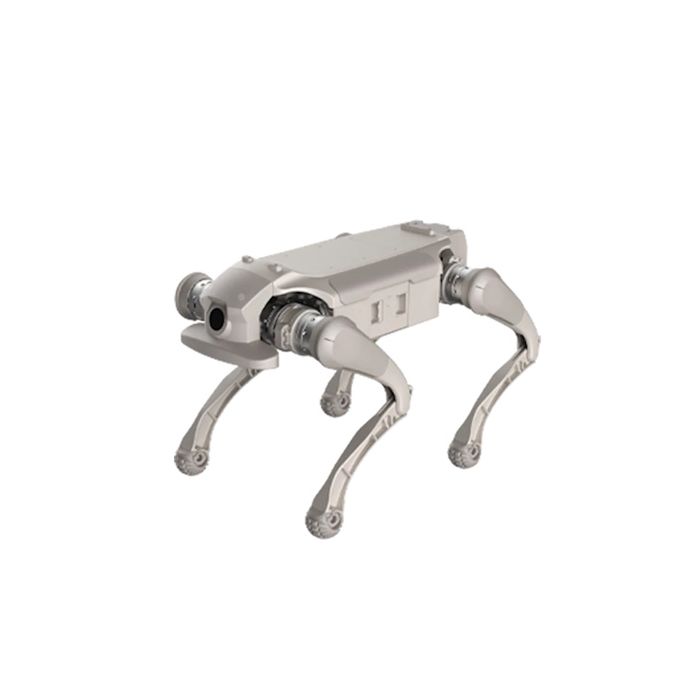
Agibot D1 Quadruped Robot Dog (D1)
In stock
- BRAND:
- AGIBOT
- PART #:
- D1
- ORIGIN:
- China
- AVAILABILITY:
- SUBJECT TO AVAILABILITY
- SKU:
- AgiBot-D1
D1 Quadruped Robot Dog (D1)
Within the broader commercial “robot dog” category, the D1 Ultra is positioned as a configurable platform: it is intended to be deployed with mission-specific payloads (for example, depth cameras, LiDAR, RTK positioning, or cellular connectivity) and controlled through a software development kit (SDK) suitable for secondary development and simulation-based testing.
AGIBOT (AgiBot) is a Shanghai-based robotics company that states it was established in February 2023, focusing on general-purpose embodied robots and an application ecosystem around them.
Design and Features
Compact, rugged chassis for field deployment
The D1 Ultra is marketed as dustproof and waterproof with a high-standard structural design intended to handle splashes, damp environments, mud, and sand. The manufacturer highlights sealed protection for core components and anti-corrosion treatment, emphasizing durability for outdoor and industrial settings.
A key design element is portability: the robot is described with both standing and folded dimensions, supporting transport and rapid deployment in the field.
RL-based gait control and stability behaviors
AGIBOT emphasizes an RL (reinforcement learning)-based gait control approach that “adapts” to complex terrains and provides stability behaviors such as self-balancing, anti-tipping, and disturbance rejection.
In practice, this positioning targets environments with uneven surfaces, debris, or route features like stairs and slopes.
Calibration-minimizing startup (dual-encoder control)
The manufacturer also highlights a dual-encoder design that reduces the need for startup calibration, describing the platform as “ready to use upon startup” without routine zero-position calibration.
Payload ecosystem and developer tooling
The D1 Ultra is presented as a payload-ready platform with standardized ports and a development workflow that supports:
-
Open SDK for secondary development and payload mounting
-
Compatibility with positioning modules, LiDAR, depth cameras, RTK, 4G/5G, and image transmission modules
-
URDF modeling plus simulation workflows (including use in simulation platforms such as Isaac Sim and MuJoCo)
This focus makes the D1 Ultra relevant not only for operational deployments but also for teams building autonomy, perception, or inspection applications.
Technology and Specifications
AGIBOT publishes a relatively detailed set of headline specifications for the D1 Ultra, which are commonly used in procurement comparisons across industrial quadrupeds.
Mobility performance
-
Maximum running speed: 3.7 m/s (with a listed “limit” near 5 m/s)
-
Maximum slope angle: ≥ 30°
-
Stair climbing ability: continuous climbing up to 16 cm step height
-
Jumping ability: up to 35 cm
These figures are intended to demonstrate all-terrain capability for mixed indoor/outdoor routes.
Size, payload, and range
-
Standing dimensions: 63 × 36 × 42 cm
-
Folded dimensions: 67 × 43 × 15 cm
-
Static payload: ~8 kg (listed “limit” near 10 kg)
-
Unloaded range: 6 km (at 1.8 m/s)
-
Loaded range: 4 km (with 5 kg load)
Environmental rating and durability indicators
-
Ingress protection: IP54
-
The manufacturer also lists a “stable operating time in extreme environments” of 200 hours (as stated in the product materials).
Power and actuation (published highlights)
-
Peak output power (whole machine): ~3,500 W
-
Joint motor peak torque: ~48 N·m
-
Joint control mode: dual encoding
Interfaces for payloads and integration
AGIBOT lists standardized interfaces commonly needed for mission payloads:
-
Ethernet, USB, SBUS, UART
-
Power outputs including 12V / 24V (for payload electronics)
Applications and Use Cases
AGIBOT groups D1 Ultra scenarios into categories such as security inspection, scientific research and education, and “special applications.” In deployment terms, these typically map to:
Security patrols and perimeter inspection
Security teams often need platforms that can traverse steps, curbs, and uneven ground while carrying cameras and communication modules. The D1 Ultra is marketed for security inspection and patrol-oriented use and is referenced in coverage of a robot leasing/rental offering as a “security patrol” quadruped option.
Hazardous or hard-to-access inspection routes
Industrial and municipal environments (construction zones, utility corridors, outdoor facilities) can contain uneven terrain where legged locomotion can reduce route constraints. The D1 Ultra’s published slope, stair, and jump metrics support these use cases, particularly when combined with payload modules like depth cameras or LiDAR.
Research and education
The Open SDK, URDF modeling support, and simulation workflow are directly relevant for robotics labs and applied R&D teams. This enables iteration on locomotion, perception, and navigation software in simulation and then transfer to hardware for real-world testing.
Interactive demonstrations and events
Public reporting on robot leasing platforms describes scenario-based rentals for events and demonstrations, with D1-series quadrupeds appearing in packaged offerings.
Advantages / Benefits
All-terrain mobility in environments that defeat wheels
The D1 Ultra’s core value proposition is mobility across stairs, slopes, and uneven ground, supported by RL-based gait control and published benchmarks (3.7 m/s speed, ≥30° slope, 16 cm stairs, 35 cm jump).
Payload flexibility for real deployments
Many “robot dog” projects fail not due to locomotion but due to integration friction. The D1 Ultra emphasizes standard interfaces (Ethernet/USB/UART/SBUS and 12V/24V power), plus compatibility with common robotics payload categories like RTK, LiDAR, depth cameras, and cellular connectivity.
Faster development cycles with simulation tooling
URDF modeling and stated compatibility with widely used simulation platforms can reduce field risk and cost by allowing teams to prototype behaviors, verify kinematics, and test payload layouts in simulation before deployment.
Ruggedization signals for professional procurement
An IP rating (IP54) and manufacturer emphasis on sealing and corrosion protection address common requirements for outdoor and industrial use—particularly in damp, dusty, or sandy environments.
FAQ Section
What is the AgiBot D1 Ultra Quadruped Robot Dog?
The D1 Ultra is an industrial-grade compact quadruped robot designed for specialized applications such as security inspection, research and education, and other professional field deployments.
How does the AgiBot D1 Ultra work?
It uses motorized joints and an RL-based gait control system to adapt its walking/running behavior to complex terrain. It also supports payload integration through standardized interfaces (Ethernet/USB/UART/SBUS and 12V/24V power) and an Open SDK for custom software development.
Why is the AgiBot D1 Ultra important?
Industrial quadrupeds are useful because they can traverse environments that are difficult for wheels—such as stairs, slopes, and uneven ground. The D1 Ultra publishes mobility targets (3.7 m/s speed, ≥30° slope, 16 cm stairs) and an IP54 rating, indicating suitability for demanding inspection and patrol routes.
What are the benefits of the AgiBot D1 Ultra?
Common benefits include all-terrain mobility (stairs, slopes, jumping), IP54 ruggedization, and developer flexibility through an Open SDK, simulation support, and compatibility with common payload modules such as LiDAR, depth cameras, RTK, and 4G/5G connectivity.
Summary
The AgiBot D1 Ultra Quadruped Robot Dog is positioned as a compact, rugged, developer-oriented quadruped platform for professional use cases including security patrols, inspection routes, and research. Manufacturer-published specifications emphasize RL-based gait control, IP54 protection, and strong mobility benchmarks (up to 3.7 m/s, ≥30° slopes, 16 cm stairs, 35 cm jump), alongside standardized integration interfaces and simulation-friendly workflows.
In a market where real-world deployments depend on both mobility and integration, the D1 Ultra’s combination of terrain capability and payload/SDK tooling places it firmly in the industrial quadruped category aimed at practical, configurable field operations.
Specifications
| PART # | D1 |
|---|---|
| ROBOT TYPE | QUADRUPED |
| BRAND | AGIBOT |