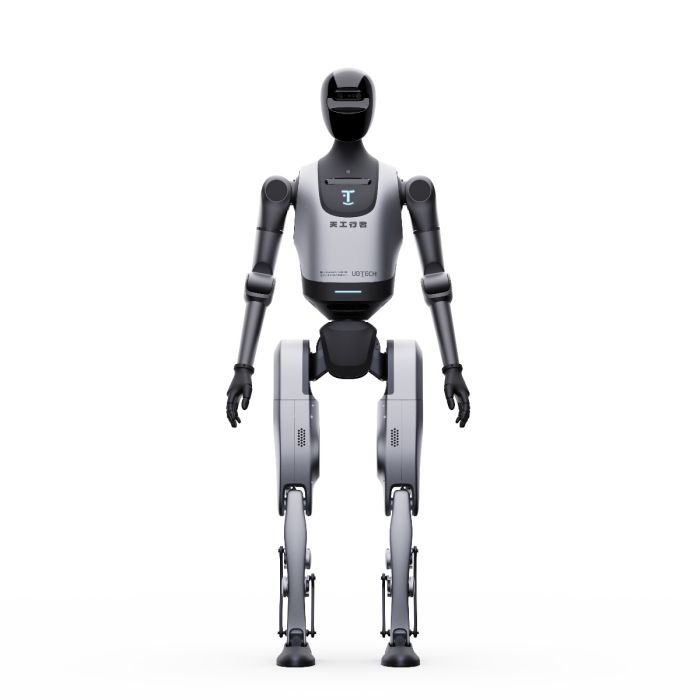
UBTech Walker Tienkung Voice and Vision Humanoid Robot
In stock
- BRAND:
- UBTECH
- MODEL:
- WALKER TIENKUNG VOICE AND VISION
- ORIGIN:
- China
- Warranty:
- 12 MONTHS
- AVAILABILITY:
- SUBJECT TO AVAILABILITY
- SKU:
- UBTECH-Walker-Tienkung
UBTech Walker Tienkung Voice and Vision Humanoid Robot
The UBTECH Walker Tienkung Voice and Vision Humanoid Robot is a full-size humanoid platform built for academic research, education, and secondary development. Standing 172 cm tall, it combines adaptive locomotion with real-time dynamic balance, allowing it to remain stable under impacts and external interference. The platform is deliberately open: every joint and sensor is exposed through documented interfaces, and UBTECH supplies guides, sample code, teleoperation support, and data-acquisition pipelines so that laboratories can move from unboxing to experimentation quickly. In the Voice and Vision configuration the robot weighs approximately 60 to 61 kg, and the product family spans 21 and 42 degree-of-freedom builds. What distinguishes this machine from demonstration-oriented humanoids is its orientation toward reproducible research, with high-fidelity URDF models, open-source training frameworks, and progressive embodied-AI datasets included in the ecosystem.
Background
Full-size humanoid robots have moved from laboratory curiosities to serious research infrastructure, and universities increasingly need platforms that are documented, modifiable, and safe to iterate on. The Walker Tienkung line sits in this space: it is not sold as a finished consumer product, but as an instrument for studying locomotion, manipulation, perception, and embodied intelligence at human scale.
A research-first humanoid platform
According to the official UBTECH product page, the Walker Tienkung is positioned for academic research, education, and secondary development rather than for turnkey commercial deployment. Its locomotion stack emphasizes adaptive walking and real-time dynamic balance, with resistance to impacts and interference — properties that matter when students and researchers run repeated, imperfect experiments on real hardware. Because the platform is offered in multiple configurations, institutions can match the degree-of-freedom count and onboard compute to their curriculum or research program instead of paying for capability they will not use.
Openness as a design principle
The second defining trait is architectural openness. UBTECH documents open interfaces for all joints and sensors and ships guides and sample code for teleoperation, data acquisition, and secondary development. The ecosystem includes high-fidelity URDF models for simulation, open-source training frameworks, and AMP-style reinforcement learning toolchains, so control policies can be developed in simulation and transferred to the physical robot. Progressive embodied-AI datasets — covering multi-view RGB-D imagery, proprioceptive state, end-effector states, and natural-language task descriptions — give teams a structured starting corpus for perception and language-conditioned manipulation research.
Technical Specifications
The table below summarizes brochure specifications, with the 42 DOF configuration shown where values are configuration-specific.
| Specification | Value |
|---|---|
| Height | 172 cm |
| Weight | Approx. 60–61 kg (Voice and Vision); approx. 73 kg (Embodied Intelligence) |
| Degrees of freedom | 21 or 42, depending on configuration |
| 42 DOF layout | 3-DOF head, 2 x 7-DOF arms, 2 x 6-DOF legs, 1 waist DOF, 2 x 6-DOF dexterous hands |
| Peak joint torque | 300 Nm |
| Vision | 3 depth cameras |
| Force sensing | 2 six-axis force sensors |
| Battery | 30 Ah + 3 Ah |
| Endurance | About 6 h standing, about 3 h continuous operation |
| Main computer | Intel Core i7, up to 4.7 GHz, 16 GB RAM, 256 GB SSD |
| AI compute | 2 x NVIDIA Jetson AGX Orin, 550 TOPS combined |
| Software | ROS2 |
| Interfaces | CAN, EtherCAT, Ethernet, Wi-Fi, Bluetooth 5.2 |
Brochure specifications vary by configuration and may change between revisions; the exact equipment list for a specific build should be confirmed during quotation.
How does the Walker Tienkung stay balanced on real terrain?
Balance is the core competency of any bipedal machine, and the Walker Tienkung approaches it through adaptive locomotion and real-time dynamic balance control. The manufacturer highlights resistance to impacts and external interference, meaning the controller continuously re-stabilizes the body rather than depending on a scripted gait. Supporting hardware backs this up: six-axis force sensors provide contact feedback, depth cameras supply geometric awareness of the surroundings, and joints with peak torque up to 300 Nm give the controller authority to execute fast corrective motions. For research groups, the practical benefit is a platform that tolerates the disturbances inherent in experimentation — nudges, uneven loads, and contact events — without ending every trial in a fall.
What can developers actually access on this platform?
Openness here is concrete rather than rhetorical. UBTECH exposes interfaces for every joint and sensor, so custom controllers can command the hardware directly instead of working around a closed vendor stack. ROS2 support ties the robot into the dominant robotics middleware, while CAN and EtherCAT provide deterministic low-level buses for real-time control work. Developers receive guides and sample code covering teleoperation, data acquisition, and secondary development, and the dual Jetson AGX Orin modules — delivering 550 TOPS — leave substantial headroom for running perception networks and learned policies onboard. Combined with the published URDF models and reinforcement learning toolchains, the platform supports a complete simulation-to-hardware workflow within one vendor ecosystem.
Who is the UBTECH Walker Tienkung Voice and Vision Humanoid Robot for?
The primary audience is universities, research institutes, and advanced technical education programs. Robotics and control laboratories gain a full-size biped for locomotion and whole-body control research; AI groups gain an embodied testbed with curated multimodal datasets for perception and language-grounded manipulation work. Educators can build coursework around a documented ROS2 platform with sample code, while corporate R&D teams can prototype humanoid applications before committing to custom hardware. It is not aimed at consumers seeking a turnkey service robot: extracting value from the platform assumes engineering staff who will program, train, and extend it.
What is the UBTECH Walker Tienkung Voice and Vision Humanoid Robot used for?
- Bipedal locomotion research — studying adaptive walking, dynamic balance, and disturbance rejection on a 172 cm platform with up to 300 Nm of joint torque.
- Reinforcement learning and sim-to-real transfer — training policies with the supplied open-source frameworks and AMP-style toolchains against high-fidelity URDF models, then deploying them to hardware.
- Manipulation studies — using the 7-DOF arms, 6-DOF dexterous hands, and six-axis force sensors of the 42 DOF configuration for grasping and contact-rich tasks.
- Embodied-AI dataset work — collecting and exploiting multi-view RGB-D, proprioceptive, end-effector, and natural-language task data for multimodal learning.
- Teleoperation and data acquisition — driving the robot remotely with the documented tooling to gather demonstrations for imitation learning.
- Robotics education — teaching ROS2, kinematics, and humanoid control through guided secondary development on open joint and sensor interfaces.
Pricing and Availability
Pricing for the UBTECH Walker Tienkung Voice and Vision Humanoid Robot is provided on request, since the final figure depends on the selected configuration, degree-of-freedom count, and optional equipment. Configuration and final pricing should be confirmed during quotation. Purchase details are available on this page, and a quotation request is the first step for institutions evaluating the platform.
Frequently Asked Questions
How tall and heavy is the Walker Tienkung?
The robot stands 172 cm tall. The Voice and Vision configuration weighs approximately 60 to 61 kg, while the Embodied Intelligence configuration is listed at approximately 73 kg.
How many degrees of freedom does it have?
Depending on configuration, 21 or 42 DOF. The 42 DOF build combines a 3-DOF head, two 7-DOF arms, two 6-DOF legs, one waist joint, and two 6-DOF dexterous hands.
What computing hardware is onboard?
Brochure specifications list an Intel Core i7 running up to 4.7 GHz with 16 GB RAM and a 256 GB SSD, plus two NVIDIA Jetson AGX Orin modules delivering 550 TOPS for AI workloads.
How long can it run on a charge?
With its 30 Ah plus 3 Ah battery arrangement, the brochure cites roughly 6 hours of standing time and about 3 hours of continuous operation.
Does it support ROS2 and custom development?
Yes. The platform runs ROS2 and exposes open interfaces for all joints and sensors, with CAN, EtherCAT, Ethernet, Wi-Fi, and Bluetooth 5.2 connectivity, plus guides and sample code for secondary development.
Is it suitable for beginners or home use?
No. It is a research and education instrument intended for institutions with robotics engineering capability, not a consumer product or a turnkey household robot.
Where can I buy UBTECH Walker Tienkung Voice and Vision Humanoid Robot and what does it cost?
Purchase details are available on this page. Pricing is not published because it varies by configuration and options; configuration and final pricing should be confirmed during quotation.
Summary
The UBTECH Walker Tienkung Voice and Vision Humanoid Robot pairs a stable, impact-tolerant full-size body with an unusually open development stack: documented joint and sensor interfaces, ROS2, URDF models, reinforcement learning toolchains, and multimodal embodied-AI datasets. For laboratories that need a human-scale biped they can genuinely program rather than merely demonstrate, it is a credible candidate, provided configuration details are confirmed during quotation. For organizations comparing advanced humanoid platforms, this page is the starting point.