Unitree H2 Humanoid Robot (Coming Soon)

The Unitree H2 is a full-size bipedal humanoid robot developed by Unitree Robotics, a Hangzhou, China-based robotics company known for producing some of the world's most price-competitive robot platforms across quadruped, compact humanoid, and full-size humanoid categories. The H2 was unveiled in October 2025 through Unitree's official YouTube channel and website in a launch video titled "Destiny Awakening," which showcased the robot performing dance sequences, boxing routines, martial arts movements, and a runway walk beside a human model.

In stock

BRAND:
UNITREE ROBOTICS
MODEL:
H2
ORIGIN:
China
Warranty:
8 MONTHS
AVAILABILITY:
PRE-ORDER
SKU:
Unitree-H2
US$39,900.00
Unitree H2  Redefining Humanoid Robotics with Human-Scale Mobility and Intelligence
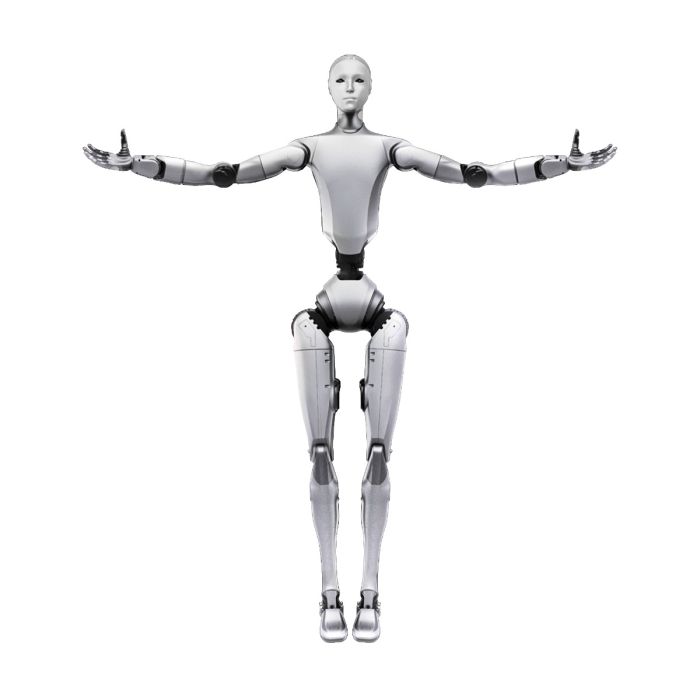
The H2 stands 182 centimeters tall and weighs approximately 70 kilograms, with 31 degrees of freedom distributed across its full body including a 3-DOF waist, 2-DOF neck, 7-DOF arms, and 6-DOF legs. It is powered by a 2,070-TOPS compute chip (NVIDIA Jetson Thor or equivalent Unitree-specified high-performance platform), provides 360 Newton-meters of joint torque, and features a bionic sculpted face with animated eyes designed to support more natural human-robot interaction than the industrial aesthetic of Unitree's previous H1 and G1 platforms.

Human-Scale Proportions and Bionic Face

The H2's most visually distinctive feature compared to previous Unitree humanoids is its carefully considered human-scale proportions and bionic face design. At 182 centimeters, the H2 matches the height of an average adult male, with longer legs than the H1 and H1-2 that improve both stride length and stability during locomotion while maintaining comparable arm proportions.


The sculpted bionic face with animated eyes is a deliberate aesthetic departure from the industrial designs of the H1 and most competing humanoid platforms. Unitree describes this as reflecting a vision of humanoids that "feel approachable and are built for real human connection." The face design incorporates a binocular camera system within the eye sockets, providing a wide field of view for perception while maintaining the visual coherence of the humanoid facial design.

This aesthetic emphasis reflects a market positioning decision: the H2 is designed for public-facing and collaborative research contexts where the robot's visual presence affects user interaction quality, not only for industrial back-of-house automation where appearance is irrelevant to operational effectiveness.

31 Degrees of Freedom Architecture

The H2's 31-DOF kinematic architecture represents an upgrade over the H1's 20 DOF, providing substantially greater body articulation for more fluid, human-like motion. The distribution includes:

  • 6 DOF per leg (identical to H1-2, enabling stable bipedal locomotion with full hip-knee-ankle articulation)
  • 7 DOF per arm (matching the arm DOF of premium industrial humanoids for full reach and wrist orientation freedom)
  • 3 DOF waist (enabling torso bending, rotation, and lateral tilt for whole-body motion coordination)
  • 2 DOF neck (enabling head pan and tilt for visual tracking and social interaction)
  • Additional DOF in hands/wrists (specific configuration varies by variant)

The 31-DOF count enables the H2 to perform the fluid, continuous-motion dance and martial arts sequences demonstrated in the launch video without the jerky, segmented movement that characterizes lower-DOF humanoid systems. RobotShop's analysis notes that the H2's longer legs "improve stride and stability while maintaining similar arm ratios" compared to the H1-2.

360 Newton-Meters of Joint Torque

The 360 Nm peak joint torque is the mechanical specification that governs the H2's strength and payload capacity. At this torque level, the H2 can carry a standard operational payload of approximately 7 kilograms and a brief peak payload of up to 21 kilograms — sufficient for handling standard industrial components, packages, and household objects across the full range of typical service and manufacturing tasks.

The torque figure also determines the robot's agility and recovery from disturbances: higher joint torque allows faster acceleration, stronger balancing responses to unexpected pushes or surface changes, and the ability to catch and correct off-balance postures more effectively. The aerial spinning kicks and dynamic gymnastics demonstrated in the H2's training videos require rapid high-torque joint responses that lower-torque platforms cannot replicate.

Quick-Swap Battery System

The H2 features a quick-swappable battery system, enabling battery replacement without powering down the robot or requiring extended recharging interruptions to operational workflows. This design supports sustained deployment in research environments and commercial applications where multiple battery cycles per day are required.


Technology and Specifications

Core Specifications at a Glance

Specification Value
Height 182 cm (6'0")
Weight ~70 kg
Total Degrees of Freedom 31
Arm DOF 7 per arm
Leg DOF 6 per leg
Waist DOF 3
Neck DOF 2
Peak Joint Torque 360 N·m
Operational Payload 7 kg
Brief Peak Payload Up to 21 kg
Compute Platform 2,070 TOPS chip
Face Design Bionic sculpted face with animated eyes
Perception Binocular cameras (wide FOV)
OTA Updates Yes (algorithms evolve continuously)
Battery Quick-swappable
Price (China domestic base) ~$29,900 USD
Price (International Commercial) $40,900 USD
Price (EDU with SDK) $68,900 USD
Delivery (North America) April 2026
Warranty (Commercial) 8 months
Warranty (EDU) 12 months

2,070 TOPS Compute Platform

The H2's 2,070 TOPS compute chip provides the AI processing capacity required for advanced embodied intelligence applications — including visual perception, manipulation policy execution, human interaction AI, and navigation in complex environments. NVIDIA Jetson Thor, the platform used by Unitree and multiple competing manufacturers (including AgiBot G2), delivers 2,070 TFLOPS of FP4 AI compute based on the Blackwell architecture.

Unitree's product page describes the compute platform as supporting "diverse intelligent models, enabling multiple work scenarios and pushing humanoid robot boundaries," with algorithms evolving continuously via over-the-air (OTA) updates. This means the H2's capabilities are not fixed at the time of hardware purchase but improve as Unitree refines its foundation models and motion algorithms and pushes updates to deployed units.

Unitree App Store Integration

In December 2025, Unitree launched the Unitree App Store — described as the world's first robot app store. By the time of the H2's commercial launch in early 2026, over 1,200 developers had joined and 237 applications were available spanning logistics (38 percent), industrial manufacturing (29 percent), and service robotics (17 percent). The H2 integrates with this ecosystem, enabling deployers to access third-party application software developed for Unitree platforms without building custom application stacks from scratch.

UnifoLM AI Framework

Unitree has released several open-source AI framework components supporting the H2 and broader Unitree humanoid lineup:

UnifoLM-WMA-0 (September 2025) is an open-source world-model-action architecture. UnifoLM-WBT (March 2026) is a real-world whole-body teleoperation dataset released with ongoing updates, supporting the development of imitation learning policies for whole-body humanoid manipulation. UnifoLM-VLA-0 is a vision-language-action model that has been open-sourced by Unitree, enabling the G1 and H2 to autonomously perform household tasks from visual and language inputs.


Applications and Use Cases

Research and University Robotics Laboratories

The H2 EDU variant with its full SDK and ROS 2 compatibility is explicitly designed for research applications. Its 31-DOF articulation, 2,070 TOPS compute, and open-source AI framework support enable research teams studying bipedal locomotion, whole-body manipulation, human-robot interaction, imitation learning, and reinforcement learning to work with a platform that combines competitive price with genuine research-grade capability. The EDU's qualification for federal grant funding makes it accessible to university programs that could not budget for $100,000+ alternatives.

Industrial Manufacturing and Logistics

At the commercial tier, the H2's 7-kilogram operational payload, 360 Nm torque, and full SDK enable integration into manufacturing and logistics workflows requiring a human-scale bipedal robot. The Unitree App Store's distribution of logistics and industrial manufacturing applications accelerates deployment for buyers who do not want to build application software from scratch.

Entertainment and Performance

The H2's bionic face, animated eyes, and fluid 31-DOF motion make it suitable for public-facing entertainment, event performance, and brand activation contexts where visual presence and expressive motion quality matter. The Spring Festival Gala performances demonstrated that the H2 can execute technically complex and visually engaging routines in front of a national audience — validating its entertainment application suitability at the highest public profile level.

Human-Robot Collaboration Research

The H2's human-scale proportions and bionic facial design support human-robot collaboration research where the robot's appearance affects participant behavior and interaction quality. Social robotics, HRI (human-robot interaction) studies, collaborative task research, and caregiving robotics research all benefit from a robot with human-scale ergonomics and a less industrial visual character than the H1 and competing industrial humanoids.


Comparison with Related Platforms

Unitree H2 vs. Unitree G1

The Unitree G1 at $16,000 is a compact humanoid (approximately 127 cm, ~35 kg) with up to 43 DOF and a focus on affordability, agility, and research accessibility. The H2 at $40,900 (commercial) is a full-size human-scale platform with 31 DOF, higher joint torque, a bionic face, and the 2,070 TOPS compute needed for advanced embodied AI. The G1 is the choice for buyers prioritizing price, compact form factor, and high DOF count in a smaller body; the H2 is the choice for buyers needing human-scale proportions, higher payload, and a more sophisticated AI compute platform.

Unitree H2 vs. Unitree H1/H1-2

The H1 was Unitree's previous full-size humanoid (20 DOF, no bionic face, ~$90,000 at commercial pricing). The H2 represents a substantial upgrade: higher DOF (31 vs. 20), higher torque (360 Nm), bionic face for improved HRI, stronger compute (2,070 TOPS), a lower price at comparable capability tiers, and a unified computing architecture replacing the H1-2's dual-core configuration. The H2 is the natural successor platform for H1 and H1-2 buyers.

Unitree H2 vs. AgiBot A2 Ultra

The AgiBot A2 Ultra is a commercial service humanoid at approximately 169 cm and $100,000 to $190,000 depending on configuration, with 40 DOF, triple-market certification (China, US, EU), 1,300-hour walking endurance validation, and the GO-1 embodied AI foundation model. The H2 offers a taller, heavier platform with a bionic face and 360 Nm of joint torque at a lower price point ($40,900 commercial), but the A2 Ultra's triple certification, validated commercial deployment track record, and AgiBot's 10,000-unit production scale provide deployment confidence that the recently shipped H2 platform has not yet had time to accumulate.


Frequently Asked Questions (FAQ)

What is the Unitree H2? The Unitree H2 is Unitree Robotics' full-size bipedal humanoid robot, unveiled in October 2025 and shipping to customers from April 2026. It stands 182 centimeters tall, weighs approximately 70 kilograms, and features 31 degrees of freedom including 7-DOF arms, 6-DOF legs, a 3-DOF waist, and a 2-DOF neck. It provides 360 Newton-meters of peak joint torque, a 2,070-TOPS compute platform for embodied AI, a binocular camera system for wide-field-of-view perception, a bionic sculpted face with animated eyes, quick-swap batteries, and OTA algorithm updates. It is available in commercial ($40,900 international) and EDU ($68,900 with full SDK and ROS 2) variants.

How much does the Unitree H2 cost? The Unitree H2 has a tiered pricing structure. The base domestic China version is listed at approximately $29,900 USD, but this version has hardware limitations and does not include international shipping or import duties. The international commercial variant is priced at $40,900 through authorized distributors in North America and Europe. The EDU variant with full SDK and ROS 2 support is priced at $68,900 in North America. EU buyers must add 7.2 percent customs duty and applicable VAT to the listed prices. The H2 EDU qualifies for US federal research grant funding (NSF, NIH, DARPA, DOE).

How does the Unitree H2 compare to the Unitree G1? The Unitree G1 ($16,000 to $27,000) is a compact humanoid approximately 127 centimeters tall with up to 43 DOF, optimized for affordability and research agility at a smaller scale. The Unitree H2 ($40,900 commercial) is a full-size human-scale platform at 182 centimeters with 31 DOF, 360 Nm joint torque, a bionic face, 2,070 TOPS compute, and an operational payload of 7 kilograms. The G1 suits applications prioritizing compact form factor, higher DOF count, and the lowest possible acquisition cost; the H2 suits research requiring human-scale proportions, higher payload, and advanced AI compute for complex embodied intelligence applications.


Summary

The Unitree H2 Humanoid Robot represents Unitree Robotics' most ambitious platform to date — a full-size, human-scale bipedal humanoid with 31 degrees of freedom, 360 Newton-meters of joint torque, a 2,070-TOPS compute chip, a bionic face with animated eyes, and a tiered pricing structure that starts at $29,900 (domestic China base) and reaches $68,900 for the full-SDK EDU variant in international markets. Available for customer delivery from April 2026, the H2 is positioned for university research, industrial manufacturing, logistics automation, entertainment, and human-robot collaboration research — backed by Unitree's App Store ecosystem of 237+ developer applications, open-source AI framework releases, and a manufacturing velocity that has already produced 5,500+ humanoid robots. For buyers evaluating full-size humanoids in the $30,000 to $70,000 range, the Unitree H2 provides the most competitive combination of price, compute capability, and established developer ecosystem currently available from a manufacturer with a proven production track record.

Specifications

Degrees of Freedom
up to hours
Runtime

General

BRAND UNITREE ROBOTICS
MODEL H2
ROBOT TYPE HUMANOID
ROBOT USE SPORTS

Dimensions

HEIGHT 182.0 cm
WIDTH 45.6 cm
DEPTH 21.8 cm
WEIGHT About 70 kg
FOREARM + UPPER ARM LENGTH 69.0 cm
CALF + THIGH LENGTH 104.5 cm

Degrees Of Freedom

TOTAL DOF 31 DEGREES OF FREEDOM
HEAD / NECK DOF 2 DEGREES OF FREEDOM
ARM DOF 7 DEGREES OF FREEDOM
HAND DOF N/A
WAIST DOF 3 DEGREES OF FREEDOM
LEG DOF 6 DEGREES OF FREEDOM

Robotics

DEXTEROUS HANDS N/A
PEAK ARM TORQUE 120 N.m
PEAK KNEE TORQUE 360 N.m
CONNECTIVITY BLUETOOTH 5.2, WiFi 6
MAXIMUM ARM PAYLOAD ~ 15 KG; RATED ~7 KG
COOLING SYSTEM LOCAL AIR COOLING
MATERIALS AIRCRAFT-GRADE ALUMINIUM, TITANIUM ALLOY, HIGH-STRENGTH ENGINEERING PLASTICS

Computing

COMPUTING POWER INTEL CORE i5
SECONDARY COMPUTING POWER N/A
GPU N/A
SECONDARY DEVELOPMENT NOT SUPPORTED
OTA UPDATES Yes

Battery + Power

RUNTIME UP TO 3 HOURS
BATTERY CAPACITY 15Ah (0.972KWh)
BATTERY VOLTAGE MAXIMUM VOLTAGE: 75.6 V
POWER SUPPLY PREMIUM LITHIUM BATTERY WITH LOW INTERNAL RESISTANCE

What's included

- Unitree H2 Humanoid Robot
- Dummy Hands
- H2 Quick Release Smart Battery
- Battery Charger
- Handheld Remote Control
- 8 Month Warranty

Videos

Product Questions

The Unitree H2 is an advanced humanoid robot known for its agility, versatile applications, and cutting-edge robotics technology. It is designed to perform a variety of tasks in research, inspection, and industrial environments, offering a combination of speed, stability, and intelligent navigation capabilities.

Read more

The Unitree H2 operates as an advanced quadruped robot utilizing a combination of sensors, actuators, and onboard computation to navigate and perform tasks. It employs sophisticated algorithms for balance and movement control, enabling it to walk, trot, and maneuver over various terrains with agility. The Unitree H2 is equipped with sensors to perceive its environment and can be programmed for autonomous or remote-controlled operations, making it suitable for research, inspection, and industrial applications.

Read more

The Unitree H2 is a significant advancement in robotic technology due to its versatile applications in various fields including research, industrial inspection, and autonomous operations. Its agility, robust design, and intelligent navigation capabilities make it a valuable tool for tasks requiring reliable mobility and adaptability in complex environments.

Read more

Unitree H2 benefits include seamless integration in human-oriented environments, advanced motion and manipulation capabilities, interactive AI and sensors, accessible developer platform and versatility across sectors including education, service and research.

Read more
Your Question:
Write a Review
You're reviewing: Unitree H2 Humanoid Robot (Coming Soon)
loader
Loading...

You submitted your review for moderation.