
Topsky All-Terrain Fire Fighting Robot
In stock
- BRAND:
- TOPSKY
- MODEL:
- RXR-M80LGD
- PART #:
- RXR-M80LGD
- ORIGIN:
- China
- Warranty:
- 12 MONTHS
- AVAILABILITY:
- SUBJECT TO AVAILABILITY
- SKU:
- Topsky-RXR-M80LGD
Topsky All-Terrain Fire Fighting Robot
Topsky RXR-M80LGD All-Terrain Fire Fighting Robot
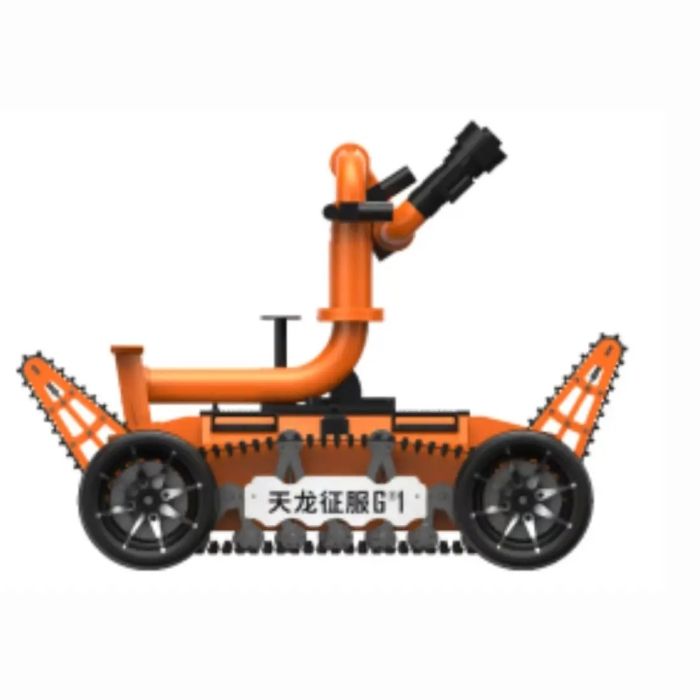
A wheeled-crawler swing-arm firefighting robot designed to replace firefighters at high-risk incidents: a large-capacity imported water cannon under remote wireless control, the TS-Multi detection system feeding environmental data back in real time, and enough obstacle capability to climb stairs.
The swing-arm chassis is what makes it all-terrain
A wheeled-crawler configuration with swing arms is a deliberate compromise between two things that usually trade against each other. Plain wheels are efficient on made surfaces and poor on debris; plain tracks cross debris and are slow and destructive on roads. Swing arms let the machine change its own geometry — lifting to mount an obstacle, lowering to spread its contact patch — which is how it manages both cement and mud, and how it climbs stairs rather than stopping at them.
Stair capability is not a specification detail on a fire ground. It decides whether the machine can reach a basement, a platform or an upper floor, or whether crews have to.
TS-Multi detection, and decisions made on data
The TS-Multi system collects and feeds back environmental data in real time to support fire control decisions. That is the difference between a machine that fights fire and a machine that also tells the commander what the atmosphere is doing — gas, heat and imagery arriving continuously from a position no one can occupy. Topsky lists it as supporting radiation data collection and dangerous-area isolation as well as fire and toxic gas detection.
Published specification
| Specification | Published figure |
|---|---|
| Model | RXR-M80LGD |
| Type | All-terrain fire fighting robot, wheeled crawler with swing arms |
| Water cannon | Large-capacity imported cannon |
| Control | Remote wireless control |
| Detection | TS-Multi system — real-time environmental data collection and feedback |
| Functions | Fire fighting, reconnaissance, self-spraying protection, obstacle avoidance |
| Mobility | Stair climbing; cement, mud and mixed surfaces; strong obstacle crossing |
| Environments | Toxic, oxygen-deficient and smoke-filled conditions |
| Cannon flow and reach, mass, dimensions and endurance | Not published — we obtain these from the manufacturer on request |
Self-spraying is worth noting: the machine wets itself to survive radiant heat. How long it can sustain that, and the cannon’s flow and reach, are the figures that determine how close it can work and for how long — we obtain both from the manufacturer and confirm them in writing.
Specifying for a fire or rescue service
Three questions decide whether a machine like this earns its place, and they are worth settling before price is discussed.
- What is the duty? Reconnaissance, suppression, smoke clearance, casualty search and material transport are different jobs, and a platform optimised for one is compromised at another. Tell us the incident types you are equipping for.
- How does it get to the incident? Transport weight, crate size and whether the machine can be deployed by the crew already on the appliance matter more in practice than headline performance.
- What approvals does your jurisdiction require? Certification and type-approval for emergency-response use vary by country and by service. This is a question to answer before purchase, not after delivery, and we will confirm the position for your jurisdiction in writing.
Specifications and confirmation before order
The figures above are those Topsky publishes for this model. Emergency-response equipment is usually configured to the buying service’s requirement, so dimensions, endurance, detection modules, pump or cannon output and control range can all differ between builds. We obtain the full specification sheet from the manufacturer and put it in writing on your quotation before any order is placed — and if a figure you need is not published, we will ask for it rather than estimate.
Typical deployment
- Rapid suppression at airports, railways and other large fire grounds
- Laying drainage pipe in high-temperature, smoke-filled conditions
- Fire and toxic gas detection with live imagery after tunnel collapse or gas explosion
- Life detection, access opening and fire-source location in building ruins
- Remote environmental and radiation data collection and dangerous-area isolation
- Petrochemical plant, tunnels, subways and collapsed structures
About Topsky
Beijing Topsky Intelligent Equipment Group Co., Ltd. was established in 2003 and is headquartered in the Zhongguancun High-Tech Park in Beijing. It manufactures emergency-response and industrial-safety equipment — firefighting and rescue robots, gas-detection instrumentation and public-security equipment — supplied to municipal fire brigades, petrochemical sites, mines, utilities and law-enforcement agencies in China and internationally.
Supply, training and support
Topsky equipment is supplied to order rather than from stock, so lead times follow production. Lithium-powered machines are regulated dangerous goods in transit and diesel-powered machines carry their own shipping requirements, both of which affect routing and timing — tell us the destination country when you enquire and we will confirm delivered cost, a realistic lead time and the paperwork required. After delivery we help with training, commissioning and ongoing support, which on equipment that may sit unused between incidents matters as much as the initial handover: crews need to stay current on a machine they may only deploy a few times a year.
Where to buy
This model is listed above alongside the rest of the Topsky range. Contact our team for a formal quotation including the full specification sheet and delivery to your country. Fire services, civil defence organisations and industrial emergency response teams buying against a purchase order or tender should request a written quotation first.