
Paxini High-Speed Communication Integrated Board (High-speed communication integrated board)
In stock
- PART #:
- High-speed communication integrated board
- ORIGIN:
- China
- AVAILABILITY:
- SUBJECT TO AVAILABILITY
- SKU:
- Paxini-High-speed-communication-integrated-board
Paxini High-Speed Communication Integrated Board (High-speed communication integrated board)
It is positioned as a companion module for PaXini’s ITPU (Intelligent Tactile Perception Unit) sensor ecosystem especially the PX-6AX GEN3 multi-dimensional tactile sensor family helping developers route tactile data between sensors, a PC “upper computer” (host software), and a robot’s main control board.
In practical deployments, tactile sensing hardware typically requires more than the sensor itself: users also need reliable wiring, power distribution, and a communication bridge that makes sensor output accessible to software tools for calibration, visualization, logging, and model training. PaXini markets the High-Speed Communication Integrated Board as part of this integration layer and recommends pairing PX-6AX GEN3 sensors with dedicated communication accessories, including the integrated board.
Design and Features
Compact, integration-oriented hardware
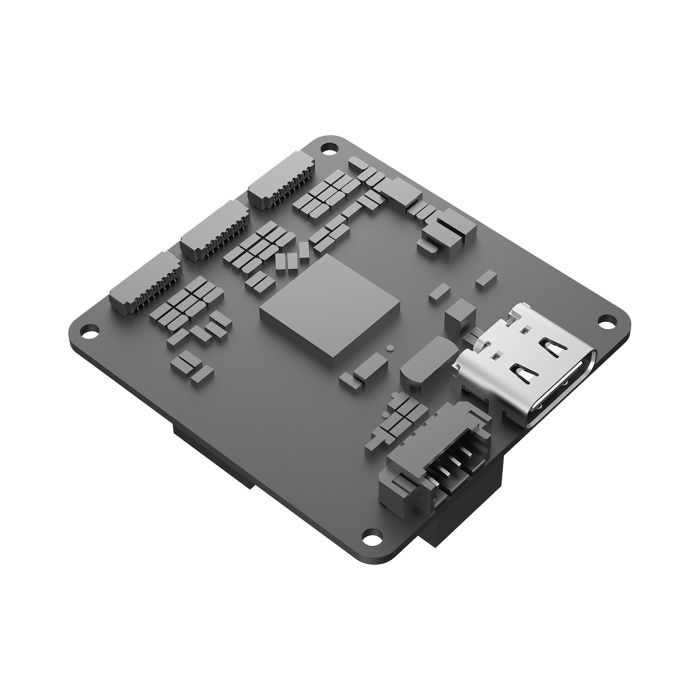
PaXini describes the High-Speed Communication Integrated Board as a miniature design measuring 32 × 34 mm, aimed at embedding inside robot hands, end effectors, or compact control enclosures where space is limited.
PC and controller connectivity
The board is marketed with two primary connectivity roles:
-
USB direct connection to a PC host (“upper computer”), intended for development workflows such as configuration, diagnostics, and data capture.
-
UART communication to a main control board, enabling integration with a robot controller or embedded compute platform that coordinates multiple sensors and actuators.
Built for multi-sensor (full-hand) tactile integration
PaXini positions the module as capable of meeting “full-hand tactile sensor integration communication” needs—i.e., supporting the system-level wiring and data routing required when tactile sensors are distributed across multiple fingers, fingertips, and palm locations.
Technology and Specifications
Manufacturer-stated specifications (public listing)
From PaXini’s product listing, the commonly cited specifications include:
-
Form factor: 32 × 34 mm (micro/compact board)
-
Host interface: USB direct connection to PC software tools
-
Controller interface: UART link to a main control board
-
Intended role: Communication integration for full-hand tactile sensor systems
-
Regional variant: Mainland China edition (restricted to China mainland)
-
Commercial terms: Listed price and shipping/payment options (see below)
System context: why “high-speed” matters
While the board’s public listing focuses on integration rather than raw electrical performance, it is marketed alongside tactile sensors that emphasize high-rate sampling and durability. For example, PaXini’s PX-6AX GEN3 family is promoted with “million-level sampling per second” messaging and industrial protection features such as IP68 on certain models.
In tactile robotics, high-rate acquisition can be important because contact events—micro-slips, incipient collisions, shear onset, and transitions between static and kinetic friction—may occur quickly and can be missed at low sampling rates. PaXini’s broader messaging around embodied intelligence and tactile sensing highlights the role of tactile data in making robot manipulation more adaptive and “human-like,” particularly for dexterous hands and humanoid end effectors.
Applications and Use Cases
1) Humanoid hands and dexterous grippers
The most direct application is dexterous manipulation, where tactile sensors are distributed across fingertips and palms and must be integrated into a single software pipeline. In this configuration, the integrated board can serve as the bridge that helps bring tactile streams to a PC during development, then route them to a robot controller for runtime control.
2) Tactile data collection for embodied AI
A common workflow in embodied AI is collecting synchronized datasets (vision, proprioception, tactile) and using them for policy learning or tactile representation learning. PaXini’s public material includes references to using tactile sensing within AI-driven interpretation pipelines and system-level simulation/training approaches, suggesting that communication accessories are part of the practical stack needed to operationalize tactile signals.
3) Calibration, diagnostics, and production testing
In sensorized robotics, production readiness often depends on calibration repeatability and robust diagnostics. The board’s USB-to-PC positioning suggests utility for:
-
factory or lab verification,
-
sensor commissioning,
-
troubleshooting communication or wiring issues,
-
and logging tactile signals during test procedures.
4) Research prototyping and retrofits
Researchers and integrators frequently retrofit tactile sensors into third-party hands or custom grippers. PaXini describes its tactile portfolio as suitable for augmenting dexterous end-effectors and embodied systems; an integrated communication module can reduce integration friction compared with bespoke wiring harnesses for each prototype.
Advantages / Benefits
Streamlined integration for PaXini tactile systems
The board is explicitly marketed as part of PaXini’s ecosystem and recommended alongside PX-6AX GEN3 sensors and other communication accessories. This packaging can simplify procurement and reduce engineering time versus assembling an ad hoc chain of adapters and breakout boards.
Dual pathway: development (USB) and deployment (UART)
A common pain point in robotics is switching between development setups (PC-based tools) and deployment setups (embedded controller). By listing both USB-to-PC and UART-to-controller connectivity, the board aligns with typical bring-up → integration → deployment workflows.
Compact footprint for embedded mounting
At 32 × 34 mm, the board is positioned for tight integration inside robot wrists, hands, or electronics bays, where larger interface boards can be difficult to mount.
Market pricing notes
Because robotics accessory pricing varies by region, channel, and bundling (e.g., kits that include cables or sensor packs), buyers typically confirm final commercial terms with the seller or manufacturer. The ¥500 listing is a useful reference point for the China mainland channel.
FAQ Section
What is the Paxini High-Speed Communication Integrated Board?
It is a compact communication accessory used to connect PaXini tactile sensor systems—such as PX-6AX GEN3 deployments—to a PC (via USB) and to a robot main control board (via UART) for integration and data handling.
How does the Paxini High-Speed Communication Integrated Board work?
In typical use, the board acts as a communication bridge: developers can plug it into a PC over USB for setup and data capture, while using UART to exchange data with the robot controller that coordinates the tactile sensing system.
Why is this board important for tactile robotics?
Multi-sensor tactile hands can require a reliable, compact interface layer to route data into software tools and controllers. PaXini positions the board as supporting full-hand tactile integration, which is a common requirement in dexterous manipulation and embodied AI workflows.
What are the benefits of the Paxini High-Speed Communication Integrated Board?
Key benefits include a compact 32 × 34 mm design, USB connectivity for PC-based development, UART connectivity for controller integration, and positioning as a dedicated communication component for full-hand tactile sensor systems.
Summary
The Paxini High-Speed Communication Integrated Board is a compact (32 × 34 mm) accessory designed to simplify tactile sensor communications in PaXini-based robotic systems, offering USB connectivity to a PC and UART connectivity to a robot controller. Marketed for full-hand tactile sensor integration, it fits into the broader PX-6AX GEN3 ecosystem and addresses a practical need in dexterous manipulation and embodied AI: turning distributed tactile sensing hardware into an accessible, reliable data stream for robotics software and control.
Specifications
| PART # | High-speed communication integrated board |
|---|