
LimX Tron 1 Standard Edition Multi-Modal Biped Robot
In stock
- BRAND:
- LIMX
- MODEL:
- TRON 1
- ORIGIN:
- China
- AVAILABILITY:
- SUBJECT TO AVAILABILITY
- SKU:
- LimX-Tron-1
LimX Tron 1 Standard Edition Multi-Modal Biped Robot
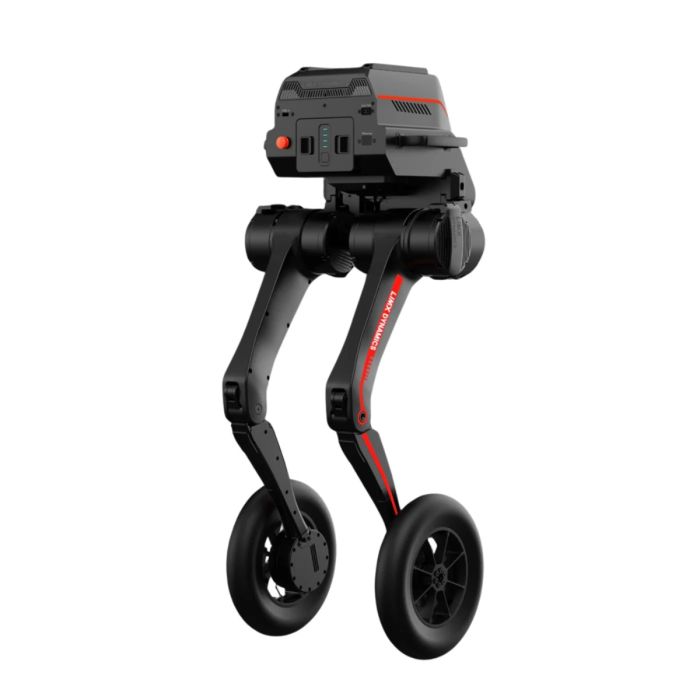
TRON 1 is best known for its modular foot-end system, which allows a single robot to operate in multiple mobility configurations—bridging the gap between legged and wheeled movement without requiring a separate hardware platform.
LimX positions TRON 1 as an onboarding robot for humanoid locomotion research and reinforcement-learning experimentation, offering a simplified biped form factor while retaining configurable “modes” that change how the robot contacts the ground.
A key distinction of the Standard Edition is its focus on usability “out of the box.” LimX’s official product listing notes that the Standard Edition does not support secondary development, with expanded development capabilities directed to the Education edition.
Design and Features
Multi-modal mobility through modular foot-ends
TRON 1’s signature feature is a three-in-one modular foot-end architecture that supports three operating modes in a single purchase. LimX describes the platform as enabling seamless switching between:
-
Point-foot mode (simplified legged contact)
-
Sole mode (a more humanoid-style foot contact)
-
Wheeled mode (higher-speed rolling mobility)
This modular design is intended to accelerate algorithm development across different locomotion conditions while using the same robot body, actuators, and control electronics.
Compact biped form factor
TRON 1 adopts a two-leg structure with a central chassis housing the compute and power system. Its mechanical design uses aluminum alloy and industrial plastics, a common materials approach that balances strength, weight, and serviceability for lab and prototype environments.
Standard Edition positioning
The Standard Edition is marketed as a ready-to-use model for demonstrations and entry-level research workflows. According to LimX’s official store listing, users requiring deeper customization and development support are directed to the Education edition instead.
Technology and Specifications
Mechanical and physical characteristics
LimX publishes a detailed TRON 1 specifications page covering physical dimensions, weight, and structural materials. Key mechanical parameters include:
-
Dimensions: ≤ 392 × 420 × 845 mm
-
Net weight: ≤ 20 kg
-
Material: Aluminum alloy + industrial plastic
These dimensions place TRON 1 in a category that is small enough for university labs, indoor testing spaces, and controlled environments, while still supporting meaningful payload and terrain negotiation experiments.
Battery system and duty cycle
TRON 1 uses a swappable lithium battery system designed for rapid turnaround between trials. Published battery parameters include:
-
Battery voltage: 46.8 V
-
Maximum battery power: 1,000 W
-
Capacity: 4.5 Ah
-
Battery swapping: supported
-
Range: up to 2 hours
-
Charging time: under 1 hour (20%–80%), ~1.5 hours to 100%
-
Charging dock: battery charging dock
Performance: payload, speed, and terrain capability
LimX lists TRON 1 as capable of carrying loads while moving across moderate obstacles and inclines:
-
Load capacity: ≤ 10 kg
-
Speed: point-foot < 1 m/s; sole < 1 m/s; wheeled ≤ 3 m/s
-
Maximum climbing angle: ≤ 30°
-
Maximum obstacle height limitation: ≤ 20 cm
Actuation characteristics
TRON 1’s actuator specifications highlight torque and peak-speed capabilities relevant to agile stepping and stabilization:
-
Rated voltage: 48 V
-
Rated torque: 30 N·m
-
Peak torque: 80 N·m
-
Peak speed: 15 rad/s
Sensors and interfaces
LimX’s specification sheet notes an IMU is included, while an RGB-D camera is not listed on the core configuration. This aligns with TRON 1’s emphasis on locomotion control and stability research, where inertial sensing is foundational.
For connectivity and expansion, TRON 1 lists:
-
USB 3.0 ×1
-
Gigabit Ethernet ×1
-
Peripheral power output: 24 V, up to 100 W (peak 200 W)
-
Peripheral mounting point support
Compute platform
LimX’s published computer specification for TRON 1 includes:
-
12th Gen Intel i3 / 16 GB RAM / 512 GB storage
This configuration is typical of mobile robotics systems designed to run mid-level autonomy stacks, logging, and model-based controllers while maintaining cost efficiency.
Operating environment
LimX lists an operating range of -5°C to 40°C, with operation noted in favorable weather conditions—suggesting the platform is oriented primarily for indoor and controlled outdoor testing rather than extreme environments.
Applications and Use Cases
Locomotion research and reinforcement learning
TRON 1 is widely positioned as a development testbed for robot locomotion algorithms, including reinforcement learning research where repeated trials are used to learn stable gait behaviors. LimX’s own product overview frames TRON 1 as a practical onboarding platform for humanoid motion control and embodied-intelligence experimentation.
Multi-modal control and “mode switching” autonomy
One of TRON 1’s most distinctive research roles is enabling comparisons between mobility strategies on the same hardware. For example, a lab can evaluate how obstacle negotiation differs between point-foot stepping, sole-based walking, and wheeled rolling—then test how controllers decide when to switch modes.
Education and lab training
TRON 1 is marketed toward universities and research institutions seeking an accessible bipedal robot for curriculum projects and demonstrations. Third-party coverage also highlights TRON 1’s accessible price point compared with larger humanoids and research bipeds.
Industrial exploration and prototype validation
While TRON 1 is not framed primarily as an industrial deployment robot, its payload rating and modular mobility can support early-stage experimentation for inspection routines, facility navigation, and motion planning under variable contact conditions—especially for teams exploring how future general-purpose robots might blend rolling and stepping mobility.
Advantages / Benefits
One platform, three mobility behaviors
The most direct benefit of TRON 1 is replacing multiple mobility platforms with a single system. Instead of testing algorithms on separate legged robots and wheeled robots, research teams can use TRON 1’s modular foot ends to explore several contact models without re-architecting the entire robot.
Clear path from beginner-friendly operation to research scaling
LimX positions the Standard Edition as a ready-to-use entry point, while indicating the Education edition is intended for deeper development work. This separation supports organizations that want a demonstration and training robot first, then scale into more advanced R&D when needed.
Practical locomotion performance in a compact package
With published 30° climbing capability and 20 cm obstacle height limits, TRON 1 supports meaningful real-world locomotion testing—especially in indoor courses, ramps, and structured obstacle setups used in robotics research programs.
FAQ Section
What is LimX TRON 1 Standard Edition?
The LimX TRON 1 Standard Edition is a multi-modal biped robot designed for locomotion research and education, featuring modular foot ends that support point-foot, sole, and wheeled mobility modes.
How does TRON 1 work?
TRON 1 operates as a compact biped robot with an onboard computer and actuator system. Its defining capability is switching between three ground-contact modules, allowing the same robot to roll or walk under different control strategies.
Why is TRON 1 important?
TRON 1 is significant because it provides a single platform to test multiple locomotion approaches, supporting research into gait design, stability control, and reinforcement learning—areas central to modern embodied robotics development.
What are the benefits of TRON 1 Standard Edition?
Key benefits include three mobility modes in one robot, a compact research-friendly form factor, published performance specifications (payload, speed, incline/obstacle handling), and a ready-to-use configuration aimed at simplifying onboarding into biped robotics.
Summary
The LimX TRON 1 Standard Edition is a compact, research-oriented multi-modal biped robot that stands out for its interchangeable foot-end system, enabling point-foot walking, sole-based locomotion, and higher-speed wheeled travel on the same platform. With published specifications covering payload, speed by mode, incline handling, and a swappable battery architecture, TRON 1 is positioned as an accessible gateway into biped locomotion research, reinforcement learning, and multi-modal mobility development—particularly for universities and R&D teams seeking a practical testbed without the complexity of full-sized humanoids