
LimX Tron 2 Multi-Form Embodied Robot
In stock
- BRAND:
- LIMX
- MODEL:
- TRON 2
- ORIGIN:
- China
- AVAILABILITY:
- SUBJECT TO AVAILABILITY
- SKU:
- LimX-Tron-2
LimX Tron 2 Multi-Form Embodied Robot
TRON 2 is typically presented as a general-purpose embodied intelligence platform for experiments that involve whole-body control, manipulation, perception, and locomotion—including research workflows that benefit from switching between stationary dual-arm manipulation, bipedal mobility, and wheeled-legged transport without changing robot families or software stacks.
Design and Features
Tri-Form modular configuration
TRON 2’s defining characteristic is its Tri-Form configuration, which supports multiple build-outs from the same ecosystem:
-
Dual-arm configuration for manipulation-intensive, desktop or bench tasks
-
Bipedal configuration for legged mobility and stairs/uneven ground
-
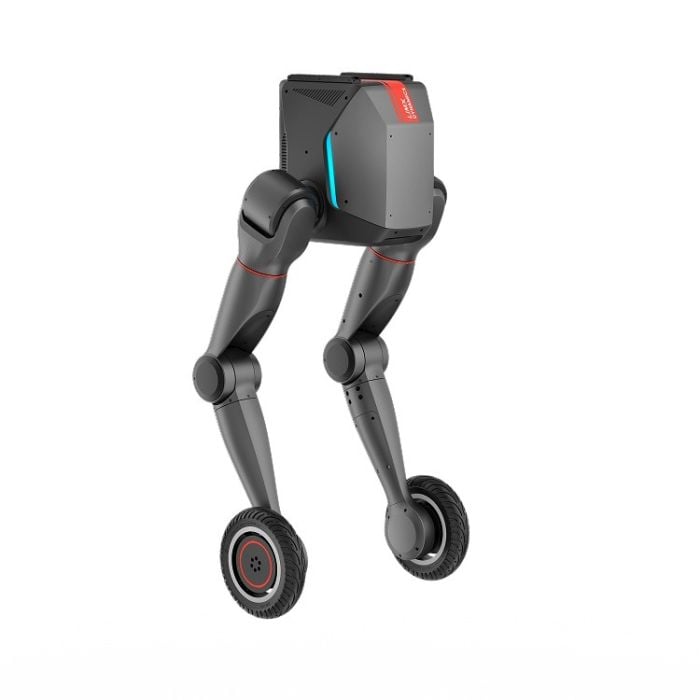
Wheeled-leg configuration for fast movement and payload transport on flat surfaces
This approach reflects a broader trend in embodied robotics toward reconfigurable “one platform, many experiments” systems, where labs can iterate faster by adapting the robot’s morphology instead of acquiring separate robots for locomotion, manipulation, and mobile logistics.
Dual-arm manipulation focus
In its dual-arm configuration, TRON 2 emphasizes manipulation performance and repeatability for research tasks such as pick-and-place, tool handling, and human-scale object interactions. LimX highlights 7 degrees of freedom (DoF) per arm, enabling dexterous reachability and flexible end-effector orientation.
A frequently referenced capability is 10 kg dual-arm payload, positioning TRON 2 as a platform for handling heavier objects than many compact lab manipulators while maintaining a collaborative-research form factor.
Mobility reconfiguration: bipedal vs wheeled legs
TRON 2’s mobility options are built to address a common robotics tradeoff: legs handle rough terrain and stairs, while wheels handle long-distance movement efficiently.
-
In bipedal mode, TRON 2 is described as using vision-based motion planning for walking and stair traversal in research scenarios.
-
In wheeled-leg mode, third-party coverage has described the platform as supporting high payload transport and features such as auto-recharging in that configuration, aligning with logistics and long-duration test cycles.
Technology and Specifications
Manipulation and kinematics
-
7-DoF per arm (dual-arm setup) for dexterous reach and end-effector positioning
-
10 kg dual-arm payload for desktop tasks and general-purpose manipulation research
-
Reports have referenced high-precision control in the context of research-grade manipulation (often summarized as repeatability-focused control loops in vendor/industry writeups).
Teleoperation and control responsiveness
LimX promotes TRON 2 for teleoperation-driven workflows, including dataset collection and imitation learning. One highlighted metric is ~100 ms teleoperation latency, intended to support responsive manipulation experiments and operator-in-the-loop development.
Perception and expandability
The official product positioning describes TRON 2 as expandable with vision, voice, and additional sensing, reflecting typical embodied robotics stacks that combine:
-
multi-camera perception,
-
depth sensing / 3D understanding,
-
proprioceptive feedback (joint sensing),
-
and safety boundaries for collaborative operation.
Active safety boundaries
LimX’s TRON 2 materials reference “active safety boundaries”, a concept generally associated with configurable motion limits, workspace monitoring, and safety-oriented control constraints used in collaborative research settings.
Payload and transport performance (wheeled mode)
Industry reporting on TRON 2 frequently highlights a wheeled configuration designed for transport efficiency:
-
up to 30 kg payload in wheeled-leg mode (flat terrain contexts)
-
mobility narratives describing fast traversal on flat ground (often presented as one advantage of wheeled-legged morphology)
Applications and Use Cases
Embodied AI research and dataset creation
TRON 2 is positioned as a platform for embodied AI workflows where real-world interaction data matters: collecting demonstrations, testing policies, validating vision-language-action ideas, and benchmarking controllers across different morphologies. Its reconfigurable structure supports repeated experiments without changing entire robot systems.
Mobile manipulation and laboratory automation
In dual-arm mode, TRON 2 can be used for bench-top and lab automation tasks such as object sorting, assembly research, and tool-use studies. In mobile modes, it can serve as a mobile manipulation testbed for “fetch-and-carry” experiments that combine navigation with manipulation.
Logistics and payload transport
The wheeled-leg configuration is commonly discussed for transport-heavy scenarios, where moving loads efficiently on flat surfaces is more important than complex terrain capability. Payload figures around 30 kg make this mode relevant for prototyping indoor logistics and warehouse-style research trials.
Stairs, uneven ground, and legged locomotion experiments
In bipedal mode, TRON 2 supports legged locomotion research, including stair climbing and navigation in constrained environments—use cases where wheels alone typically struggle.
Education and prototyping for modular robotics
Because TRON 2 can be physically reconfigured, it is frequently described as an education-friendly platform for teaching:
-
locomotion fundamentals,
-
whole-body control,
-
safety constraints,
-
and system integration (sensing + actuation + compute).
Advantages / Benefits
One platform, multiple robot forms
A central advantage of TRON 2 is that it can reduce the need to maintain separate hardware stacks for manipulation, bipedal locomotion, and wheeled transport. This can simplify:
-
software integration,
-
hardware maintenance,
-
and long-term experiment reproducibility.
Faster iteration in embodied robotics
By encouraging teleop workflows and modular configuration, TRON 2 aligns with modern embodied intelligence practices where teams iterate quickly through:
-
demonstrations,
-
policy updates,
-
sim-to-real calibration,
-
and safety tuning.
Balanced mobility tradeoffs
TRON 2’s modes address a standard robotics tradeoff:
-
legs for obstacles and stairs,
-
wheels for efficient long-distance movement.
FAQ
What is LimX TRON 2?
LimX TRON 2 is a multi-form embodied robot that can be reconfigured into dual-arm, bipedal, or wheeled-leg modes, designed for embodied AI research, teleoperation, and robotics development.
How does LimX TRON 2 work?
TRON 2 works by using a modular mechanical architecture that lets users switch physical configurations while maintaining a unified platform for perception, control, and teleoperation. Its arms support 7-DoF per arm manipulation, and mobility options support experiments ranging from stairs to fast indoor transport.
Why is LimX TRON 2 important?
TRON 2 is important because it represents a “one robot, multiple embodiments” approach—helpful for labs and teams that want to test embodied intelligence across different morphologies without buying multiple robotic platforms.
What are the benefits of LimX TRON 2?
Key benefits include Tri-Form reconfiguration, dual-arm manipulation capability (including widely published 10 kg dual-arm payload), and mobility options that combine bipedal stairs with wheeled transport efficiency.
Summary
LimX TRON 2 is a Tri-Form, multi-configuration embodied robot designed to accelerate robotics development across manipulation, locomotion, and mobile transport. By enabling dual-arm, bipedal, and wheeled-leg modes within a single modular platform, TRON 2 stands out as a flexible testbed for embodied AI, teleoperation, and real-world experimentation—especially where researchers need to iterate quickly across different embodiments.