
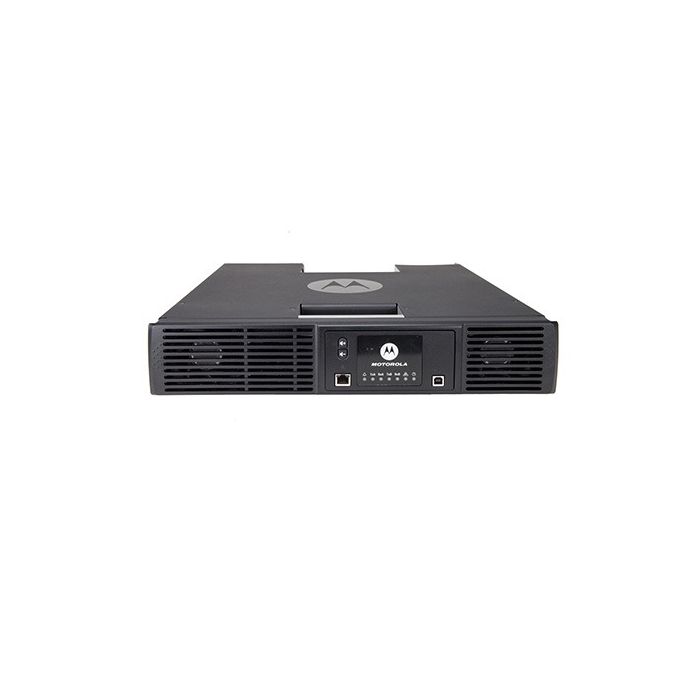
Motorola MOTOTRBO SLR 8000 Repeater VHF (SLR8000D100W136174)
In stock
- BAHAGIAN #:
- SLR8000D100W136174
- AVAILABILITY:
- SUBJECT TO AVAILABILITY
- SKU:
- Motorola-SLR8000D100W136174
Motorola MOTOTRBO SLR 8000 Repeater VHF (SLR8000D100W136174)
Motorola MOTOTRBO SLR 8000 Repeater VHF (SLR8000D100W136174)
At the platform level, Motorola’s official SLR 8000 data sheet identifies the VHF version as operating in the 136–174 MHz band with 1–100 watts of RF output power, 64-channel capacity, and 100% duty cycle. That places the SLR 8000 above more compact mid-tier repeaters and makes it suitable for customers who need higher transmit power, larger site coverage goals, or more robust infrastructure headroom.
For the exact requested model, dealer listings consistently map SLR8000D100W136174 to the 100W VHF 136–174 MHz version of the SLR 8000. Motorola’s public product literature describes the family and its specifications, while reseller pages provide the SKU-level mapping for this specific order code.
Design and Features
High-Power Rack-Mount Infrastructure
The SLR 8000 is designed as serious rack-mounted radio infrastructure rather than a light-duty repeater. Motorola’s official data sheet lists the chassis at approximately 89 x 483 x 438 mm (3.5 x 19 x 17.25 inches) and about 14.1 kg / 31 lb, reflecting a more substantial 2U-class platform built to support 100W output and continuous-duty operation.
Built for Continuous Operation
One of the model’s defining characteristics is its 100% duty cycle. Motorola specifies the SLR 8000 as a continuous-duty repeater, which is especially important in sites with sustained daily traffic such as dispatch-heavy operations, industrial plants, transport systems, or busy campus-wide radio networks. High-duty infrastructure is a key differentiator between enterprise repeaters and lower-tier equipment intended for lighter traffic.
Analog and Digital Flexibility
Motorola states that the SLR 8000 can operate in analog, digital, or mixed-mode configurations. That flexibility makes it useful for organizations migrating from older analog systems to MOTOTRBO DMR networks, because the repeater can support a phased transition rather than forcing all subscriber radios to be replaced immediately.
Front-Panel Status and Site Utilities
Reseller descriptions for the exact VHF model highlight clear front-panel LED indicators for operating mode, repeater disable state, and TX/RX status by slot. They also note an integrated power supply, battery backup and charging interface, and Repeater Diagnostics and Control support. Those details align with the SLR 8000’s role as managed network infrastructure rather than a simple repeater box.
Technology and Specifications
Frequency Band and Power
Motorola’s official data sheet lists the VHF SLR 8000 at 136–174 MHz with 1–100W RF output power. That exact combination is what makes SLR8000D100W136174 the high-power VHF variant in the family. Compared with 50W-class repeaters, the extra output margin can be important in larger coverage areas or sites with more difficult propagation conditions.
Channel Capacity and Stability
The official specification sheet lists 64 channels, 12.5/20/25 kHz channel spacing, and ±0.5 ppm frequency stability. These are professional-grade infrastructure figures that support both conventional repeater deployments and more advanced MOTOTRBO network architectures. Motorola also notes that 25 kHz channels are not available in the US, which is a regulatory point buyers should keep in mind.
Receiver Performance
Motorola specifies receiver sensitivity for the VHF SLR 8000 at 0.3 µV (0.22 µV typical) for 12 dB SINAD and 0.25 µV (0.18 µV typical) at 5% BER. The same data sheet lists strong selectivity, intermodulation rejection, and spurious rejection figures, all of which contribute to reliable real-world repeater performance in busy RF environments.
System and Network Support
Motorola positions the SLR 8000 as a flexible infrastructure platform that supports Digital Conventional, IP Site Connect, Capacity Plus, Capacity Max, and Connect Plus, in addition to analog conventional operation. This gives organizations room to start with a simpler site and expand toward multi-site or trunked architectures as operational complexity grows.
Power and Physical Specifications
The official data sheet lists 100–240 Vac, 47–63 Hz AC input, current figures for standby and 100W transmit operation, and the larger rack-mount footprint noted earlier. The SLR 8000 is clearly intended for fixed-site deployment with proper infrastructure support, not for ad hoc or mobile repeater use.
Applications and Use Cases
The Motorola MOTOTRBO SLR 8000 VHF is designed for organizations that need to extend radio coverage, improve system reliability, and support sustained communication traffic across broad or difficult environments. Motorola describes the SLR 8000 as optimized for the workplace, including both simple single-site systems and larger linked or trunked systems.
Because this requested model is the VHF 136–174 MHz variant, it is especially relevant where VHF coverage characteristics are preferred, such as utilities, field service, transport corridors, rural or semi-rural campuses, and wider-area operational footprints. That is an inference from the band and common deployment practice, while Motorola directly supports the broader use case of workplace-wide dependable voice and data coverage.
The repeater is also a strong fit for migration projects. Since Motorola supports analog, digital, and mixed-mode operation, an organization can deploy the SLR 8000 as a modern infrastructure core first, then transition handheld and mobile radios over time. That staged modernization path is one of the enduring practical advantages of the MOTOTRBO repeater ecosystem.
In larger systems, the SLR 8000 can serve as the backbone for IP-linked and trunked networks. Motorola’s support for IP Site Connect, Capacity Plus, Capacity Max, and Connect Plus makes it relevant not only for conventional coverage extension, but also for network growth where higher site performance and centralized infrastructure matter.
Advantages / Benefits
One of the clearest advantages of the SLR 8000 VHF is its combination of 100W output, continuous-duty performance, and MOTOTRBO network compatibility. That makes it suitable for more demanding coverage and traffic requirements than lower-power repeaters.
Another benefit is infrastructure flexibility. Motorola supports conventional, IP-linked, and trunked architectures on the same platform, which can help organizations avoid replacing their repeater layer as communications requirements expand.
A third benefit is migration support. Because the repeater can operate in analog and digital modes, it reduces the disruption associated with system upgrades. Organizations can maintain legacy support while moving toward a fully digital MOTOTRBO environment.
Finally, the SLR 8000 offers infrastructure-grade build characteristics, including a large rack-mount chassis, integrated site-oriented power design, and operating parameters intended for always-on use. Those characteristics are especially valuable in radio systems that cannot tolerate repeated downtime or capacity constraints.
FAQ Section
What is the Motorola MOTOTRBO SLR 8000 Repeater VHF (SLR8000D100W136174)?
It is a high-power Motorola MOTOTRBO repeater for the 136–174 MHz VHF band. Dealer mappings identify SLR8000D100W136174 as the 100W VHF version of the SLR 8000 family.
How does the Motorola SLR 8000 VHF work?
Like other repeaters, it receives radio signals on one frequency and retransmits them on another to extend coverage. Motorola also supports analog, digital, and mixed-mode operation, plus systems such as IP Site Connect, Capacity Plus, Capacity Max, and Connect Plus.
Why is the Motorola SLR 8000 VHF important?
It is important because it combines 100W output, 100% duty cycle, and scalable MOTOTRBO system support in a professional rack-mount platform. That makes it a strong infrastructure choice for organizations that need reliable communications over larger or more demanding areas.
What are the benefits of the Motorola SLR 8000 VHF?
Its main benefits are 136–174 MHz VHF operation, 1–100W power range, 64-channel capacity, analog/digital mixed-mode support, 100% duty cycle, and compatibility with major MOTOTRBO network architectures.
Is the SLR 8000 a rack-mount repeater?
Yes. Motorola’s official data sheet gives it a full rack-mount form factor sized at approximately 89 x 483 x 438 mm, which is consistent with fixed-site rack deployment.
What frequency does SLR8000D100W136174 use?
The exact SKU maps to the VHF 136–174 MHz version of the Motorola SLR 8000.
Summary
The Motorola MOTOTRBO SLR 8000 Repeater VHF (SLR8000D100W136174) is a high-power professional repeater designed for organizations that need dependable VHF radio infrastructure with room to grow. Based on Motorola’s official SLR 8000 specifications and SKU-level reseller mapping, it offers 136–174 MHz operation, up to 100W output, 100% duty cycle, 64-channel capacity, and support for major MOTOTRBO conventional, linked, and trunked architectures. For buyers searching for a Motorola VHF repeater, SLR 8000 VHF 100W repeater, or SLR8000D100W136174, this model is best understood as a heavyweight infrastructure platform for demanding professional radio networks.
Specifications
| BAHAGIAN # | SLR8000D100W136174 |
|---|