
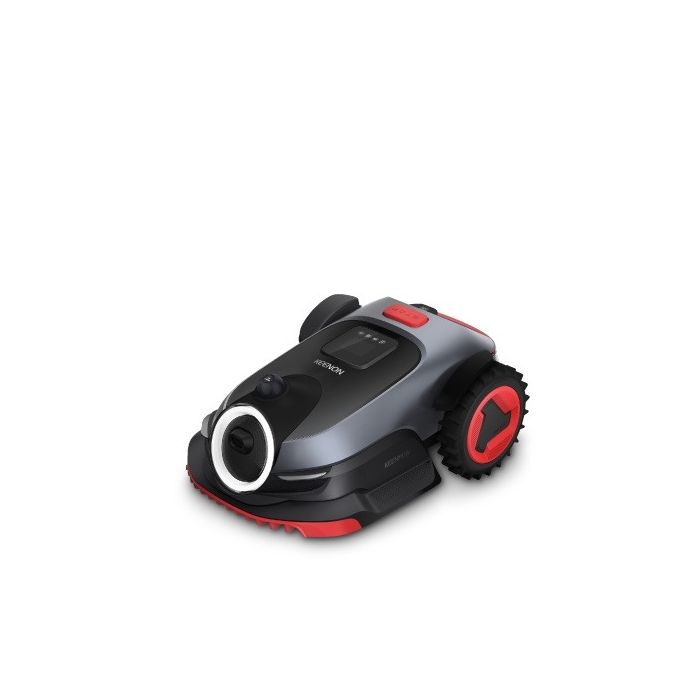
KEENMOW K1
In stock
- JENAMA:
- KEENON
- ORIGIN:
- China
- AVAILABILITY:
- SUBJECT TO AVAILABILITY
- SKU:
- KEENON-KEENMOW-K1
KEENMOW K1: The Wire-Free LiDAR Robot Lawn Mower from the World's Largest Commercial Robotics Company
Interesting Engineering's coverage of the K1 confirms KEENON's commercial credentials: "KEENON Robotics, the world's largest service robotics company by commercial deployment scale," bringing to the consumer market the same navigation and sensor fusion technology that has been refined through over 100,000 deployed commercial robots.
The Company Behind the Mower: Why KEENON's Background Matters
From Commercial Robots to Consumer Outdoor Products
The KEENMOW K1's most commercially unusual characteristic is not its technology but its manufacturer. KEENON Robotics is not a garden tools company or a consumer electronics startup: it is the company that created the world's first commercial restaurant delivery robot in 2016, deployed robots to over 100 hospitals during COVID-19, signed a strategic cooperation agreement with Wyndham Hotel Group, and now operates more than 50,000 commercial robots daily across 60-plus countries.
This background is commercially significant for the K1 because the navigation and sensor fusion technology in the mower is not being developed for the first time for a consumer application. The 3D LiDAR perception, SLAM mapping, obstacle avoidance, and path planning algorithms in the K1 have been refined through thousands of commercial deployments in dynamic, complex indoor environments: hotel lobbies, hospital corridors, crowded restaurant dining rooms. Consumer lawns, despite their outdoor complexity, present a less demanding navigation environment than a busy hotel lobby during check-in, which is where KEENON has been deploying its perception technology commercially.
The Gadgeteer's March 2026 review of the K1 captures this distinction directly: "The tech behind it isn't from a hardware startup feeling its way through a new category."
CES 2026 Debut
The K1 made its first public appearance at CES 2026 in Las Vegas in January 2026, where Keenon demonstrated it in a simulated garden alongside the XMAN-R1 humanoid robot. Interesting Engineering reported: "The standout new product, Keenmow K1, drew strong attention at CES as it smoothly navigated a simulated garden, flexibly maneuvering around obstacles with impressive precision."
The CES showcase established the K1 as KEENON's formal entry into the consumer outdoor robotics market, described by the company as "a major step in the company's expansion from commercial service robots into home applications."
Design and Physical Characteristics
The Power Body: Large Wheels and High-Torque Motor
The KEENMOW website describes the K1's chassis as the "Power Body," featuring a 90W high-performance motor and 23-centimeter diameter, 5-centimeter thick anti-slip tires specifically engineered for outdoor terrain. KEENON's description: "no rescue needed," meaning the mower is designed to handle all typical lawn obstacles without getting stuck and requiring human intervention.
The large wheel diameter and tire thickness address the specific terrain challenges of residential lawns that smaller robot mowers struggle with: exposed tree roots, soft soil, uneven ground, sudden terrain transitions between mowed grass and garden bed edges, and the debris accumulation from leaves, small branches, and other organic material that accumulates across a yard. A mower that gets stuck on these obstacles once a week requires regular human rescue operations that negate the time-saving value of the automation.
The 50 percent slope capability (27 degrees) is a meaningful performance specification for residential deployment. Many older residential robot mowers are limited to 35 to 40 percent slopes. The K1's 50 percent capability covers the full range of residential lawn gradients in most geographic markets, including the sloped gardens common in hillside residential neighborhoods.
App-Adjustable Cutting Height
The cutting height range of 20 to 70 millimeters (approximately 0.8 to 2.75 inches) is adjustable through the smartphone app rather than requiring manual physical adjustment at the mower. The Gadgeteer's review notes: "The 20mm to 70mm electric cutting height range is wider than most competitors at this price. You're adjusting that in the app, not bending down with a wrench." This app-based height adjustment enables users to set different cutting heights for different lawn zones, matching the cut to the grass type and growth pattern of each area.
Front LED for Night Operation
The K1 includes a front LED light enabling operation after dark, though KEENON includes a specific wildlife welfare note with this feature: mowing at night is generally discouraged to protect hedgehogs and other nocturnal wildlife that are active during twilight and nighttime hours. The LED's primary practical value is for early morning or late evening operation in summer when daylight hours extend beyond conventional schedule windows.
Technology and Specifications
AuraVue: 3D LiDAR Plus 150-Degree AI Vision Fusion
The AuraVue system is the K1's core navigational technology, combining two complementary sensing modalities:
3D LiDAR emits laser pulses in a 360-degree pattern and measures the time-of-flight of each pulse to construct a three-dimensional point cloud map of the mower's environment. Unlike 2D LiDAR, which captures only a horizontal plane, 3D LiDAR captures height information as well, enabling the K1 to map the actual topographic profile of the lawn including slope changes, raised garden beds, and variations in ground level. The 3D map is used for both navigation and path planning.
150-degree RGB camera with AI Vision Fusion adds visual context to the geometric data from LiDAR. The wide-angle camera enables the AI system to recognize object types beyond simple geometry: the camera can distinguish between a garden hose, a child's ball, a sleeping pet, and a flower border, enabling the mower to make contextually appropriate avoidance decisions that geometry-only detection cannot support. The AI is trained on hundreds of common lawn objects and learns through operational experience.
The combination is described by Homecrux as: "combines 3D LiDAR scanning with a 150-degree RGB camera and advanced AI. Unlike traditional robotic mowers that require buried perimeter wires or external RTK-GPS base stations, the K1 needs no physical infrastructure whatsoever."
SmartPath AI Navigation
SmartPath is the K1's route planning AI, described by The Gadgeteer as the system that "analyzes your lawn's geometry, factors in obstacle distribution, and generates [routes]." In practice, SmartPath determines the most efficient mowing pattern for the specific geometry of the user's lawn, taking into account the positions of mapped obstacles, the shapes of different grass zones, the presence of narrow passages and dead-end corners, and the slope profile of the terrain.
Rather than applying a default zigzag or spiral pattern uniformly across any lawn, SmartPath generates a route specifically optimized for each lawn's individual layout. For a lawn with multiple separate grass areas, SmartPath plans transitions between zones through narrow connecting passages. For a lawn with significant slope variation, it adjusts the mowing direction to reduce cross-slope strain on the mower.
Patch-Free Adaptive Power Adjustment
Patch-Free is the K1's real-time cutting power management system. The Gadgeteer's review describes it: "Patch Free watches terrain and grass density as the mower moves, adjusting cutting power in real time. Thick patches get more motor output. Steep sections get adjusted traction. A fixed output mower running through variable conditions leaves an uneven finish. This doesn't."
For residential users who have experienced the uneven cutting quality that conventional robot mowers produce when they encounter thick patches, seasonal growth variations, or slope transitions at fixed motor output, Patch-Free provides a meaningful quality improvement. The result is a more even finish across varied lawn conditions without requiring the user to adjust settings seasonally.
Complete Verified Specifications
From confirmed sources including Notebookcheck, Homecrux, The Gadgeteer, Interesting Engineering, and the official KEENMOW website:
Navigation: AuraVue 3D LiDAR + 150° RGB camera with AI Vision Fusion
Route Planning: SmartPath AI
Cutting Power: Patch-Free adaptive system
Maximum Lawn Size: 1,500 m²
Cutting Efficiency: Up to 300 m²/hour (Notebookcheck); up to 200 m²/hour (Homecrux; may reflect different mode)
Daily Coverage: Up to 1,200 m² (Homecrux)
Cutting Height: 20 to 70 mm, app-adjustable
Slope Capability: Up to 50% gradient (27 degrees)
Minimum Passage Width: 0.8 meters
Battery Capacity: 105 Wh
Runtime Per Charge: Up to 120 minutes
Recharge Time: 100 minutes
Motor: 90W high-performance
Tires: 23 cm diameter, 5 cm thick anti-slip
Lighting: Front LED for low-light operation
Weather Response: Auto-return on rain detection, breakpoint resumption when rain stops
Connectivity: Wi-Fi standard; optional 4G Net Box with 3-year data plan
App Features: Virtual boundaries, no-go zones, multi-zone scheduling, cutting height, direction, mowing frequency, real-time monitoring, system health alerts
Infrastructure Required: None (no wires, no base stations, no physical installation)
Applications and Use Cases
Standard Residential Lawns
The K1's 1,500-square-meter maximum coverage and no-wire setup make it appropriate for the majority of residential lawn sizes in US, European, and Australian markets. The typical US suburban lot has a lawn area of approximately 500 to 800 square meters; the typical UK or German garden is smaller. The K1's coverage range comfortably serves these mainstream residential applications.
Multi-Zone Properties
The K1's multi-zone support enables a single robot to manage lawns with multiple separated grass areas: a front yard, a backyard, and a side passage, for example, each with individual scheduling, cutting height, and mowing frequency settings. The app-based zone management eliminates the physical perimeter wire installation at each zone boundary that traditional robot mowers require.
Lawns with Complex Obstacles
For residential properties with trees, garden beds, outdoor furniture, play equipment, and irregular shapes, the K1's AI obstacle recognition system, trained on hundreds of common lawn objects, provides more contextually appropriate navigation than simpler sensor systems. The mower can distinguish between a permanent tree root and a temporarily placed toy, making decisions that fixed-map-only navigation systems cannot support.
Properties with Significant Slopes
The K1's 50 percent slope capability covers the range of residential lawns in hillside neighborhoods, terraced gardens, and rural properties where flatter robot mowers would be unable to operate. The Patch-Free adaptive power system maintains traction and cutting quality across slope transitions without requiring the user to set slope-specific manual configurations.
Advantages and Benefits
No infrastructure installation removes the primary adoption barrier: The absence of perimeter wire installation, RTK base station mounting, and complex calibration procedures removes what has historically been the most significant barrier to robot mower adoption. Users can unbox, place, draw virtual boundaries, and start mowing in a single session.
KEENON's 100,000-robot commercial deployment track record behind the navigation technology: The 3D LiDAR perception and AI obstacle avoidance system in the K1 is not speculative technology from a new company; it is derived from the same sensor fusion and SLAM navigation systems deployed in commercial environments where reliable autonomous navigation is an operational requirement.
50 percent slope capability exceeds most residential robot mower competitors: At 27-degree gradient capability, the K1 covers lawn slope profiles that most competing residential robot mowers cannot handle, expanding the usable lawn surface without requiring manual mowing of steep sections.
Weather-aware operation with breakpoint resumption: The automatic rain detection and exact-position resumption after rain stops provides genuine set-and-forget operation that requires no user intervention for weather management, which is one of the most frequent sources of operational friction with conventional robot mowers.
55 percent early-bird discount on Kickstarter: The USD $899 Kickstarter early-bird price against a USD $1,999 planned MSRP provides early adopters with access to LiDAR navigation technology at a price point comparable to conventional residential robot mowers, substantially below where LiDAR robot mowers have historically entered the market.
Summary
The KEENMOW K1 is the most commercially credentialed entry into the wire-free robot lawn mower category in 2026, backed by KEENON Robotics' position as the world's leading commercial service robot manufacturer by deployment scale and the navigation technology refined through 100,000-plus commercially deployed robots. Its AuraVue 3D LiDAR and AI Vision Fusion eliminating perimeter wires and base stations, SmartPath AI route optimization for individual lawn geometries, Patch-Free adaptive power management for consistent cutting quality, 50 percent slope capability, 1,500-square-meter coverage, weather-aware operation with breakpoint resumption, and USD $899 Kickstarter early-bird pricing collectively establish the K1 as a technically credible and commercially accessible option for homeowners who want wire-free robot mowing without the setup complexity and higher price points that have historically characterized the category's better-performing products.
Frequently Asked Questions (FAQ)
What is the KEENMOW K1?
The KEENMOW K1 is a wire-free autonomous robotic lawn mower developed by KEENON Robotics Co., Ltd. It uses the AuraVue system combining 3D LiDAR with a 150-degree RGB camera and AI Vision Fusion to map lawns and mow autonomously without perimeter wires, RTK base stations, or any physical installation. Key specifications: up to 1,500 m² lawn coverage, 300 m²/hour efficiency, 120-minute runtime per charge, 100-minute recharge, 20-70mm app-adjustable cutting height, 50% (27°) slope capability, 0.8m narrow passage navigation, 90W motor with 23cm anti-slip tires, weather-aware auto-return with breakpoint resumption, and multi-zone scheduling. Kickstarter early-bird price: USD $899. Planned MSRP: USD $1,999.
How does the KEENMOW K1 navigate without perimeter wires?
The K1 uses the AuraVue 3D LiDAR + AI Vision Fusion system to create a three-dimensional map of the lawn environment and navigate autonomously within virtual boundaries set in the smartphone app. LiDAR provides a 360-degree geometric 3D point cloud of the environment for precise positioning and map building. The 150-degree RGB camera adds visual context for AI object recognition, enabling the system to identify and avoid hundreds of common lawn objects. SmartPath AI generates an optimized mowing route for the specific geometry of the individual lawn, including multi-zone transitions and slope-adapted paths.
What makes the KEENMOW K1 different from other wire-free robot mowers?
The K1's primary differentiator from other 2026 wire-free robot mowers from consumer electronics companies is its manufacturer: KEENON Robotics holds the IDC-confirmed #1 global position in commercial service robot shipment share, with over 100,000 commercial robots deployed across 60-plus countries. The navigation, obstacle avoidance, and path planning technology in the K1 has been derived from commercial deployment experience rather than developed for the first time for a consumer product. Additional differentiators include the Patch-Free adaptive cutting power system for consistent finish quality across variable grass density and terrain, and the 50 percent slope capability exceeding most residential robot mower competitors.
What are the benefits of the KEENMOW K1 for homeowners with complex lawns?
The K1 addresses the specific challenges of complex residential lawns through several integrated capabilities. Multi-zone support with individual scheduling, cutting height, and frequency settings for each zone enables management of lawns with separated grass areas. AI object recognition of hundreds of common lawn objects provides contextually appropriate obstacle avoidance for properties with trees, garden beds, outdoor furniture, and irregular features. SmartPath generates routes optimized for the individual lawn's geometry rather than applying default patterns. The 50 percent slope capability covers gradient ranges that most competitor robot mowers cannot handle. And the 0.8-meter narrow passage navigation enables access to side yards, gated passages, and areas between garden features that wider-clearance robots cannot reach.