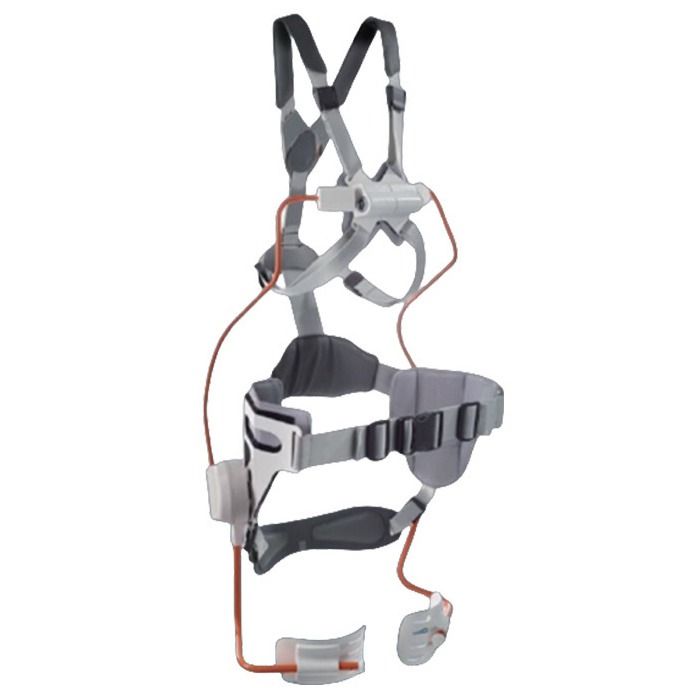
iTR Lumbar Passive Assistor
In stock
- ماركة:
- ITR ROBOT
- AVAILABILITY:
- SUBJECT TO AVAILABILITY
- SKU:
- ITR-LUMBAR-PASSIVE-ASSISTOR
iTR Lumbar Passive Assistor
iTR Lumbar Passive Assistor: The Lightweight Industrial Back Support Exoskeleton
The device weighs 2.7 kilograms, operates on a passive drive (no battery, motor, or electronic components), provides a maximum assistive support of 12 kgf (kilograms-force) or 50 N·m (Newton-meters) of torque when handling heavy materials, has 5 degrees of freedom including driving rotation and length adjustment, allows waist bending to approximately 150 degrees, and operates in two modes: walking mode and working mode.
iTR's official product page at itrobotgroup.com/products_detail/10.html confirms the complete specification table: dimensions 480 × 180 × 720 mm (W × D × H), passive drive with hybrid module replacement and expandability, waist bending range of motion approximately +150 degrees, 5 DOF system, and the confirmed primary markets of construction and logistics.
The product description confirms the core design intent: "The Lumbar Passive Assistor is engineered to improve labor efficiency while reducing strain on the lower back." The harness design is "tailored to body type and easy detachment structure," and the system includes a "hybrid module design" that ensures versatility across different application requirements.
The Work-Related Back Injury Problem
The Occupational Musculoskeletal Disease Burden
Work-related musculoskeletal disorders (WMSDs), and specifically low back pain (LBP) from manual material handling (MMH), represent one of the largest categories of occupational injury globally. A peer-reviewed review published in Biomimetics (MDPI, May 2025) on wearable back-support exoskeletons for preventing WMSDs confirms the scope: "Long-term manual material handling (MMH) work leads to the trend of the younger onset of work-related musculoskeletal disorders (WMSDs), with low back pain (LBP) being the most common, which causes great trouble for both society and patients."
Research published in the Frontiers in Bioengineering and Biotechnology systematic review of back-support exoskeletons confirms the magnitude of the workplace safety issue: "Lower back pain and musculoskeletal injuries are serious concerns for workers subjected to physical workload and manual material handling tasks."
The University of Singapore's Back-Support Exoskeleton research program documents the injury statistics directly: "Statistics show that back injuries are the most common injuries in the workplace, comprising approximately 41.7% of all workplace injuries in 2017."
For construction and logistics workers, the daily physical demands include repeated bending, heavy lifting, carrying loads over varied terrain, and sustained awkward postures that create cumulative lumbar load far exceeding the spine's long-term tolerance. The iTR Lumbar Passive Assistor addresses this cumulative load through a passive mechanical system that supplements the worker's lumbar musculature during these high-load tasks.
Why Passive Exoskeletons Are Specifically Appropriate for Construction and Logistics
Passive exoskeletons (those without motors, batteries, or active control systems) are distinguished from active (powered) exoskeletons in the academic literature. The MDPI Biomimetics review categorizes wearable lumbar assistive exoskeletons into "powered, unpowered, and quasi-passive types," with passive designs using stored mechanical energy (springs, elastic elements, carbon fiber flexures) to provide assistive torque during bending and heavy lifting without requiring electrical power.
For construction and logistics applications specifically, passive exoskeleton designs offer practical advantages over active designs. They require no battery charging, eliminate the risk of electronic component failure in dusty and wet outdoor construction sites, weigh less than active alternatives (the iTR's 2.7 kg versus typical active exoskeleton weights of 4 to 8 kg or more), and have no operational cost beyond the initial purchase. Workers on construction sites or warehouse floors can wear passive exoskeletons throughout a complete working shift without the battery management requirement that active devices impose.
Design and Features
The Passive Drive Mechanism: 12 kgf / 50 N·m Support
The iTR Lumbar Passive Assistor's passive drive mechanism provides up to 12 kilograms-force (approximately 120 Newtons of force) or 50 Newton-meters of assistive torque when the wearer bends forward to handle heavy materials. In practical terms, 50 N·m of assistive torque represents a meaningful supplement to the lumbar musculature's own torque production during a bending-and-lifting task.
The passive mechanism stores energy as the worker bends forward (compressing or stretching the elastic or spring elements in the device's torque generation system) and releases this stored energy as assistive torque when the worker returns to an upright position. This stored-energy release is the mechanism that reduces the peak demand on the erector spinae and other lumbar muscles during the return-to-upright phase of lifting, which is typically the peak load moment for spinal compression and injury risk.
The "hybrid module replacement/expandable" power specification indicates that the iTR device uses a modular mechanism that can be reconfigured or upgraded, enabling the device to be adapted for different assistive profiles or maintained by replacing the energy storage module rather than replacing the complete device when components wear.
5 Degrees of Freedom: Natural Motion Preservation
The iTR Lumbar Passive Assistor provides 5 degrees of freedom, specifically noted as including "driving rotation and length adjustment." In an exoskeleton device, degrees of freedom correspond to the joints at which the device allows independent movement. A 5-DOF lumbar assistor can accommodate the natural combined movements of the human torso and hips during occupational tasks: forward bending, lateral bending, rotation, hip flexion, and length adjustment for different user height profiles.
The practical significance of the DOF count for users is natural motion preservation: a device that restricts movement degrees of freedom that the wearer needs for their occupational tasks creates operational friction rather than performance support, reducing user acceptance and compliance. The 5-DOF design's length adjustment component specifically addresses the requirement that a single device model must fit workers of different heights.
150-Degree Waist Bending Range of Motion
The confirmed waist bending range of motion of approximately +150 degrees covers the full range of bending angles that construction and logistics tasks require, from an upright standing posture through a fully bent-forward position. A device with a restricted range of motion would limit the worker's ability to complete tasks requiring full forward bend, making it impractical for the deep-bending postures required for ground-level material handling, floor-level construction work, and container loading.
Walking Mode and Working Mode
The two operation modes address the practical reality that workers do not continuously perform heavy lifting: they alternate between transit (walking between task locations) and active task performance (lifting, carrying, bending). In walking mode, the device reduces its assistive engagement profile to allow free lower-limb movement without the constraint of the working-mode configuration. In working mode, the full assistive engagement provides the maximum 12 kgf / 50 N·m support during active lifting.
The ability to switch between modes without removing the device is the practical design requirement for the construction and logistics contexts: workers who must remove and don the exoskeleton each time they transition between walking and working will quickly abandon the device in favor of unrestricted movement, regardless of the injury protection benefit the device provides.
Harness Design: Tailored to Body Type with Easy Detachment
The harness system's two confirmed design requirements, "tailored to body type" and "easy detachment structure," reflect the two primary user experience factors that determine industrial exoskeleton adoption: fit quality and donning/doffing speed.
Fit quality matters because a poorly fitting exoskeleton that shifts during movement creates discomfort and reduces the effectiveness of the assistive torque application by misaligning the device's mechanical leverage points with the user's anatomy. The body-type customization capability addresses the range of worker physiques that a commercial device must accommodate across different users.
Easy detachment matters because construction and logistics workers encounter situations throughout their working day where the device must be quickly removed: confined space entry, tasks requiring full freedom of movement, vehicle operation, and the end-of-shift undressing. A device that requires several minutes to remove creates a barrier that most workers will avoid by not wearing the device in the first place.
Verified Product Specifications
From iTR's official product page (itrobotgroup.com/products_detail/10.html):
Purpose: Supports hip and back strength for workers handling heavy materials in construction and logistics
Power: Passive drive, hybrid module replacement/expandable
Size: 480mm (W) × 180mm (D) × 720mm (H)
Weight: 2.7 kg
Range of Motion: Waist bending angle approximately +150°
Operation Modes: Walking mode, working mode
Degrees of Freedom: 5 DOF (including driving rotation and length adjustment)
Maximum Support Load: 12 kgf / 50 N·m
Harness: Body-type tailored, easy detachment structure
Applications
Construction Workers
Construction work combines multiple categories of lumbar strain: heavy material handling (blocks, concrete bags, timber, steel components), sustained awkward postures (sustained forward bend over formwork), and repetitive bending tasks (rebar tying, floor laying). The iTR Lumbar Passive Assistor's confirmed target market for construction workers directly addresses these demands.
Construction sites additionally benefit from the passive (no battery) design: outdoor sites with limited charging infrastructure, exposure to dust and water that compromises electronic components, and the high physical activity that drains active device batteries rapidly are all factors that make passive designs more practically appropriate for construction than active alternatives.
Logistics and Warehouse Workers
Warehouse and logistics workers face a specific injury risk pattern: high repetition of moderate-weight lifts (packages in the 5 to 25 kg range) performed rapidly throughout a shift, combined with awkward postures at conveyor height mismatches and during container unloading. The cumulative lumbar compression of this repetitive pattern exceeds the acute compression of single heavy lifts, making sustained assistive support throughout the shift more important than maximum assistive torque in individual lift events.
The iTR's 2.7 kg weight is directly relevant for logistics deployment: a heavier exoskeleton that adds 5 to 8 kg to the worker's physical burden during a full shift of rapid movement and lifting creates a net physical cost that may offset the spinal load reduction benefit. At 2.7 kg, the iTR Lumbar Passive Assistor adds modest physical burden relative to the assistive benefit.
iTR's Rationale for Including a Wearable Device in a Robotics Company's Range
The iTR Lumbar Passive Assistor's inclusion in a product range that otherwise consists entirely of autonomous cleaning robots, outdoor sweepers, an all-terrain transport vehicle, and a municipal street sweeper reflects iTR's description of its mission as including "smart agriculture and public services" alongside commercial cleaning. The Lumbar Passive Assistor addresses the same fundamental operational challenge that drives automation: reducing the physical burden of work on human operators.
Where iTR's cleaning robots eliminate the need for human operators to perform floor cleaning physically, the Lumbar Passive Assistor reduces the physical injury risk of work that still requires human performance. Both approaches serve the common goal of making commercial and industrial work physically safer and more sustainable for the workers who perform it.
Summary
The iTR Lumbar Passive Assistor is a 2.7-kilogram passive back support exoskeleton designed for construction and logistics workers, providing up to 12 kgf (50 N·m) of assistive torque during heavy material handling through a 5-DOF mechanism with approximately 150-degree waist bending range of motion, two operation modes (walking and working), and a body-type tailored harness with easy detachment. Its passive drive design requires no battery or electronics, providing full-shift deployment in the outdoor construction and indoor logistics environments where electronic device reliability and battery management create practical barriers to exoskeleton adoption. As the only human-wearable product in iTR's commercial range, the Lumbar Passive Assistor represents iTR's application of its engineering capability to the physical safety challenge that manual material handling in construction and logistics presents to millions of workers globally.
Frequently Asked Questions (FAQ)
What is the iTR Lumbar Passive Assistor?
The iTR Lumbar Passive Assistor is a wearable passive back support exoskeleton from iTR Robot Technology Co., Ltd., designed for construction and logistics workers who perform heavy lifting. Specifications from iTR's official product page: weight 2.7 kg, dimensions 480 × 180 × 720 mm, passive drive (no battery), 5 degrees of freedom including driving rotation and length adjustment, waist bending range of approximately 150 degrees, two operation modes (walking and working), maximum support load of 12 kgf (50 N·m), and body-type tailored harness with easy detachment structure.
How does the iTR Lumbar Passive Assistor work?
The iTR Lumbar Passive Assistor works through a passive mechanical energy storage and release mechanism. As the worker bends forward during heavy lifting tasks, the device's passive drive mechanism stores mechanical energy through compression or stretching of its elastic elements. When the worker returns to an upright position, this stored energy is released as assistive torque of up to 12 kgf (50 N·m), supplementing the worker's lumbar musculature and reducing the peak muscle force demand during the return-to-upright phase of lifting. The device requires no external power source, operating entirely from the mechanical energy of the worker's own body motion.
Why is passive design preferable to active (powered) design for construction workers?
Passive exoskeletons require no battery, have no electronic components to fail in dusty or wet construction site conditions, weigh less than active alternatives (the iTR's 2.7 kg versus 4 to 8 kg for typical powered devices), and have no per-shift operating cost beyond device wear. For construction workers on outdoor sites with limited charging infrastructure and high exposure to dust and water, the passive design provides all-day deployment reliability that active devices cannot match without significant battery management overhead. The iTR's 2.7 kg weight also limits the physical cost of wearing the device throughout a full shift.
What is the difference between the walking mode and working mode?
Walking mode reduces the assistive engagement of the device to allow free, unrestricted lower-limb movement during transit between work locations. Working mode activates the full assistive engagement, providing up to 12 kgf (50 N·m) of torque support during active bending and lifting tasks. The ability to switch between modes without removing the device addresses the practical reality that workers alternate between transit and active material handling throughout the day. A device that required removal between modes would be impractical for the rapid task switching characteristic of construction and logistics work.
- Purpose: Supports hip and back strength for workers handling heavy construction and logistics materials
- Power: Passive drive, hybrid module replaceable/expandable
- Size: 480 mm W × 180 mm D × 720 mm H
- Weight: 2.7 kg
- Range of motion: Waist bending angle to +150°
- Operation modes: Walking mode, working mode
- Degrees of freedom: 5 DOF including driving rotation and length adjustment
- Support load: 12 kgf / 50 N·m